Chef vs. Pastry Chef: A Second-Career Comparison
The savoury line and the pastry bench differ on training time, start times and pay ceilings — a practical comparison for anyone changing track after 40.
Quick answer
- Pay goes to the savoury chef route: a $62,470 median for chefs and head cooks in May 2025, against $36,650 for bakers in May 2024 (U.S. Bureau of Labor Statistics).
- Speed of entry goes to baking: no formal educational credential and moderate-term on-the-job training, versus five years or more of related experience for chefs and head cooks (U.S. Bureau of Labor Statistics).
- The demands split by clock: chefs work late evenings, weekends and holidays (U.S. Bureau of Labor Statistics, 2025), while bakers take pre-dawn starts and hot-oven heat exposure (U.S. Bureau of Labor Statistics, 2024).
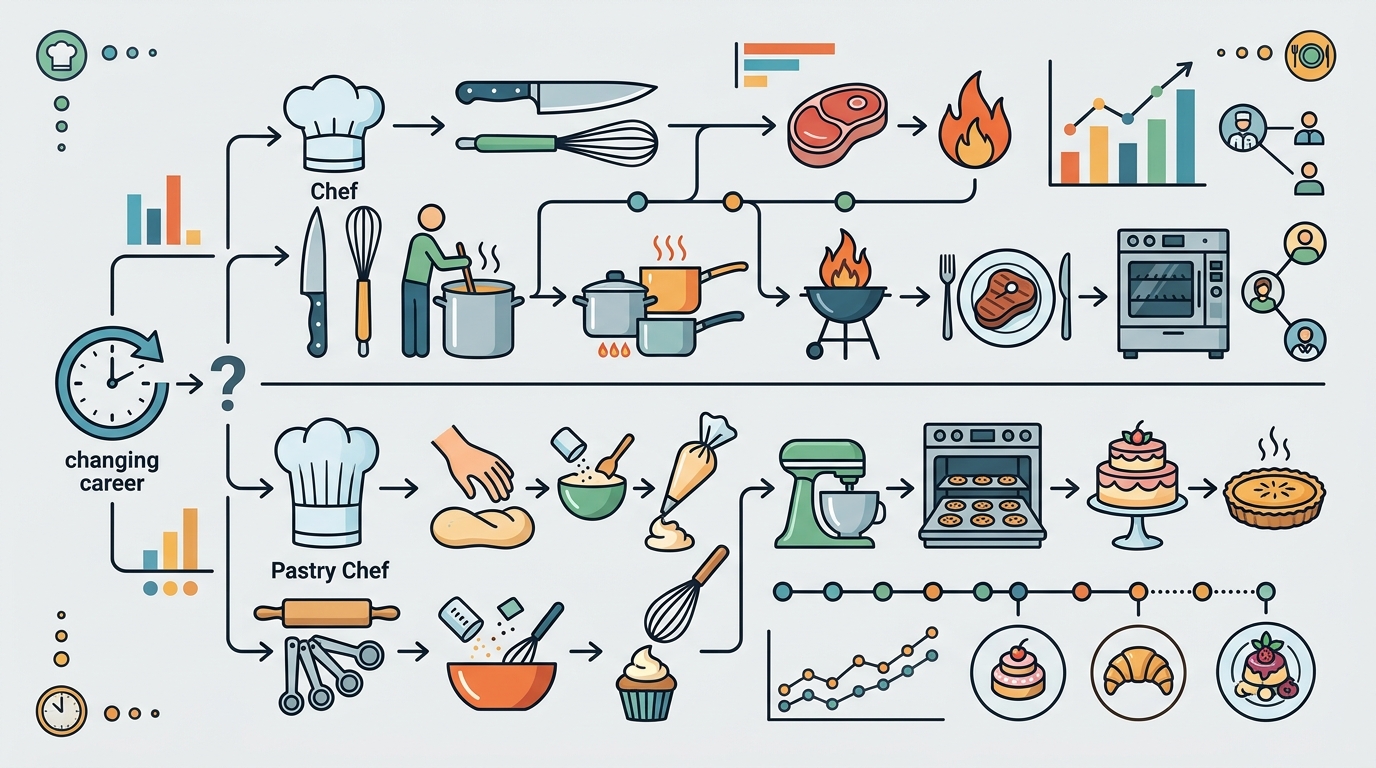
Switching into a professional kitchen later in life usually means picking between the savoury line, which leads to chef and head cook roles, and the pastry side, which you normally enter through baking. The savoury route pays more — the U.S. Bureau of Labor Statistics put the median for chefs and head cooks at $62,470 a year in May 2025 — but typically asks for five years or more of related experience before you hold the title. Baking starts faster, with no formal educational credential required, though the median for bakers was $36,650 in May 2024 (U.S. Bureau of Labor Statistics).
Figures here are US dollars from US federal sources. If you work elsewhere, check the ONS in the UK, Statistics Canada or the ABS in Australia, because pay, licensing and training routes differ by country and, within the US, by state.
Side-by-Side Comparison
"Pastry chef" is not a separate occupation in US federal data. ONET lists Pastry Chef and Executive Pastry Chef as sample reported titles under code 35-1011.00, Chefs and Head Cooks (ONET OnLine), while the production job most people enter pastry through is Bakers. So the real comparison is the chef track against the baker track, with pastry chef sitting at the top of the pastry ladder.
| Dimension | Chef / head cook (savoury) | Baker to pastry chef |
|---|---|---|
| Entry education | High school diploma or equivalent (U.S. Bureau of Labor Statistics, 2025) | No formal educational credential (U.S. Bureau of Labor Statistics, 2024) |
| Time to the title | 5 years or more of related work experience (U.S. Bureau of Labor Statistics, 2025) | Moderate- to long-term on-the-job training; some employers run apprenticeships, some bakers attend technical or culinary school (U.S. Bureau of Labor Statistics, 2024 and 2020) |
| Median annual pay | $62,470, or $30.03 an hour, May 2025 (U.S. Bureau of Labor Statistics; O*NET lists the same 2025 figure) | $36,650, or $17.62 an hour, May 2024 for bakers; a newer BLS production summary lists $37,160 for 2025. Pastry chef titles count under the chef figure |
| Hours and physical demands | Early mornings, late evenings, weekends and holidays; hectic and fast-paced; most work full time (U.S. Bureau of Labor Statistics, 2025) | Pre-dawn starts and exposure to high temperatures around hot ovens; some bakers work part time (U.S. Bureau of Labor Statistics, 2024) |
| Credentials | Food handler's certification required in some states and localities; voluntary ones such as Certified Executive Chef (CEC) may aid advancement and pay (U.S. Bureau of Labor Statistics, 2025; CareerOneStop, 2022) | Same state and local food-handling rules; apprenticeship completion is the usual formal marker |
| Outlook | 7 percent growth 2025–2035, about 25,200 openings a year (U.S. Bureau of Labor Statistics, 2025) | 6 percent growth 2024–2034, about 39,900 openings a year (U.S. Bureau of Labor Statistics, 2024) |
| Typical second-career start age | 30s to 50s, entering as a line or prep cook | 30s to 50s, entering as a bakery assistant or overnight baker |
For changers aged roughly 45 to 60, the friction is rarely the hiring decision; it is the shape of it. Kitchens fill the junior station, so you may take direction from a sous chef in their twenties. Saying in the interview that you expect to start at the bottom removes the objection most chefs will not raise aloud. Turnover works in your favour: about 25,200 annual openings for chefs and head cooks (U.S. Bureau of Labor Statistics, 2025) and about 39,900 for bakers (U.S. Bureau of Labor Statistics, 2024).
The money tradeoff is concrete. Expect 12 to 24 months at an entry hourly rate below both medians, plus the cost of a food handler's certification where your state or locality requires one (U.S. Bureau of Labor Statistics, 2025), knives and clogs. Reaching a chef or pastry chef title realistically takes 3 to 7 years from your first paid shift.
What Each Job Looks Like Day to Day
A chef or head cook runs people as much as food. Core duties include supervising and coordinating cooks and food-preparation workers, developing recipes, planning menus, hiring and training kitchen staff, and ordering supplies (U.S. Bureau of Labor Statistics, 2025). In practice that is a morning counting walk-in stock against tomorrow's order sheet, an afternoon costing a special so it clears margin, then service: calling tickets, plating under the heat lamp, pulling a dish that went out wrong. Hours run to early mornings, late evenings, weekends and holidays, and the work is often hectic and fast-paced (U.S. Bureau of Labor Statistics, 2025). The steady drain is staffing, because somebody always calls out.
The pastry side front-loads the clock and the precision. Bakers typically learn through long-term on-the-job training, with some employers offering apprenticeship programs (U.S. Bureau of Labor Statistics, 2020), and the day often starts before dawn: scaling flour and butter to the gram, laminating dough on a cold bench, loading and rotating deck ovens while watching colour. Heat exposure around hot ovens is a standing condition of the job (U.S. Bureau of Labor Statistics, 2024). Closer to a pastry chef role, the work turns to writing dessert menus, costing plated desserts and training the overnight bench — the supervisory duties listed for chefs and head cooks, the occupation pastry chef titles sit inside (O*NET OnLine).
Which Fits Your Background
- Retail store manager or restaurant front-of-house manager — go chef. Rota building, ordering supplies and hiring are already listed duties of chefs and head cooks (U.S. Bureau of Labor Statistics, 2025).
- Elementary teacher or corporate trainer — chef again. Hiring and training kitchen staff is core to the role (U.S. Bureau of Labor Statistics, 2025), and breaking a technique into repeatable steps for a nineteen-year-old commis is familiar ground.
- Accountant, bookkeeper or pharmacy technician — pastry chef track. Weighing to the gram and holding a formula constant across hundreds of units suits people who like a tolerance band, and bakers can enter with no formal educational credential (U.S. Bureau of Labor Statistics, 2024).
- Night-shift nurse, security officer or long-haul driver — pastry chef track. You already sleep on an inverted schedule, so a 3am bench start costs you less; the chef route pushes you into late evenings, weekends and holidays instead (U.S. Bureau of Labor Statistics, 2025).
- Carpenter or machinist — either, but lean chef for the higher ceiling: a $62,470 median against $36,650 for bakers (U.S. Bureau of Labor Statistics, 2025 and 2024).
- Caring for a parent or school-age children — the pastry chef track starts more easily, because some bakers work part time (U.S. Bureau of Labor Statistics, 2024) and the shift usually ends by early afternoon, where chef hours run through dinner service.
How to Decide and Test the Waters
- Get the food handler's certification first, if your state or locality requires one. It is cheap, takes a day or less, and is the one credential that may be legally required on either path (U.S. Bureau of Labor Statistics, 2025).
- Work one trial shift on each side. Ask a restaurant for a stage on garde manger and a bakery for one overnight bench shift. Two shifts, around 16 hours, tell you more about heat, standing and pre-dawn alarms than months of reading.
- Take a weekend or evening course while still employed. Some bakers attend a technical or culinary school (U.S. Bureau of Labor Statistics, 2020); part-time modules in bread, lamination or knife skills test aptitude without a resignation. Budget tuition and tools as a real cost.
- Hold a paid part-time shift for 3 to 6 months before you quit. Some bakers work part time (U.S. Bureau of Labor Statistics, 2024), so a Saturday bench job is realistic; a Friday-night prep shift is the savoury equivalent.
- Do the arithmetic on the gap. Assume 12 to 24 months at an entry rate below the $36,650 baker median or the $62,470 chef median (U.S. Bureau of Labor Statistics, 2024 and 2025), then count how many months of savings cover the shortfall.
- Pick a title and work back from it. For head chef, plan on five years or more of related experience (U.S. Bureau of Labor Statistics, 2025) and voluntary credentials such as Certified Executive Chef (CEC) (CareerOneStop, 2022). For pastry chef, plan an apprenticeship or long-term on-the-job training and a 3 to 5 year climb from bench to menu.
Frequently asked questions
Which pays more, chef or pastry chef?
The chef track pays more at entry and mid level: chefs and head cooks had a median of $62,470 a year in May 2025, while bakers, the usual way into pastry, had $36,650 in May 2024, with a newer BLS production summary listing $37,160 for 2025 (U.S. Bureau of Labor Statistics). The gap closes at the top, because pastry chef and executive pastry chef are reported titles inside the chefs and head cooks occupation (O*NET OnLine), counted against that same $62,470 median.
Which one can I switch into faster in my forties or fifties?
Baking. Bakers need no formal educational credential and moderate-term on-the-job training (U.S. Bureau of Labor Statistics, 2024), so you can be earning within weeks of a first shift, where chefs and head cooks typically need five years or more of related experience to hold the title (U.S. Bureau of Labor Statistics, 2025). For a changer aged 45 to 60, the pastry route shortens the low-pay stretch to roughly 12 to 24 months; the chef route asks you to absorb a 3 to 7 year climb.
Is there enough hiring in either career to be worth the risk?
Both grow and both turn over. Chefs and head cooks are projected to grow 7 percent from 2025 to 2035, about 25,200 openings a year (U.S. Bureau of Labor Statistics, 2025); bakers 6 percent from 2024 to 2034, about 39,900 openings a year (U.S. Bureau of Labor Statistics, 2024). CareerOneStop reported 174,400 chefs and head cooks in 2022 rising to a projected 183,600 by 2032, a 5 percent change with 22,000 annual openings (CareerOneStop, 2022). Baking has more raw openings; the chef occupation has the higher median. Neither figure guarantees an offer.
Sources
- U.S. Bureau of Labor Statistics — Chefs and Head Cooks : Occupational Outlook Handbook (2025)
- U.S. Bureau of Labor Statistics — Bakers : Occupational Outlook Handbook (2024)

Written by
Wyatt covers work outside the office: construction, logistics, repair, and the people who keep things running. He's skeptical of career advice that assumes everyone sits at a desk.