Flight Attendant Interview Questions: What to Expect and How to Prepare
From the recorded video screening to the group exercise and the final panel, here is how airlines assess cabin crew candidates at every stage.
Quick answer
- Prepare eight to ten STAR stories from customer-facing work — one source citing the U.S. Bureau of Labor Statistics notes airlines favour retail and hospitality backgrounds (Chron).
- Rehearse the physical reach test at home: reaching into overhead bin height and lifting a weight above your head (Chron), and check your target airline's published height and arm-reach rules before applying.
- Practise the group exercise, not just the interview — assessors score whether you are positive, involved, a good listener, friendly and calm under pressure (Flight Attendant Central).
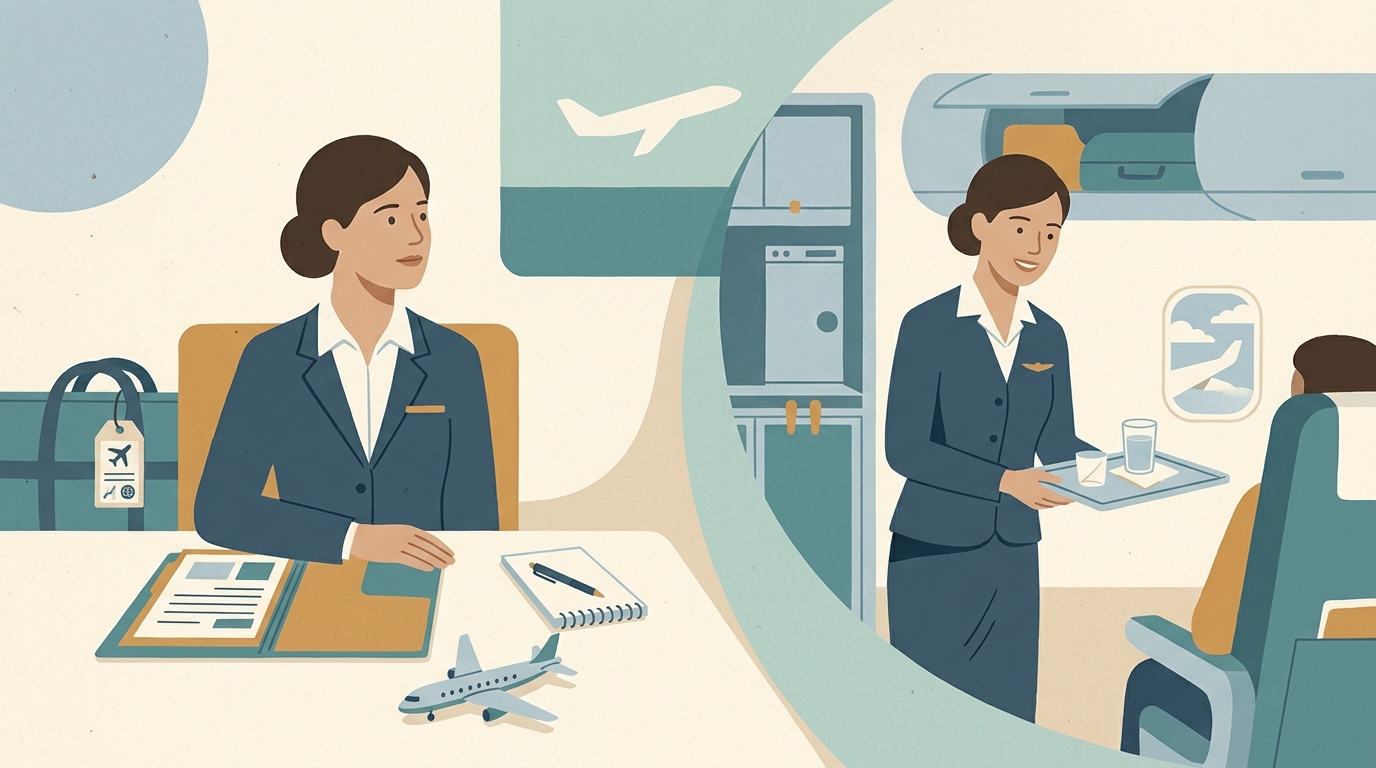
A flight attendant interview is rarely one conversation. Most large airlines move candidates through five broad stages — an online application, a screening step such as a recorded video interview or recruiter call, an assessment or group day, a final interview, and a conditional offer followed by checks (CoPilot Interview, 2026-11-03) — and you can be cut at any of them.
This guide walks through what each stage tests, the behavioural questions recruiters actually ask, sample answers you can adapt, and the specific habits that get otherwise strong candidates sent home early.
What This Interview Usually Covers
Most large airlines hire cabin crew in five stages: online application, a screening step such as a recorded video interview or recruiter call, an assessment or group day, a final interview, then a conditional offer with checks (CoPilot Interview, 2026-11-03). Cabin crew roles tend to use all five; airport and reservations jobs often skip the group day (same source).
The assessment day itself is usually built in five parts — introduction, a reach and height test, a group exercise, an English test and a final interview (Flight Attendant Central). The reach test checks whether you can reach into overhead bin space and lift a set weight above your head (Chron). The written or English test is timed and covers language, comprehension and problem-solving (Chron; Flight Attendant Central). Only candidates who pass the earlier sections are interviewed one to one (Chron).
The final interview is behavioural, run by recruiters or managers, either one to one or as a panel (CoPilot Interview, 2026-11-03). It runs to a set length and draws on your resume, experience, education and how you performed during the day (Flight Attendant Central). Any offer is conditional: background, reference, drug, medical or airport security checks follow, depending on the role and country (CoPilot Interview, 2026-11-03).
Common Questions and Sample Answers
Why do you want to be a flight attendant?
Sample answer
Situation: I spent two years on the front desk of a 140-room airport hotel, mostly handling guests off delayed flights. Task: My job was to settle people who were tired, late and often angry, within a few minutes each. Action: I learned to read body language fast, offer one clear option rather than three, and follow through personally rather than passing people on. Result: My desk averaged 4.7 out of 5 on guest feedback cards over 18 months. I want to do that work in a cabin, where safety sits alongside service.
Tell me about a time you dealt with a difficult customer.
Sample answer
Situation: A passenger at my airline check-in counter had missed baggage cut-off by six minutes and began shouting at the queue. Task: I had to hold the rule, protect the other 30 people waiting, and keep the area calm. Action: I stepped around the counter, lowered my voice, named what had happened, and walked him to a colleague who could rebook him onto a flight two hours later. Result: He accepted the rebooking, the queue moved again within four minutes, and he emailed an apology the next day.
Describe a time you had to follow a safety procedure exactly.
Sample answer
Situation: Working in a warehouse, I found a pallet stacked above the marked load line in an aisle shared with forklifts. Task: Fixing it myself would have been quicker than reporting it, but the procedure required a supervisor sign-off. Action: I taped off the aisle, logged it in the shift book and called the supervisor on the radio rather than restacking it alone. Result: The pallet was re-secured properly in 20 minutes and the near-miss went into the monthly safety brief. Nobody was hurt, and the rule did its job.
Tell me about a time you worked with people you had just met.
Sample answer
Situation: I was placed on a four-person catering team for a 300-guest conference with no prior shift together. Task: We had 45 minutes to turn a plenary room into a lunch service. Action: I suggested we each take one zone, said my own name and task out loud so nobody guessed, and checked in with the slowest zone twice. Result: We opened the doors two minutes early, and the events manager asked for the same four of us for the following month.
How do you handle unpredictable rosters and time away from home?
Sample answer
Situation: My last role used a rotating pattern of early, late and weekend shifts published 10 days ahead. Task: I needed to stay rested and reliable without constantly rearranging my personal life. Action: I kept a shared calendar with my family, booked sleep blocks in it as if they were shifts, and stopped accepting plans that needed more than 24 hours' notice to cancel. Result: I had zero sick days in 14 months and no late starts, and I can bring the same routine to a roster with overnight layovers.
Tell me about a time you noticed something others had missed.
Sample answer
Situation: During a quiet evening shift in a restaurant, I noticed a regular customer had gone grey and stopped talking mid-sentence. Task: Nobody else had looked up, and I had to decide quickly whether to act. Action: I knelt beside him, asked two direct questions, called the manager to phone emergency services and cleared the neighbouring table so there was floor space. Result: Paramedics arrived in nine minutes and treated him for low blood sugar on site. The manager added a check-in prompt to our closing routine.
How do you respond to critical feedback?
Sample answer
Situation: My supervisor told me my phone manner on a retail support line sounded rushed to older callers. Task: I disagreed at first, but she offered to review three recorded calls with me. Action: We listened together, I counted how often I interrupted, and I started pausing for two seconds after each caller finished speaking. Result: Average handling time rose by about 20 seconds, but repeat calls from the same customers dropped noticeably over the next quarter, and she used my calls as training examples.
Mistakes That Cost Candidates the Job
- Arriving at the assessment day without having physically tried the reach test — standing flat-footed and failing to reach overhead bin height, or being unable to lift the required weight above your head (Chron), ends the day on the spot.
- Treating the group exercise as a competition: talking over quieter candidates or pushing your idea through. Assessors are scoring whether you listen, involve others and stay calm under pressure (Flight Attendant Central).
- Going silent in the group exercise instead. Saying nothing reads as disengaged, not polite — contribute at least one idea and one question that builds on someone else's.
- Badmouthing a former employer or a past passenger when asked why you left. Recruiters hear it as a preview of how you will describe them.
- Answering safety questions with improvisation — "I'd use my judgement" — rather than showing you can follow a written procedure even when a shortcut is faster.
- Rushing the timed written test and leaving blanks. The English or written section is timed and covers comprehension and problem-solving (Flight Attendant Central; Chron), so answer every item and return to the hard ones.
- Giving unstructured, rambling stories in the final interview. It runs to a set length and is based on your resume and your performance earlier in the day (Flight Antendant Central), so each answer needs a situation, a task, an action and a result.
- Paying a third party for an "application", "training place" or "visa fee". Legitimate airlines do not charge these, and you should apply only through the airline's own careers site or a hiring partner it names there (CoPilot Interview, 2026-11-03).
Frequently asked questions
What should I wear to a cabin crew assessment day?
Wear business formal in a plain dark colour, with closed-toe polished shoes, hair tidy and off the face, and minimal jewellery. Bring the airline's published grooming standards from its careers site and match them. Carry a spare pair of tights or a spare shirt in your bag for the full-day format.
How do I answer the salary question?
Cabin crew pay is usually built from a base plus flight-hour or duty pay and a per-diem allowance, and it varies by airline, country and any union agreement. Say you are comfortable with the published package and ask for the breakdown at offer stage. Check the airline's careers site and your national statistics agency for current ranges.
Should I follow up after the interview?
Send one short email to the recruiter within 24 hours, naming the date and location of your assessment and one thing you discussed. Then wait. Timelines run long because a conditional offer is followed by background, reference, drug, medical or airport security checks, depending on the role and country (CoPilot Interview, 2026-11-03).
What if I don't meet the height or reach requirement?
Check before you apply, not on the day. Airlines publish their own rules — Emirates states a minimum height and a vertical arm reach, Qatar Airways states a reach requirement, and Etihad states a minimum height (Flight Attendant Central). Age, physical ability and language fluency are also commonly set before application (Chron).
Does experience in retail or hospitality help?
Yes — put it at the top of your resume. One source citing the U.S. Bureau of Labor Statistics notes many airlines want candidates with customer-facing backgrounds such as retail or hospitality (Chron). Write each bullet as action, task and a number: "Handled 60+ guest check-ins per shift with 4.7/5 average feedback."
How do I prepare for a recorded video interview?
Record yourself answering three behavioural questions on your phone, timed to 90 seconds each. Check that your face is lit from the front, your background is plain, and you look at the lens rather than your own image. Rehearse until you can finish a full STAR answer inside the time limit.
Sources
- CoPilot Interview — Airline Job Interviews (2026): How Major Airlines Hire Cabin Crew, Agents and Ground Staff (2026-11-03)
- Flight Attendant Central — Cabin Crew Assessment Day: Every Stage Explained

Written by
Noor writes personal essays and interviews about career changes, burnout, and starting over. She's interested in the stories people tell themselves about what a job is supposed to mean.