How to Become a Bartender With No Experience
No formal education credential is required to start, but age rules, server training and a few weeks learning behind a real bar usually are.
Quick answer
- No degree is required: bartenders typically enter with no formal educational credential, no related work experience and less than one month of on-the-job training (CareerOneStop, U.S. Department of Labor).
- A realistic timeline is 2–3 hours for an online alcohol-server course such as eTIPS, then a few weeks of paid on-the-job training learning recipes and bar setup under an experienced bartender (TIPS; U.S. Bureau of Labor Statistics, 2025).
- Serving, barback and counter work transfers well: many bartenders start as waiters, food and beverage serving workers, or bartender helpers and move up as they learn mixing procedures and recipes (U.S. Bureau of Labor Statistics, 2025).
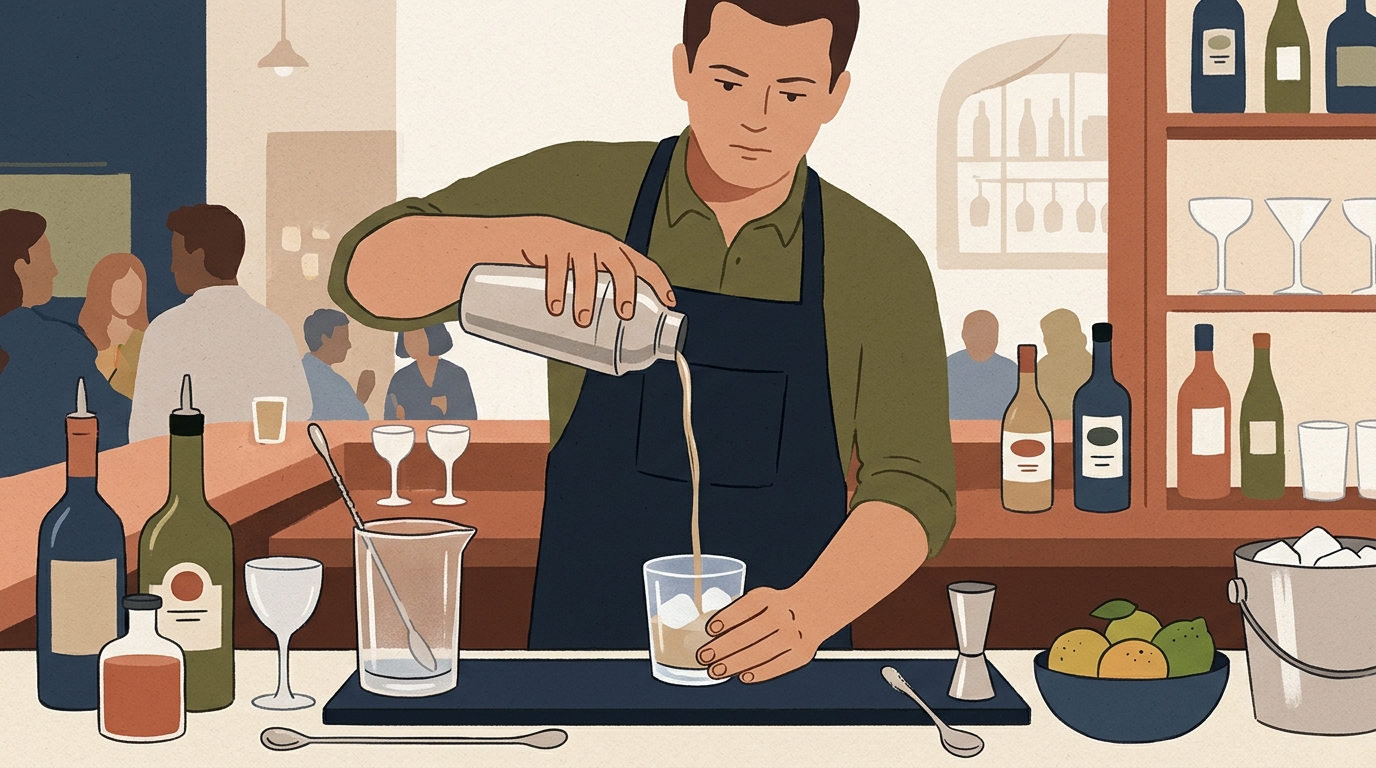
You can enter bartending without a degree and without prior bar work. The U.S. Bureau of Labor Statistics (2025) reports that bartenders typically need no formal education credential and no related work experience, and learn the job through short-term on-the-job training instead.
What you do need is to meet the minimum serving age where you live, hold any responsible-server certificate your state or locality demands, and get in front of a hiring manager who will give you a trial shift. Rules differ sharply by country, state and city, so check your own licensing authority before you spend money.
Who Successfully Makes This Transition
Three backgrounds show up again and again behind the bar, and each already covers part of the job that is hard to teach in a hurry.
Waiters, waitresses and other food and beverage serving workers. The U.S. Bureau of Labor Statistics (2025) notes that some bartenders gain previous food-service experience in these roles first. A server has proved they can hold several tickets in their head, read a table, handle payment and keep moving when the room fills. What they lack — cocktail recipes and bar setup — is exactly what the Bureau describes bartenders learning on the job in a few weeks under an experienced bartender.
Bartender helpers and dining room attendants. O\*NET OnLine lists Dining Room and Cafeteria Attendants and Bartender Helpers among occupations related to bartenders, and the Bureau (2025) states that some bartenders start as helpers and progress as they learn basic mixing procedures and recipes. A barback already knows the well layout, the glassware, the keg change and the pace. Promotion from barback is the most ordinary route in, and it needs no classroom.
Baristas, fast food and counter workers. O\NET also lists these as related occupations. What transfers is speed, cash and card handling, drink-build consistency and customer contact under time pressure. Managers accept it in place of a degree because O\NET classifies bartender as Job Zone 1–2 — very little to some preparation, usually a high school diploma or GED, with some workers not holding one. In a survey of bartender postings, O\*NET found education requirements split between high school diploma or equivalent, less than high school, and some college with no degree. The gate is a trial shift, not a transcript.
Traditional Path vs. Alternative Path
The "traditional" route here is not a degree — none exists for this job — it is paid bartending school or a community college hospitality course. The alternative is the certificate-plus-barback route.
| Path | Time to Entry | Upfront Cost | Credential Required | Typical Starting Pay |
|---|---|---|---|---|
| Bartending school or community college course | A few days of intensive classes up to a 10–16 week college term, plus the same few weeks of on-the-job training once hired (U.S. Bureau of Labor Statistics, 2025) | Tuition is set by each school and driven by course length and whether a bar kit and exam fee are bundled — ask for the all-in total in writing; you still pay $20–$40 for the alcohol-server certificate (liquorlicensecost.com, 2025) | None legally. Professional bartending certification is optional and may demonstrate basic knowledge or competency (U.S. Bureau of Labor Statistics, 2025) | Tipped employees earn at least the federal minimum wage, paid as a combination of direct wages and tips depending on the state (U.S. Bureau of Labor Statistics, 2025) |
| Certificate plus barback-to-bartender | 2–3 hours for self-paced eTIPS online training (TIPS), then under 1 month of on-the-job training (CareerOneStop, U.S. Department of Labor) | $38–$40 for TIPS online, valid 3 years, or $20–$35 for ServSafe Alcohol online, valid 5 years (liquorlicensecost.com, 2025; TIPS) | Minimum age — most states require at least 18 (U.S. Bureau of Labor Statistics, 2025) — plus any state or local responsible-server course and, in some localities, a licence held by the server, owner, manager or business | Same statutory floor and tip structure; the variable is the venue's trade and shifts, not the route |
Check current figures for your area in the U.S. Bureau of Labor Statistics Occupational Outlook Handbook and with your state labour department. Outside the United States, use your national statistics agency and employment standards authority.
Step-by-Step Alternative Path
- Confirm your age and local alcohol rules before spending anything. Most states require bartenders to be at least 18, and many states and localities require a responsible-server course covering alcohol sale laws, responsible serving practices and conflict management (U.S. Bureau of Labor Statistics, 2025). Depending on the locality, a server, owner, manager or business may need a licence to sell alcohol. Your state alcoholic beverage control board publishes the rule that applies to you.
- Complete an alcohol-server certification in week one. eTIPS from TIPS (Training for Intervention ProcedureS) is self-paced, takes 2–3 hours, costs $38–$40 and is generally good for three years; ServSafe Alcohol online costs $20–$35 and lasts five years (TIPS; liquorlicensecost.com, 2025). TIPS is delivered in all 50 states and more than 50 countries. Pass marks are set locally — in Connecticut, participants must score 70% or higher on the final exam.
- Take a barback, server or counter job at a venue with a real bar. Hotel banquet departments, chain casual-dining restaurants, stadium concessions and catering companies hire helpers with no experience. Search by location using the CareerOneStop job finder from the U.S. Department of Labor, and tell the manager you want the bartender training track.
- Learn the house specs deliberately during on-the-job training. Bartenders typically learn cocktail recipes and bar-setup procedures under an experienced bartender (U.S. Bureau of Labor Statistics, 2025). Write every menu drink into a pocket spec book — glass, ice, pour, build, garnish — and volunteer for opening and closing setup, where par levels and keg lines get learned.
- Check for a Registered Apprenticeship near you. "Bartender" is listed as an example apprenticeship title vetted by industry and approved by the U.S. Department of Labor for a Registered Apprenticeship Program (O\*NET OnLine). Search the Department of Labor's apprenticeship listings and ask hotel and restaurant groups whether they sponsor one.
- Add a course only if it buys you something a shift cannot. Some aspiring bartenders attend a bartending school or community college courses covering mixing cocktails, serving customers and setting up a bar, and some schools help graduates find jobs (U.S. Bureau of Labor Statistics, 2025). Ask in writing what placement help is provided and to which venues.
What to Have Ready Instead of a Degree
- A current alcohol-server certificate with the expiry date visible — TIPS runs three years, ServSafe Alcohol five (TIPS; liquorlicensecost.com, 2025) — saved as a PDF on your phone.
- Proof you meet the minimum serving age; most states set it at 18 for bartenders (U.S. Bureau of Labor Statistics, 2025).
- Any state or local server permit, or a note of which authority issues it and when you applied.
- A written spec book covering every cocktail on your target venue's menu plus the classics asked for most.
- A log of barback or serving hours by venue and shift type — Friday nights, banquet service, event days — because volume under pressure is what managers screen for.
- Two or three references from a head bartender or bar manager who has watched you work a busy service.
- Your Registered Apprenticeship record, if you started or completed one approved by the U.S. Department of Labor.
- A high school diploma or GED if you have one; O\*NET OnLine found postings split across diploma, less than diploma, and some college, so list it and do not stall if you lack it.
- Open availability in writing for hard-to-staff shifts, and a short answer ready for how you would refuse service to an intoxicated guest.
Frequently asked questions
Will employers take me less seriously without bartending school?
Most will not, because the occupation has no formal education entry requirement and training happens in-house (U.S. Bureau of Labor Statistics, 2025). Hiring managers test whether you pour accurately at speed, handle payment and stay calm with a difficult guest. A school certificate can open a first conversation, but it does not replace a successful trial shift.
Can I really start earning while I learn?
Yes — the learning period is paid work rather than unpaid study, since recipe and setup training happens on shift under a more experienced colleague (U.S. Bureau of Labor Statistics, 2025). That is the main financial argument against paying tuition up front. Confirm your trainee rate and tip-pooling arrangement in writing before your first shift.
Does a server certificate from one state work elsewhere?
Not automatically. Requirements are set by individual states and localities, and some require a licence held by the server, owner, manager or business to sell alcohol (U.S. Bureau of Labor Statistics, 2025). TIPS training is conducted in all 50 states and over 50 countries, but confirm acceptance with the licensing authority where you plan to work before you move.
How long until I am running a bar section alone?
CareerOneStop (U.S. Department of Labor) puts the usual on-the-job training at under one month, which is enough to hold a station on a standard service. Running the whole bar on a peak night, ordering stock and handling incidents takes longer and depends on how often you are rostered onto busy shifts. Ask your manager for a written checklist of what you must demonstrate first.
Sources
- U.S. Bureau of Labor Statistics — Bartenders : Occupational Outlook Handbook (2025)
- CareerOneStop (U.S. Department of Labor) — Occupation Profile for Bartenders

Written by
Priya tracks wages, layoffs, and the slow shifts in what counts as a stable job. She writes for readers trying to make sense of numbers that rarely match their own experience.