How to Become a Commercial Airline Pilot: Step-by-Step Guide
From student pilot certificate to the right-hand seat of an airliner: the licences, flight hours, medicals and cadet schemes that decide how long it takes.
Quick answer
- The minimum credential to fly for a scheduled airline in the US is an airline transport pilot (ATP) certificate, held by all pilot crew on scheduled commercial airliners, with a commercial pilot certificate (250 hours under 14 CFR 61.129) as its prerequisite (U.S. Bureau of Labor Statistics, 2025; migflug, undated).
- Realistic time from zero flight experience to a first airline job is roughly 2 to 5 years in the hour-building model; an ICAO multi-crew pilot licence (MPL) cadet programme is typically completed in about 16-18 months from no flight experience to flying for an airline (Wikipedia, undated).
- The medical is the hard gate and it recurs — vision correctable to 20/20 and no condition that could impair performance (U.S. Bureau of Labor Statistics, 2025), with periodic training and medical examinations generally every year or every other year.
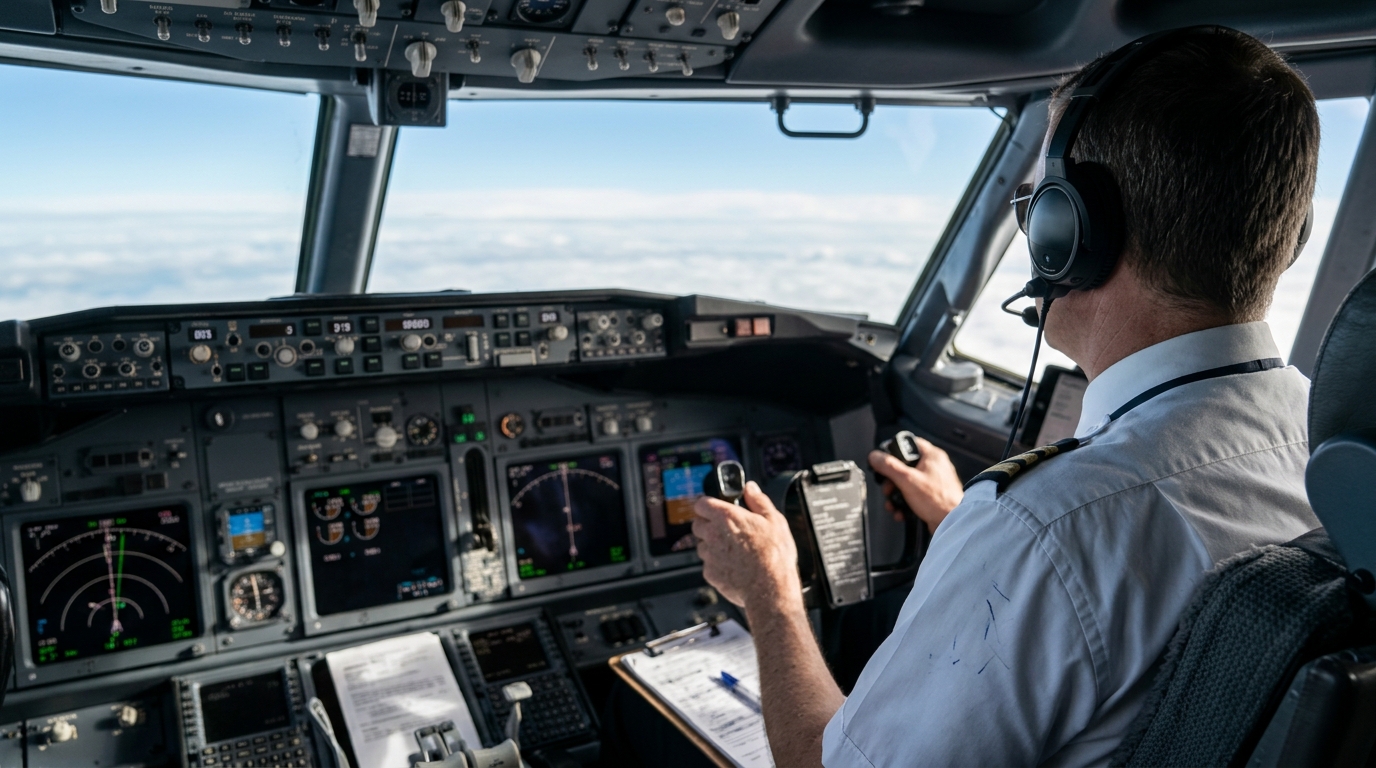
Becoming a commercial airline pilot means collecting a fixed stack of licences in a set order, passing a strict medical, and building flight hours until you meet the minimum for airline operations. In the United States that stack runs student pilot certificate, private pilot certificate, instrument rating, commercial pilot certificate, multi-engine rating, then airline transport pilot (ATP) certificate (U.S. Bureau of Labor Statistics, 2025). Europe, and countries that follow EASA or ICAO rules, use different licence names and an alternative cadet route, but the same logic applies.
The path is regulated, expensive and medically conditional — you can be stopped at any point by a failed medical rather than a failed exam. Check the exact requirements with the civil aviation authority of the country where you intend to fly, because minimum hours, licence names and training approvals differ.
Step-by-Step Path to Entry
- Confirm basic eligibility and pass a medical first. To be eligible for a commercial pilot certificate you must be at least 18 and able to read, speak, write and understand English (eCFR, undated). The medical exam confirms vision correctable to 20/20 and no physical or mental condition that could impair performance (U.S. Bureau of Labor Statistics, 2025). A first-class medical certificate is required to act as pilot-in-command (ATP Flight School, undated). Sit the medical with an authorised examiner before you pay for training.
- Get a student pilot certificate, then a private pilot certificate. This is the first rung of the order used by the FAA: student pilot certificate, private pilot certificate, instrument rating, commercial pilot certificate, multi-engine rating, airline transport pilot certificate (U.S. Bureau of Labor Statistics, 2025). In EASA states the equivalent starting licence is the PPL(A).
- Add the instrument rating. Pilots may qualify by holding at least 40 hours of instrument flight experience and 50 hours of cross-country flight time as pilot in command, among other requirements (U.S. Bureau of Labor Statistics, 2025).
- Earn the commercial pilot certificate and a multi-engine rating. A US commercial pilot certificate under 14 CFR 61.129 requires 250 hours of flight time and is the certificate that makes you legally employable to fly for compensation (migflug, undated). Under EASA rules a CPL holder may already fly as co-pilot in commercial air transport, with the ATPL required to act as pilot in command of a multi-pilot aircraft (Aviation Connect, undated).
- Build hours in a paid flying role. Common hour-building jobs include flight instructor, aerial survey, banner towing, pipeline patrol and air-taxi flying. Count carefully: EASA credits at most 100 hours from simulators and training devices toward the 1,500-hour ATPL total (Aviation Connect, undated).
- Complete the ATP CTP and obtain the ATP certificate. The Airline Transport Pilot Certification Training Program must be satisfactorily completed before an applicant can earn the ATP certificate (ATP Flight School, undated). For a multiengine class rating the applicant generally needs 1,500 hours total pilot time including 200 hours cross-country, unless qualifying for a reduced-hour pathway of 1,000 or 1,250 hours under specified education or experience provisions (eCFR, undated). The EASA ATPL(A) requires 1,500 hours including at least 500 in multi-pilot operations, 200 hours cross-country, 75 hours instrument and 100 hours night (European Union Aviation Safety Agency, 2023-08).
- Apply to an airline and complete type-rating training. Aircraft type ratings, such as for the Boeing 737, are typically acquired through employer-based training and are generally earned by pilots who already hold at least a commercial pilot certificate (U.S. Bureau of Labor Statistics, 2025). After hiring, expect periodic training and medical examinations, generally every year or every other year (U.S. Bureau of Labor Statistics, 2025).
Education and Certification Options
No route is cheap, and costs are quoted per flight hour plus ground school, so the figure you are given depends on aircraft type, country, currency and how quickly you fly. Ask approved training organisations and flight schools for current written quotes, and ask what happens if you need extra hours.
| Route | Typical duration | Approximate cost | Required or preferred |
|---|---|---|---|
| Modular licences (PPL, instrument rating, CPL, multi-engine, then hour building to ATP) | 2-5 years, paced by how fast you accumulate the 250 hours for a commercial certificate and 1,500 for the ATP (migflug, undated) | Pay-as-you-go per flight hour; request a per-hour and per-stage quote from the school | The certificates themselves are legally required; the modular structure is a choice |
| Integrated zero-to-frozen-ATPL course (EASA states) | Typically full-time; the course contains at least 750 hours of theory instruction and 195 hours of flying training (Aviation Connect, undated) | Usually a single package price from an Approved Training Organisation; confirm what is excluded | Preferred by many European airlines; the licence outcome is what is required |
| Multi-crew pilot licence (MPL) cadet programme | About 16-18 months from no flight experience to flying for an airline (Wikipedia, undated); minimum 240 hours of flying training, much in a full-motion simulator, with 40 hours and 12 takeoffs/landings in an actual aeroplane, plus 750 hours of classroom theory (Wikipedia, undated) | Often part-funded or bonded by the sponsoring airline; terms are set in the cadet contract | Accepted where the regulator recognises the ICAO MPL, added to the 10th edition of Annex 1 on 23 November 2006; restricted to the sponsoring airline until a conversion course is completed (Wikipedia, undated) |
| Bachelor's degree with an approved flight programme | Typically 4 years for the degree, flight training run alongside | University tuition plus flight fees charged separately | Airline pilots typically need a bachelor's degree and experience as a commercial or military pilot (U.S. Bureau of Labor Statistics, 2025); a qualifying degree can support a reduced-hour ATP pathway of 1,000 or 1,250 hours (eCFR, undated) |
| Military pilot service | Multi-year service commitment set by the armed force | Training is funded in exchange for a service obligation | A recognised source of the commercial or military flying experience airlines look for (U.S. Bureau of Labor Statistics, 2025) |
| Type rating (for example, Boeing 737) | Weeks of ground school and simulator work | Commonly employer-funded or bonded after hiring | Earned by pilots who already hold at least a commercial pilot certificate; typically acquired through employer-based training (U.S. Bureau of Labor Statistics, 2025) |
Are You Ready? Readiness Checklist
Work through these before you pay a deposit. Each one can be checked, not guessed at.
- You are at least 18, the minimum age for a commercial pilot certificate and also for the MPL (eCFR, undated; Wikipedia, undated).
- You can read, speak, write and understand English, which is listed among the eligibility requirements for a commercial pilot certificate (eCFR, undated).
- Your vision is correctable to 20/20 and you have no physical or mental condition that could impair performance — the standard the commercial pilot medical exam confirms (U.S. Bureau of Labor Statistics, 2025).
- You have booked, not just read about, a class 1 or first-class medical with an authorised examiner, knowing it is required to act as pilot-in-command (ATP Flight School, undated).
- You accept that medical fitness must be re-proven, with periodic training and medical examinations generally every year or every other year, and that a failed renewal can end your flying (U.S. Bureau of Labor Statistics, 2025).
- You have a written funding plan that covers training through the 250-hour commercial certificate and the gap until you reach 1,500 hours for the ATP, including the risk of needing extra hours (migflug, undated).
- You have checked, with the relevant civil aviation authority, whether you qualify for a reduced-hour ATP pathway of 1,000 or 1,250 hours under the specified education or experience provisions (eCFR, undated).
- You have confirmed with a training provider which background, security and right-to-work checks apply in the country where you plan to train and fly, and that you can satisfy them.
- You are willing to accept night flying, early starts, nights away from home and a roster set by seniority — the EASA ATPL alone requires 100 hours of night flight (European Union Aviation Safety Agency, 2023-08).
Typical Timeline From Start to First Job
Elapsed time depends on weather, aircraft availability, funding and how many hours a week you fly. Treat these as planning markers, not promises.
- Month 0-1: Medical and eligibility. Pass the medical exam confirming vision correctable to 20/20 and no impairing condition (U.S. Bureau of Labor Statistics, 2025), and obtain a student pilot certificate.
- Month 1-9: Private pilot certificate. The second step in the standard FAA certificate order (U.S. Bureau of Labor Statistics, 2025), including solo and cross-country flying.
- Month 9-18: Instrument rating. Reach at least 40 hours of instrument flight experience and 50 hours of cross-country time as pilot in command, among other requirements (U.S. Bureau of Labor Statistics, 2025).
- Month 18-30: Commercial pilot certificate and multi-engine rating. The commercial certificate requires 250 hours of flight time under 14 CFR 61.129 and is what makes you legally employable to fly for compensation (migflug, undated). On an EASA integrated course this stage follows at least 750 hours of theory and 195 hours of flying training (Aviation Connect, undated).
- Month 24-60: Hour building as a flight instructor or commercial pilot. Work toward the 1,500 hours total pilot time, including 200 hours cross-country, needed for the ATP, or the 1,000 or 1,250-hour reduced pathway if you qualify (eCFR, undated). Remember the EASA cap of 100 simulator hours toward the total (Aviation Connect, undated).
- Month 30-66: ATP CTP, ATP certificate, then first officer. Complete the Airline Transport Pilot Certification Training Program before earning the ATP certificate (ATP Flight School, undated), since all pilot crews of a scheduled commercial airliner must hold ATP certificates (U.S. Bureau of Labor Statistics, 2025). The entry job title is first officer, usually at a regional or short-haul operator, where the airline provides type-rating training such as a Boeing 737 rating (U.S. Bureau of Labor Statistics, 2025). On an MPL cadet scheme the same end point is typically reached in about 16-18 months (Wikipedia, undated).
Frequently asked questions
Can I become a commercial airline pilot without a four-year degree?
Yes, in licence terms. The legal gate is certificates and hours, not a diploma — a commercial pilot certificate requires 250 hours and the ATP 1,500 hours (migflug, undated). But airline pilots typically need a bachelor's degree plus commercial or military flying experience (U.S. Bureau of Labor Statistics, 2025), and an approved degree can qualify you for a reduced 1,000 or 1,250-hour ATP pathway (eCFR, undated).
What is the MPL, and is it a shortcut?
The multi-crew pilot licence was developed by ICAO and added to the 10th edition of Annex 1 on 23 November 2006 (Wikipedia, undated). It needs 240 hours of flying training, much of it in a full-motion simulator, with 40 hours in an actual aeroplane, plus 750 classroom hours. The tradeoff: it is restricted to the sponsoring airline until you complete a conversion course.
How many flight hours do I actually need?
In the US system, 250 hours for the commercial pilot certificate under 14 CFR 61.129 and 1,500 hours for the ATP required on scheduled airline flights (migflug, undated). The EASA ATPL(A) also requires 1,500 hours, including 500 in multi-pilot operations, 200 cross-country, 75 instrument and 100 night (European Union Aviation Safety Agency, 2023-08).
What happens if I fail a medical later in my career?
It can stop you flying. The exam confirms vision correctable to 20/20 and that no physical or mental condition exists that could impair performance (U.S. Bureau of Labor Statistics, 2025), and pilots undergo periodic training and medical examinations generally every year or every other year. Build a financial and career contingency before you commit to training, and discuss any existing condition with an authorised examiner first.
How is pilot pay structured, and where do I check current rates?
Airline pay is usually built from a per-flight-hour or block-hour rate, a minimum monthly hour guarantee, seniority-based pay scales, and per-diem allowances for time away from base, with type and aircraft size affecting the scale. Figures differ by country, airline and contract. Check your national statistics agency and the published pay scales or collective agreements for the airlines you are targeting.
Is demand for pilots growing?
In the United States, overall employment of airline and commercial pilots is projected to grow 7 percent from 2025 to 2035, much faster than the average for all occupations, with about 16,400 openings projected each year (U.S. Bureau of Labor Statistics, 2025). That projection is national and US-specific; for other countries, check your civil aviation authority and national labour statistics body.
Sources
- U.S. Bureau of Labor Statistics — Airline and Commercial Pilots : Occupational Outlook Handbook (2025)
- eCFR (U.S. Government) — 14 CFR § 61.123 -- Eligibility requirements: General.

Written by
Desmond writes about the mechanics of job searching: resumes, interviews, the long silence after applying. He's fascinated by how much of getting hired depends on luck dressed up as skill.