
How to Become a Correctional Officer
A practical look at the age rules, academy training, background investigation and state certification steps that sit between an application and a first shift.
Quick answer
- The minimum education for entry in the United States is typically a high school diploma, though federal agencies may also require a bachelor's degree or work experience and may set a maximum age for entry (U.S. Bureau of Labor Statistics, 2025).
- The fastest route is applying directly to a county jail or state corrections agency that hires at the high school diploma level; from application to first solo shift commonly runs 6 to 12 months across testing, background investigation, academy and on-the-job training.
- Certification is mandatory in some states and optional in others — some states require correctional officers to complete state certification, and you should check with your state's public safety, corrections or other agency that establishes it (U.S. Bureau of Labor Statistics, 2025).
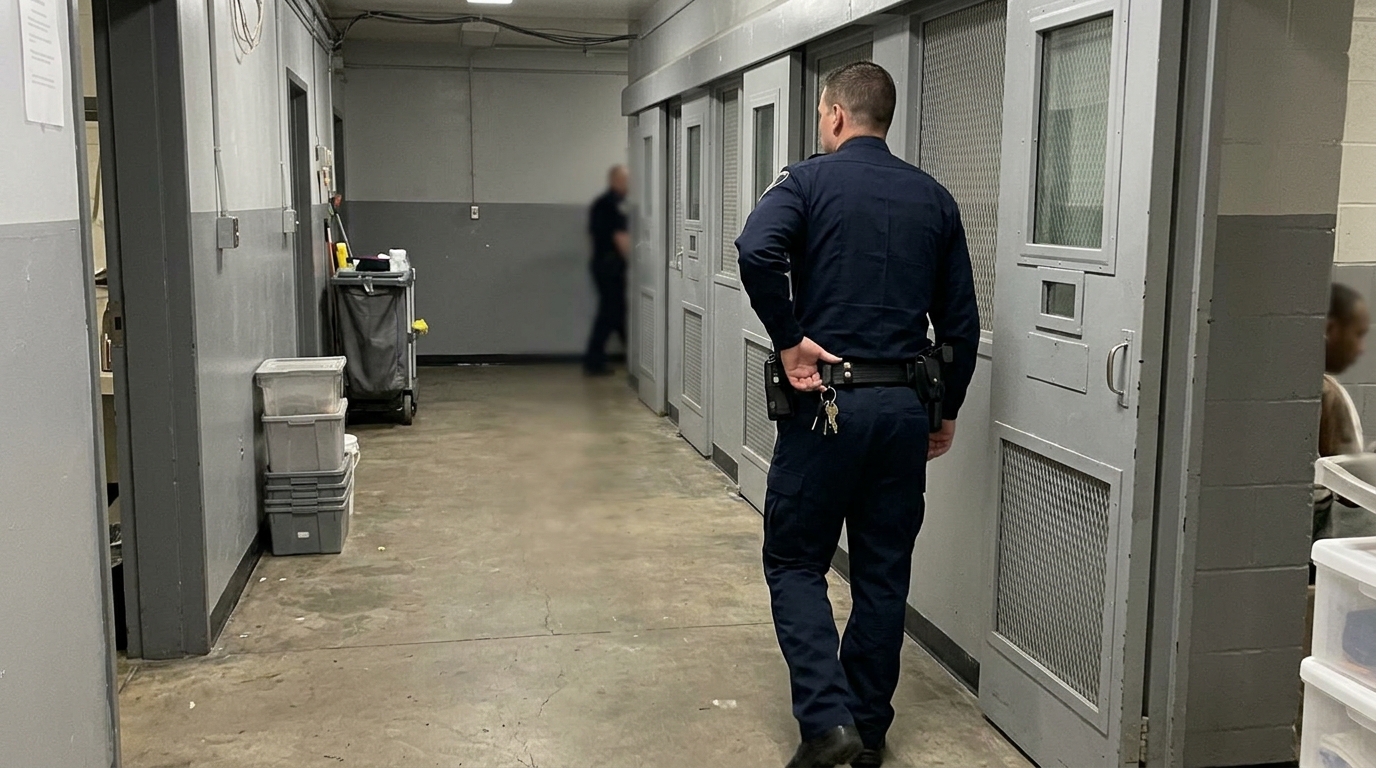
Becoming a correctional officer usually means meeting an agency's age and background standards, passing a selection process, completing a training academy, then learning the job on the floor under experienced officers. In the United States, correctional officers and bailiffs typically need a high school diploma to enter the occupation, typically attend a training academy, and are then assigned to a facility where they receive on-the-job training (U.S. Bureau of Labor Statistics, 2025).
The details differ by employer and by state: county jails, state prison systems and federal facilities each set their own entry rules, and some states add a formal certification. Outside the United States, recruitment is usually run centrally by the national prison service, so check that service's own pages rather than assuming US rules apply.
What This Job Involves Day to Day
The core of the job is order and accounting for people. Correctional officers enforce rules and keep order within jails or prisons, supervise the activities of people in custody, inspect facilities to ensure security and safety standards, conduct searches of persons and property for rule violations, report on the conduct of people in custody, and escort and transport them between jail, courtroom, prison or another point (U.S. Bureau of Labor Statistics, 2025).
Four tasks come up on almost every shift:
- Conducting head counts to make sure each prisoner is present (O*NET OnLine, U.S. Department of Labor).
- Inspecting the condition of locks, window bars, grills, doors and gates to help prevent escapes (O*NET OnLine, U.S. Department of Labor).
- Searching prisoners and vehicles and conducting shakedowns of cells for valuables and contraband such as weapons or drugs (O*NET OnLine, U.S. Department of Labor).
- Writing up incidents and rule violations in reports supervisors, investigators and courts may later rely on.
The setting is a secure facility that never closes. Because security must be provided 24 hours a day, officers work shifts covering all hours of the day and night, including weekends and holidays, and may work both indoors and outdoors at penal institutions (U.S. Bureau of Labor Statistics, 2025). Posts range from a housing unit control room to a perimeter tower or a transport van.
It is physical work with real risk: officers may be injured in confrontations with people in custody, giving the occupation one of the highest rates of injuries and illnesses of all occupations (U.S. Bureau of Labor Statistics, 2025). Advancement runs through the uniformed ranks — sergeant, lieutenant or captain — or into specialized units such as a gang task force or hostage negotiation (U.S. Bureau of Labor Statistics, 2025).
Step-by-Step Path to Get Started
- Check the eligibility rules of nearby agencies (1-2 hours). Many agencies set a minimum age, and federal agencies may also require a bachelor's degree or work experience and may set a maximum age for entry (U.S. Bureau of Labor Statistics, 2025). Read the age, residency, driving and criminal-history conditions in a live vacancy announcement first.
- Finish a high school diploma or state high school equivalency credential (4 years in school, or about 2-6 months of preparation and testing for an equivalency). This is the typical entry-level education for correctional officers and bailiffs (U.S. Bureau of Labor Statistics, 2025).
- Choose between local, state and federal employers (1-2 weeks of research). County sheriff's offices run jails and state departments of corrections run prisons, while the Federal Bureau of Prisons requires entry-level correctional officers to have a bachelor's degree or several years of experience in a field providing counseling, assistance or supervision (U.S. Bureau of Labor Statistics, 2025). The federal experience route means planning 3 or more years in qualifying work; a bachelor's degree takes about 4 years full time.
- Apply through the hiring agency's own portal (2-4 hours per application). Apply to several agencies at once, since county jails often recruit more frequently than state systems.
- Clear the selection process (commonly 2-6 months). Expect a written or computer-based entrance test, a physical ability test, medical and vision screening, a drug test, a psychological evaluation and a background investigation covering employment, addresses and criminal history. The background investigation is usually the longest stage.
- Complete the training academy (weeks to months, set by each state or agency). Trainees receive instruction in subjects including self-defense, institutional policies, regulations, operations and security procedures, and training varies by state (U.S. Bureau of Labor Statistics, 2025).
- Do on-the-job training at your assigned facility (several weeks to a few months). After graduating from an academy, officers may shadow experienced officers before taking a post alone (U.S. Bureau of Labor Statistics, 2025).
- Complete state certification if your state requires it (timing set by the state board). Check with your state's public safety, corrections or other agency that establishes this certification, and use CareerOneStop's certification information to see what applies where you live (U.S. Bureau of Labor Statistics, 2025).
Education, Certification, and Cost Requirements
| Requirement | Where to Get It | Typical Cost | Typical Time |
|---|---|---|---|
| High school diploma or state high school equivalency credential | Public or private high school; your state's high school equivalency testing agency | No tuition at a public high school; equivalency testing fees are set by each state's testing agency and some states waive them — check its published fee schedule before registering | 4 years in school, or about 2-6 months of preparation and testing for an equivalency |
| Bachelor's degree or qualifying experience (federal route only) | Any accredited college or university; or 3 or more years in counseling, assistance or supervision work such as youth work, social services or teaching | Tuition is set by the institution and by in-state versus out-of-state status — check the college's published schedule; the experience route costs only time | About 4 years full time for a degree; 3 or more years for the experience route |
| Agency application and selection process | County sheriff's office, state department of corrections, or the Federal Bureau of Prisons | Agencies normally run and pay for these screenings; you cover travel to test sites and any state-charged fingerprinting fee named in the vacancy announcement | 2-6 months from application to conditional offer |
| Training academy | The hiring agency's own academy or a state corrections training academy | No tuition charged to recruits the agency has hired; most agencies pay recruits as employees during the academy — confirm this in the offer letter | Weeks to months, with the exact length set by each state (U.S. Bureau of Labor Statistics, 2025) |
| On-the-job training and shadowing | The facility you are assigned to | No cost to you; it is paid duty time | Several weeks to a few months |
| State correctional officer certification (where required) | Your state's public safety, corrections or peace officer standards agency; use CareerOneStop to find the body for your state | Where a fee applies it is set by the state board and is commonly paid by the employing agency — confirm with its training unit | Awarded on completion of academy and probation; renewal cycles set by the state board |
Before You Apply
Have these ready before you open an application form, because most agencies will not hold a file open while you chase documents.
- Proof of education — your high school diploma or equivalency certificate, plus sealed college transcripts if you are applying to the Federal Bureau of Prisons on the degree route.
- A full address and employment history covering the number of years the vacancy announcement specifies, with dates, supervisor names and phone numbers. Unexplained gaps slow the background investigation more than anything else.
- Photo ID and a current driving record abstract from your state's motor vehicle agency — many posts involve escorting and transporting people in custody.
- Military discharge paperwork (DD-214 in the United States) if you are claiming veterans' preference.
- A resume in the format the agency asks for. Federal announcements usually expect a detailed resume with month-and-year dates and hours per week; county and state applications are often a structured online form. Lead with work involving supervision, de-escalation, security, healthcare or youth services.
- Three or more professional references who have seen you handle conflict calmly.
- Your certification number and academy graduation certificate if you are already certified in another state and applying on a lateral or reciprocity route.
- An honest self-assessment against the background standards — criminal history, drug history, credit and prior terminations are all examined, and withholding something is usually disqualifying even when the underlying issue would not have been.
- A fitness plan started weeks before the physical ability test, matched to the published events such as timed runs, stair climbs, dummy drags or grip strength.
- Childcare and transport that work at 04:00 and on holidays, confirmed before you accept a post.
Frequently asked questions
Do I need a college degree to become a correctional officer?
Not for most state and county roles, where a high school diploma meets the stated entry-level education (U.S. Bureau of Labor Statistics, 2025). The federal route is the exception, since the Federal Bureau of Prisons requires a bachelor's degree or several years of experience in a field providing counseling, assistance or supervision (U.S. Bureau of Labor Statistics, 2025). An associate degree in criminal justice is optional everywhere, but can help when you later compete for sergeant or specialist posts.
How long does it take from first application to working a post alone?
Budget 6 to 12 months at most state and county agencies. Waiting for the next academy class is a common delay, because intakes run on fixed dates a few times a year rather than continuously. Applying to three or four agencies in one region improves your odds of catching an intake that is about to open.
Will I be paid during the training academy?
At most agencies recruits are hired first and sent to the academy as paid employees, which is why it is not something you buy in advance like a college course. Pay is usually set by a public salary schedule or a union contract, with shift differentials and overtime on top. Check the agency's published pay plan and, in the United States, the Bureau of Labor Statistics occupational wage pages for current figures in your state.
What disqualifies someone from being hired?
Agencies publish their own disqualifiers, typically covering felony convictions, certain domestic violence offences, recent illegal drug use, dishonesty during the application itself, and failing the medical or psychological evaluation. Vision, hearing and driving-record standards also appear in many announcements. Read that list before you invest time, and ask the recruiter about anything borderline instead of guessing.
Does certification transfer if I move to another state?
Sometimes, but never automatically. Because some states require certification and others do not, and the academies behind them differ in length and content, a receiving state usually runs its own reciprocity review and may require a bridge course or a challenge exam (U.S. Bureau of Labor Statistics, 2025). Contact the corrections or public safety standards agency in the destination state before you move, and keep your academy transcript and certificate.
Sources
- U.S. Bureau of Labor Statistics — Correctional Officers and Bailiffs : Occupational Outlook Handbook (2025)
- O*NET OnLine (U.S. Department of Labor) — 33-3012.00 - Correctional Officers and Jailers

Written by
Wyatt covers work outside the office: construction, logistics, repair, and the people who keep things running. He's skeptical of career advice that assumes everyone sits at a desk.


