
How to Become a Court Reporter
Stenography, voice writing and digital recording lead to the same courtroom chair by different routes, with different training lengths and equipment bills.
Quick answer
- The minimum education is normally a secondary school diploma plus a court reporting program; stenography programs are the longest because of speed-building, voice writing is shorter, and digital reporting training is measured in weeks to a few months.
- Certification is mandatory in some US states, such as California's Certified Shorthand Reporter licence, and optional but widely expected elsewhere; the common national credentials are the NCRA's RPR, the NVRA's CVR, and AAERT's CER and CET.
- The fastest realistic path to a first paid assignment is digital reporting training followed by the AAERT exams; the stenographic path takes years because test speed, not coursework, is the limiting factor.
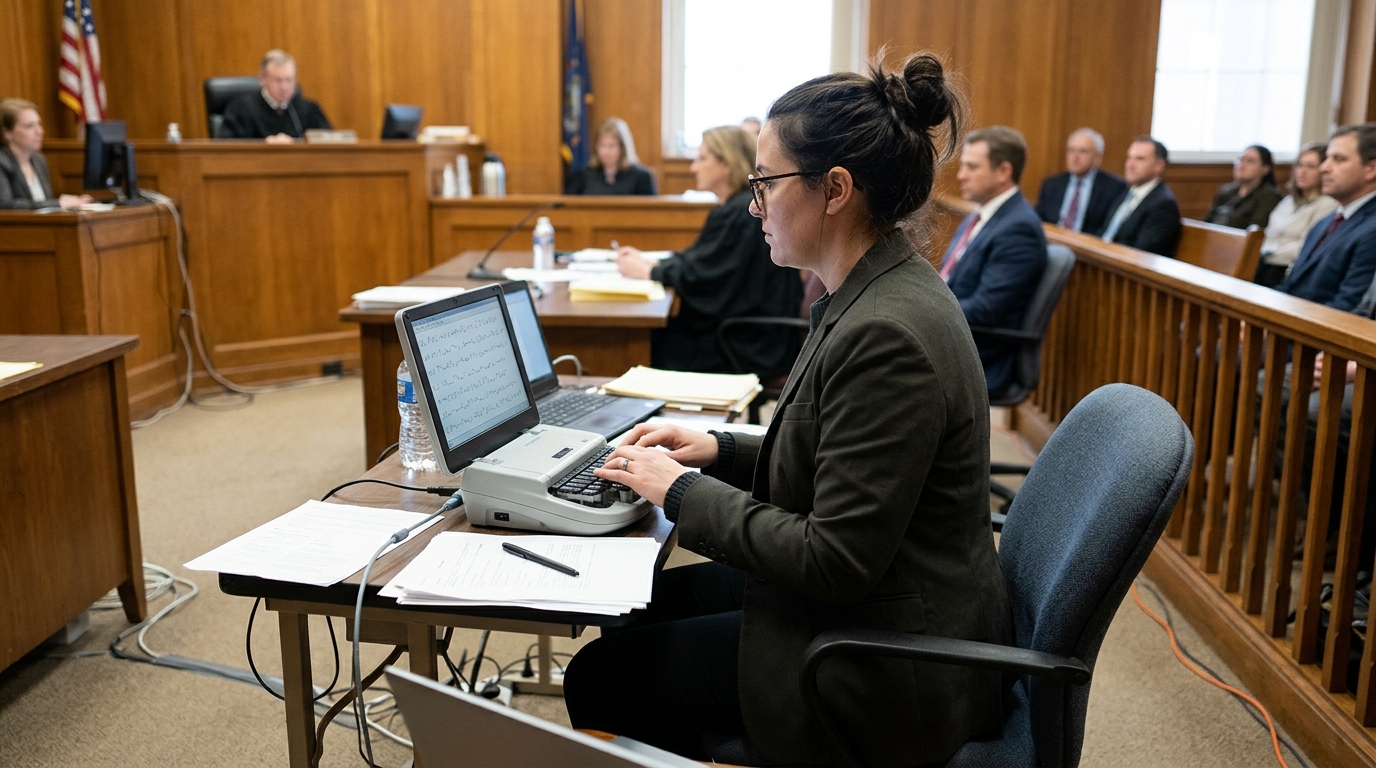
Court reporters create the official word-for-word record of legal proceedings and then produce a certified transcript from it. Three routes lead in: stenographic machine shorthand, voice writing into a sound-shielded mask, and digital recording paired with transcript production. Digital reporting has the shortest training; stenography has the longest, because of the time it takes to build speed.
Whether a licence is compulsory depends on where you work. Some US states license reporters through a board such as the Court Reporters Board of California or the Texas Judicial Branch Certification Commission, while others rely on national credentials from the NCRA, NVRA or AAERT. In the UK and Australia, reporters are usually engaged by private reporting firms, with no statutory licence.
What This Job Involves Day to Day
You capture everything said in a proceeding, verbatim, as it happens. On a steno machine that means writing phonetic chords through fast question-and-answer testimony. As a voice writer it means repeating every word, plus speaker identification and punctuation, into a sound-shielded mask feeding a speech engine. As a digital reporter it means monitoring multi-channel audio, logging speakers and timestamps, and flagging inaudible passages for the transcriptionist.
A typical day includes:
- Setting up and testing equipment before anyone is sworn in — writer or mask, laptop, CAT software, backup audio recorder, table microphones, and the video platform if the deposition is remote.
- Marking and tracking exhibits, noting who introduced each one and when, and keeping the index that will go into the finished transcript.
- Reading back a question or answer on request from the judge, arbitrator or attorney, which means finding any passage in your notes within seconds.
- Editing and certifying the transcript afterwards: resolving untranslated outlines, checking names and technical terms against your job dictionary, formatting to the court's page and line rules, and signing the certificate page.
Some reporters also provide realtime, a live text feed to attorneys' screens, or CART captioning for a deaf or hard-of-hearing participant. Both leave no editing window at all.
The setting splits between fieldwork and desk work. Official reporters sit in a courtroom on a fixed court calendar. Freelance reporters take deposition assignments from agencies, often in law firm conference rooms or entirely over video, then spend several hours at home producing the transcript. Deadlines are firm and set either by court rule or by the ordering party: standard delivery runs on a published timetable, while expedited and daily copy orders compress it to overnight.
Step-by-Step Path to Get Started
- Check the rules where you intend to work (a few days). In the US, look up your state through the NCRA's state requirements listing and the relevant board, such as the Court Reporters Board of California, which administers the Certified Shorthand Reporter (CSR) exam, or the Texas Judicial Branch Certification Commission. In the UK, check the British Institute of Verbatim Reporters (BIVR). In Australia and Canada, check the hiring criteria of private reporting firms and the court administration in your state or province.
- Try the method before you pay for a program (several weeks). The NCRA's A to Z Intro to Steno is a short introductory course run through participating schools and state associations, and it is a cheap way to find out whether machine shorthand suits you. Voice writing schools and digital reporting providers usually offer a taster lesson or trial module.
- Enrol in a court reporting program. Stenography programs run at community colleges and NCRA-approved online schools. Voice writing programs follow the NVRA skill standards. Digital reporting training is aligned to the AAERT exams and is the shortest of the three.
- Practise to test speed daily, throughout the program. Students who finish typically add several hours of dictation practice a day on top of coursework. Check the current speed and accuracy standards for the RPR skills test on the NCRA site and track your dictation against them weekly.
- Complete an internship or supervised practicum (several weeks). Arrange it through your school, your state court reporters association, or a deposition agency that takes student interns. Sit in on live proceedings and write along silently to build endurance.
- Pass your certification exam. Options are the NCRA's Registered Professional Reporter (RPR), made up of a Written Knowledge Test plus three skills legs; the NVRA's Certified Verbatim Reporter (CVR) for voice writers; and AAERT's Certified Electronic Reporter (CER) and Certified Electronic Transcriber (CET) for digital work. If your state licenses reporters, sit the state exam as well.
- Clear the background and oath requirements (weeks). Fingerprint-based criminal record checks are standard for court-adjacent work, and several US states require a notary commission or an oath before you may certify transcripts.
- Apply. Freelancers register with deposition and reporting agencies in their region; official reporter posts are advertised on state and county judicial branch job boards and in the listings of the NCRA and state court reporters associations. Expect to submit a transcript sample and sit a practical speed screening.
Education, Certification, and Cost Requirements
Fees in this field are set individually by each school, board and certifying body, and they are revised periodically. Exam fees usually differ for members and non-members, and tuition differs sharply between community colleges and private online schools. Take the current figures from the fee schedule published by the body in the right-hand column before you budget, and ask schools for the total including equipment, not just tuition.
| Requirement | Where to Get It | Typical Cost | Typical Time |
|---|---|---|---|
| Secondary school diploma or equivalent | National, state or provincial school system | No fee if already held; equivalency tests carry a sitting fee set by the awarding body | Already complete for most applicants |
| A to Z Intro to Steno | NCRA, through participating schools and state associations | Low or no fee; some state associations run it free to recruit students | Several weeks, part time |
| Stenographic court reporting program | NCRA-approved community college or online school | Tuition charged per credit or per term; community college rates are well below private online schools | Commonly two to three years, driven by speed-building |
| Voice writing program | NVRA-aligned school or online provider | Tuition per term, plus the mask and speech engine | Commonly one to two years |
| Digital reporting training | AAERT-aligned provider or an employer's in-house program | Course fee plus your own audio kit; some agencies train new staff at no charge | Weeks to a few months |
| Steno writer and CAT software | Writer manufacturer, school rental scheme, used market, software vendor | Monthly rental or outright purchase; student software editions are discounted while you are enrolled | One to two weeks to obtain and configure |
| NCRA RPR | National Court Reporters Association | Separate fee per component: Written Knowledge Test and each of the three skills legs | Test day, after months of targeted preparation |
| NVRA CVR | National Verbatim Reporters Association | Exam fee plus annual membership | Test day |
| AAERT CER or CET | American Association of Electronic Reporters and Transcribers | Fee per credential, plus membership | Test day, after weeks of preparation |
| State licence, e.g. California CSR | Court Reporters Board of California, Texas JBCC or your state board | Application and examination fees set by the board | Several months including processing |
| Fingerprint background check | State police or the board's approved vendor | Vendor fee plus a state processing fee | One to four weeks |
| Notary commission, where required | State or provincial commissioning authority | Application fee plus bond and seal | Two to eight weeks |
| BIVR membership (UK) | British Institute of Verbatim Reporters | Annual subscription set by the institute | Application assessed within weeks |
Before You Apply
Have all of this assembled before you contact agencies or apply for an official reporter post:
- Your certification number and the awarding body's name — RPR, CVR, CER or your state licence — on the first line of your résumé, with the renewal date.
- A one-page reverse-chronological résumé listing your certified speed, the CAT software you use by name and version, whether you can deliver realtime, and the proceeding types you have covered: depositions, arbitrations, examinations under oath, hearings.
- Two transcript samples from mock or practice proceedings, formatted to the page and line rules of the court you are applying to, with a correct appearance page, exhibit index and certificate page. Never submit a transcript from a live case.
- Proof of speed: your school's final speed certificate or the score report from your certification exam.
- An equipment inventory: writer or mask, two machines or a laptop plus tablet, primary and backup audio recorders, microphones, power banks and cabling. Agencies ask specifically whether you carry redundancy.
- Fingerprint clearance and, where your jurisdiction requires it, a current notary commission with seal.
- Freelance paperwork: registered business or sole trader number, an invoicing template with your page rate and expedite surcharge, professional liability cover if agencies in your region require it, and a confidentiality agreement you are prepared to sign.
- A job dictionary already loaded with legal boilerplate, local court and firm names, and the medical or technical terms common in your area of work.
- Two references from your practicum supervisor or internship agency, with current contact details and permission to be contacted.
- Tested familiarity with remote deposition platforms, including running a realtime feed and a separate backup recording at the same time.
Frequently asked questions
Do I need a university degree to become a court reporter?
No. The standard qualification is a vocational certificate or associate-level court reporting program, and most schools ask only for a secondary school diploma or equivalent to enrol. Some official court posts in the US prefer candidates with extra college credit, and a few employers accept verified reporting experience in place of formal schooling.
Why do so many people drop out of stenography programs?
Speed-building is the obstacle, not the coursework. Moving up through the speed levels to testimony standard consumes most of the program, and students who cannot commit to daily dictation practice tend to stall at one level and stay there. If you want a shorter runway, the voice writing and digital reporting routes reach employability sooner, though the work mix and rate structure differ.
How is pay usually structured in this job?
Freelance reporters are generally paid an appearance or per-diem fee for attending, plus a per-page rate for the transcript, with surcharges for expedited delivery, realtime and copies ordered by other parties. Salaried official reporters receive a wage from the court, often with transcript page fees on top. For current figures, check your national statistics agency: the BLS Occupational Employment and Wage Statistics in the US, the ONS Annual Survey of Hours and Earnings in the UK, the ABS in Australia, or Statistics Canada.
What happens if I fail part of the certification exam?
The skills portions of exams such as the RPR are taken as separate legs, and candidates commonly sit them across more than one testing window rather than passing everything in a single attempt. Retakes are charged per component, so a partial failure costs much less than starting over. Confirm the current retake policy and how long a passed leg stays valid with the NCRA, NVRA or AAERT before you book.
Can I train entirely online?
For the academic and speed-building parts, yes — several NCRA-approved programs are delivered fully online, and digital reporting training is routinely remote. You will still need a proctored or in-person testing centre for most certification exams, and agencies generally expect a supervised practicum in live proceedings before they send you out alone.

Written by
Noor writes personal essays and interviews about career changes, burnout, and starting over. She's interested in the stories people tell themselves about what a job is supposed to mean.


