How to Become a Home Health Aide
A practical look at the training hours, registry listing and competency test that stand between you and your first paid in-home care shift.
Quick answer
- The minimum education is usually a high school diploma or equivalent, and aides typically need no prior work experience in a related occupation (U.S. Bureau of Labor Statistics, 2025).
- Certification is optional for some private-pay personal care work but mandatory at certified home health or hospice agencies, where aides must complete formal training and pass a standardized test (U.S. Bureau of Labor Statistics, 2025).
- Federally certified agencies in the United States must provide at least 75 hours of classroom and supervised practical training (Indiana Department of Health, undated), so many people go from enrolment to a first agency job in 4 to 10 weeks.
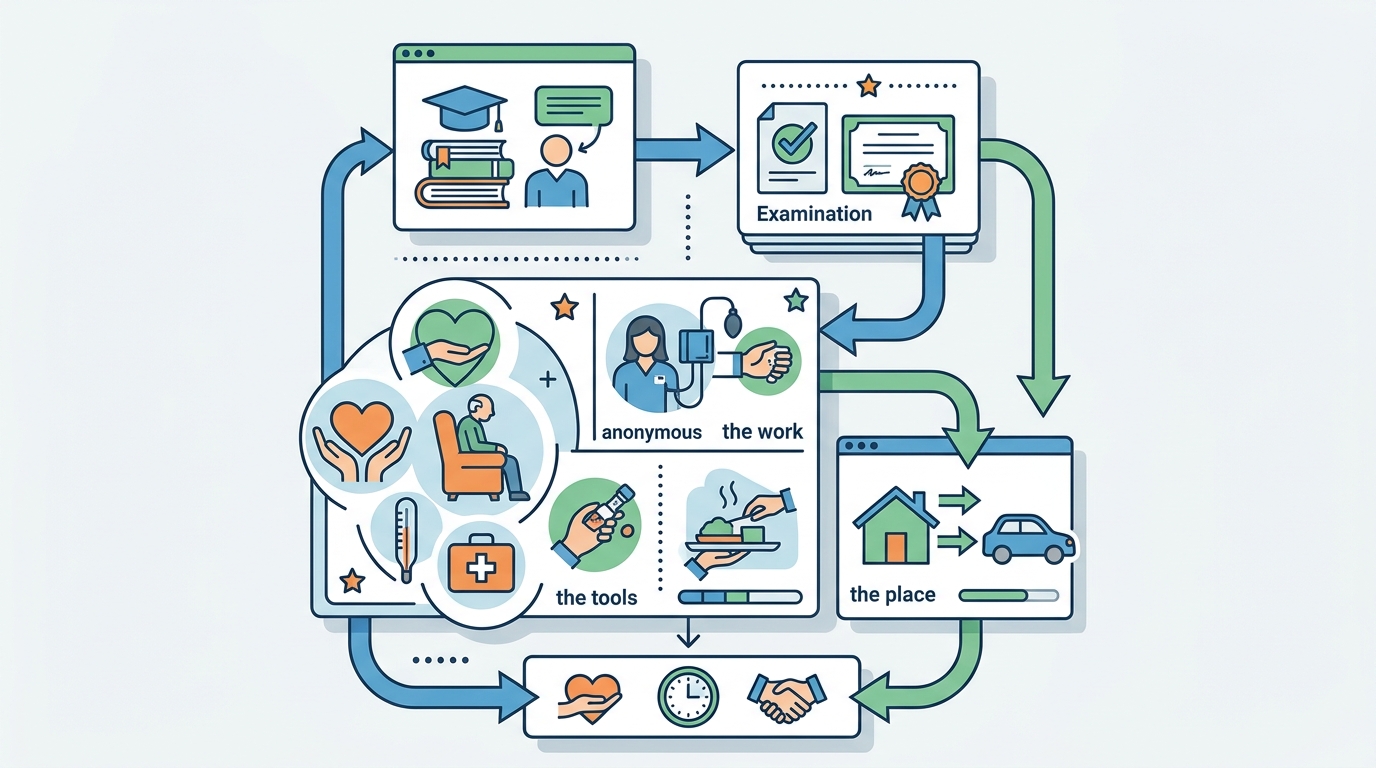
Becoming a home health aide is one of the shorter entry paths in healthcare: the typical entry-level education is a high school diploma or equivalent, and most aides receive short-term on-the-job training with no prior experience in a related occupation (U.S. Bureau of Labor Statistics, 2025). To work for a certified home health or hospice agency, though, you must complete formal training and pass a standardized test (U.S. Bureau of Labor Statistics, 2025).
Rules differ by country, and within the United States by state — some states require a licence or certification involving training, a background check and a competency exam (U.S. Bureau of Labor Statistics, 2025). Confirm your own state or national health authority's rules before you enrol in anything.
What This Job Involves Day to Day
Most of your day is hands-on personal care in someone else's home. You bathe and dress clients, assist with personal care and change bed linens, and plan, purchase, prepare or serve meals according to a prescribed diet — a low-sodium plan after heart failure, or soft foods after a stroke (O*NET OnLine, U.S. Department of Labor, undated).
The second block of work is the household and the calendar. Aides do housekeeping such as laundry and vacuuming, help organise a client's schedule and plan appointments, arrange transportation to doctors' offices, and shop for groceries (U.S. Bureau of Labor Statistics, 2025). A two-hour visit might run personal care first, then a meal, then a load of washing and a call to confirm next week's clinic appointment.
There is a clinical element, within limits. Home health aides may check a client's pulse, temperature and respiration rate depending on the state in which they work, and are supervised by medical practitioners, usually nurses (U.S. Bureau of Labor Statistics, 2025). You maintain records of care and report to a supervisor or case manager (O*NET OnLine, U.S. Department of Labor, undated) — written notes, a phone app, or a call to the nurse if a client seems confused or a wound looks worse.
The setting is mostly domestic. Many aides work in clients' homes, others in group homes or care communities; the largest employers are individual and family services, at 51 percent of jobs, and home healthcare services, at 23 percent (U.S. Bureau of Labor Statistics, 2025). Most aides work full time, part-time work is common, and evening and weekend hours depend on clients' needs (U.S. Bureau of Labor Statistics, 2025). Expect travel between two or three clients a day, and some lifting and transferring.
Step-by-Step Path to Get Started
- Finish a high school diploma or equivalent (0 to 12 months). This is the typical entry-level education (U.S. Bureau of Labor Statistics, 2025), and ONET places home health aides in Job Zone 1-2, needing very little to some preparation, usually a high school diploma or GED (ONET OnLine, U.S. Department of Labor, undated). A GED preparation course and test usually takes 3 to 12 months.
- Check your jurisdiction's rules before you pay for anything (1 to 3 days). Some states require a licence or certification involving training, a background check and a competency exam (U.S. Bureau of Labor Statistics, 2025). In the United States the rules sit with the state health department — the Indiana Department of Health, for example, publishes the subjects a competency evaluation must cover and runs the state aide registry (Indiana Department of Health, undated). Elsewhere, check the national or regional care regulator.
- Enrol in a home health aide training program (2 to 10 weeks). Federally certified home health agencies must provide classroom and supervised practical training totalling at least 75 hours, with at least 16 classroom hours completed before at least 16 hours of supervised practical training (Indiana Department of Health, undated). That is roughly two weeks full time, or 6 to 10 weeks in an evening or weekend cohort. Ask home healthcare and hospice agencies near you whether they train candidates in-house.
- Pass the competency evaluation program (1 day of testing). You must successfully complete a competency evaluation covering the subjects listed in state rule (Indiana Department of Health, undated). This is the standardized test required at certified home health and hospice agencies (U.S. Bureau of Labor Statistics, 2025), usually written questions plus a skills demonstration such as transfers, handwashing and taking a pulse.
- Clear the background check and get onto the state aide registry (2 to 6 weeks). You must be entered on and in good standing on the registry to work as a home health aide (Indiana Department of Health, undated). In Indiana it can take up to 2 weeks for an application to process and a registry number to be issued, and Indiana will not transfer a registration from another state (Indiana Department of Health, undated).
- Obtain first aid and CPR certification (1 day). Aides may be required to hold certification in first aid and cardiopulmonary resuscitation (U.S. Bureau of Labor Statistics, 2025), and agencies often insist on it even where the state does not.
- Apply to agencies (2 to 6 weeks to a first offer). Target the two biggest employer groups, individual and family services and home healthcare services (U.S. Bureau of Labor Statistics, 2025), plus hospice agencies, group homes and care communities. Aides typically receive short-term on-the-job training (U.S. Bureau of Labor Statistics, 2025), and for this Job Zone related training ranges from a few days to one year (O*NET OnLine, U.S. Department of Labor, undated), usually supervised shifts alongside an experienced aide or nurse.
Education, Certification, and Cost Requirements
What you pay depends on three things: whether an employing agency trains you free of charge as a condition of hire, whether your state charges registry, testing and background-check fees, and whether you need a GED first. Ask the training provider for its published fee schedule and the state health department for its current application fee before you enrol.
| Requirement | Where to Get It | Typical Cost | Typical Time |
|---|---|---|---|
| High school diploma or GED | Public high school; adult education or GED testing centre | Free in public high school; GED centres charge a per-subject test fee set by the state | 3 to 12 months if you still need the GED |
| Home health aide training, at least 75 hours | Federally certified home health agency; approved community college or vocational program | Often no charge when an agency trains candidates it intends to employ; otherwise tuition set by the school | 2 weeks full time, 6 to 10 weeks part time |
| Competency evaluation program | Approved evaluator under state rule, usually via the training agency | Frequently bundled into the training fee; stand-alone fees set by the evaluator | 1 day of written and skills testing |
| State aide registry listing | State health department, such as the Indiana Department of Health | Application fee set by the state | Up to 2 weeks to process in Indiana (Indiana Department of Health, undated) |
| Criminal background check | State-designated vendor or police service named by the regulator | Fee set by the state vendor; some agencies reimburse after hire | 1 to 4 weeks |
| First aid and CPR certification | Accredited first aid and CPR providers; many agencies run in-house sessions | Course fee set by the provider; commonly free when run in-house | 1 day; renewal typically every 2 years |
Before You Apply
Have these ready before you send the first application:
- Your state aide registry number, plus a printout showing you are in good standing (Indiana Department of Health, undated).
- The training certificate showing hours completed, with classroom and supervised practical hours broken out — certified agencies need evidence of at least 75 hours, including 16 classroom hours taken before supervised practice (Indiana Department of Health, undated).
- Your competency evaluation result, dated and signed by the evaluator.
- Current first aid and CPR cards, with the expiry date visible (U.S. Bureau of Labor Statistics, 2025).
- Background check clearance, or the reference number of the application in progress.
- A one-page chronological resume listing care tasks plainly: bathing and dressing, meals to prescribed diets, laundry and vacuuming, appointment scheduling, and pulse, temperature and respiration checks if your state allows them (O*NET OnLine, U.S. Department of Labor, undated).
- A driving licence, insurance details and proof of reliable transport, since aides arrange transportation to doctors' offices and shop for groceries (U.S. Bureau of Labor Statistics, 2025).
- Your availability in writing — name the evenings and weekends you can cover, because hours follow clients' needs (U.S. Bureau of Labor Statistics, 2025).
- Two supervisor references from your practical placement or previous care, hospitality or childcare work.
- Immunisation and health screening records your state or agency requires.
Frequently asked questions
Can I work as an aide without any certification?
In some settings, yes — personal care arranged privately or through individual and family services may not require a credential, and the occupation as a whole typically needs only short-term on-the-job training (U.S. Bureau of Labor Statistics, 2025). The moment you want shifts at a certified home health or hospice agency, formal training and a standardized test become compulsory (U.S. Bureau of Labor Statistics, 2025). Several states go further for anyone using the home health aide title, so ask your state health department first.
How long does the whole process take from zero to a first job?
If you already hold a high school diploma, the realistic window is about 6 to 14 weeks across training, testing, registry processing and an agency's hiring cycle. Anyone needing a GED first should add 3 to 12 months. Agencies that train their own candidates often compress this, because the interview happens before the course rather than after it.
Does my certification move with me if I relocate?
Not automatically. Indiana, for example, will not transfer a home health aide registration from another state (Indiana Department of Health, undated), and other states set their own reciprocity rules. Ask the receiving state's health department what evidence of training and testing it accepts, and keep your original course certificate and evaluation result.
Is this a stable field to enter?
The United States outlook is strong on paper: employment is projected to grow 18 percent from 2025 to 2035, much faster than the average for all occupations, with about 760,500 openings each year on average over the decade (U.S. Bureau of Labor Statistics, 2025). The occupation already accounts for roughly 4.7 million jobs (U.S. Bureau of Labor Statistics, 2025). Turnover drives part of that opening figure, so ask any agency about guaranteed hours and supervision before accepting.
How is pay usually structured?
Aides are most often paid an hourly rate, sometimes with separate rates for travel time, mileage, overnight or live-in shifts, and weekend or holiday cover. Rates are set by the employing agency and influenced by state Medicaid reimbursement levels, so two agencies in the same city can differ. Check current figures on the U.S. Bureau of Labor Statistics occupational wage pages for your state and metropolitan area, or your own country's national statistics agency.
Do employers expect any college study?
Formally, no — the typical entry-level education is a high school diploma or equivalent (U.S. Bureau of Labor Statistics, 2025). In O*NET survey data on education needed for new hires, however, 32 percent of respondents said a post-secondary certificate is required and 29 percent said some college with no degree is required (O*NET OnLine, U.S. Department of Labor, undated), which reflects how many agencies prefer candidates who have already finished a formal aide course.
Sources
- U.S. Bureau of Labor Statistics — Home Health and Personal Care Aides : Occupational Outlook Handbook (2025)
- O*NET OnLine (U.S. Department of Labor) — 31-1121.00 - Home Health Aides

Written by
Desmond writes about the mechanics of job searching: resumes, interviews, the long silence after applying. He's fascinated by how much of getting hired depends on luck dressed up as skill.