
How to Become a Licensed Security Guard
Licensing for security work is handled jurisdiction by jurisdiction, so age rules, training hours and background checks depend on where you plan to work.
Quick answer
- The typical entry education is a high school diploma, and basic licence qualifications are being at least 18 years old, passing a background check and completing training (U.S. Bureau of Labor Statistics, 2026-08-27).
- There is no single national exam: in California the BSIS requires Power to Arrest training plus a California DOJ and FBI criminal history check for a security guard registration, while Great Britain's SIA requires a licence-linked qualification before you apply.
- Renewal cycles are jurisdiction-specific — all SIA licences last 3 years except a vehicle immobiliser licence, which lasts 1 year, and a California registration not renewed within 60 days of expiration is cancelled and cannot be renewed.
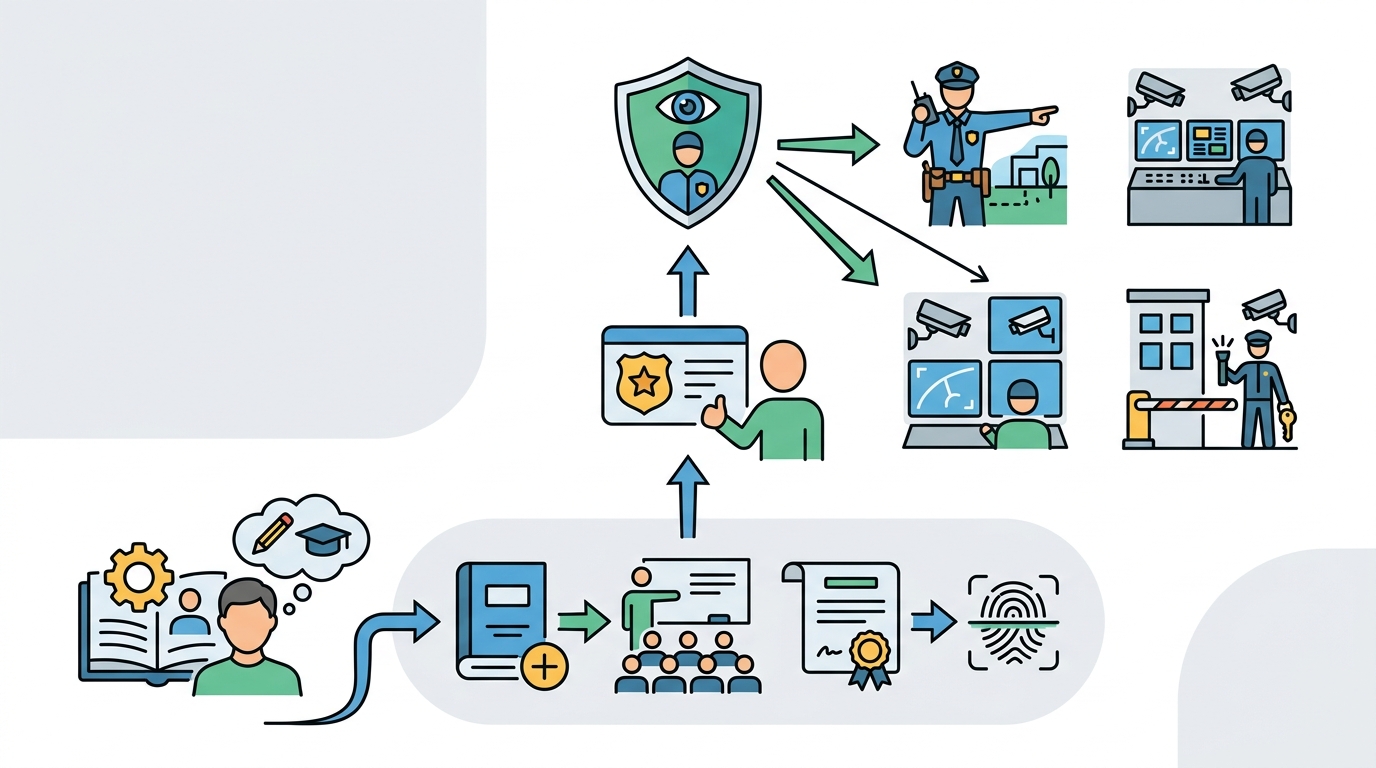
Becoming a licensed security guard usually means meeting a minimum age, passing a criminal background check and completing set training hours before a government body issues you a licence or registration. In the United States, most states require guards to be licensed by the state where they work (U.S. Bureau of Labor Statistics, 2026-08-27), and in Great Britain the Security Industry Authority issues the licence instead.
There is no single worldwide credential and no universal exam. What follows is the pattern that repeats across jurisdictions, with the specific rules of two named regulators — the California Bureau of Security and Investigative Services and the SIA — as worked examples of how the details differ.
Why This Credential Matters
A security guard licence is usually a legal condition of doing the work at all, not an optional extra that makes your application look stronger. In the United States, most states require that security guards be licensed by the state in which they work (U.S. Bureau of Labor Statistics, 2026-08-27), which means the regulator is a state body rather than a national one — in California, for example, it is the Bureau of Security and Investigative Services (BSIS), part of the Department of Consumer Affairs. In Great Britain the regulator is the Security Industry Authority, and you must hold the right licence-linked qualification before you can even apply for a security guard SIA licence (Security Industry Authority via GOV.UK, 2026-06-19).
The employers that care most are contract guarding companies, which supply officers to client sites and cannot bill for an unlicensed officer; in-house corporate and campus security departments; hospitals; shopping centres and retail chains; event and stadium operators; and casinos, where gambling surveillance work sits alongside guarding.
To a hiring manager, the licence signals three things that are expensive for them to check themselves: that you are of legal working age for the role, that a criminal history check has already been run on you by a government authority, and that you have been taught the limits of your powers. If you intend to carry a weapon, expect a separate authorisation — armed guards usually must be licensed by the appropriate government authority and face more stringent background checks and entry requirements than unarmed guards (U.S. Bureau of Labor Statistics, 2026-08-27).
Step-by-Step Path to Certification
- Confirm the regulator for your jurisdiction before you spend anything. Search for the state, provincial or national licensing body by name — the California Bureau of Security and Investigative Services, the Security Industry Authority, or the equivalent department of public safety, justice or consumer affairs where you live. Rules, training hours and fees are set by that body, not by employers.
- Check you meet the basic eligibility rules. The common baseline is being at least 18 years old, passing a background check and completing training (U.S. Bureau of Labor Statistics, 2026-08-27). The SIA also requires you to be 18 or over to hold a licence (Security Industry Authority via GOV.UK, 2026-06-19). Most regulators also expect a high school diploma or equivalent as typical entry-level education.
- Complete the required pre-licence training or qualification. In California this is the Power to Arrest training required for BSIS registration. In Great Britain it is an approved licence-linked qualification for the security guarding role, which you must hold before applying.
- Submit your fingerprints and consent to the criminal history check. California applicants undergo a criminal history background check through the California Department of Justice and the FBI. Expect to book a fingerprinting appointment and pay the fingerprint processing charge separately from the licence application.
- File the application and pay the fee. Submitting a BSIS security guard registration or renewal online through the BreEZe system can reduce processing time by up to two weeks compared with the Cashiering Office. With the SIA, the licence fee is not refundable if the application is unsuccessful, so check your qualification and identity documents before you pay.
- Finish any post-registration training within the deadline. Registered California security guards must complete thirty-two hours of training in security officer skills within the first six months of registration.
- Apply for an armed or specialist endorsement only if the job needs it. This is a separate authorisation with stricter entry requirements and a heavier background check, and employers will usually tell you which sites require it.
Exam and License Details
| Detail | Specification |
|---|---|
| Credential name | State or national security guard licence or registration — for example, a BSIS security guard registration in California, or an SIA security guarding licence in Great Britain |
| Qualifying assessment | No single national exam. California requires Power to Arrest training; the SIA requires a licence-linked qualification before you apply (Security Industry Authority via GOV.UK, 2026-06-19) |
| Minimum age | 18 years old (U.S. Bureau of Labor Statistics, 2026-08-27; SIA via GOV.UK, 2026-06-19) |
| Background check | Criminal history check — in California, through the California Department of Justice and the FBI |
| Post-registration training | 32 hours of security officer skills training within the first 6 months of BSIS registration |
| Continuing training | 8 hours annually for registered California security guards |
| Licence term | All SIA licences last 3 years, except a vehicle immobiliser licence, which lasts 1 year |
| Renewal deadline | A California registration not renewed within 60 days of expiration is cancelled and cannot be renewed |
| Fee structure | Set by the regulator, not the employer. The SIA charges a fee per licence, applies a 50% discount to each additional licence in the same application, and does not refund the fee if the application fails. Check the current amount on the regulator's own site (GOV.UK for the SIA; the state board's site in the US) |
| Processing time | Allow approximately 4-6 weeks for an initial BSIS security guard registration application, reduced by up to 2 weeks when filed online via BreEZe |
| Armed endorsement | Separate licence from the appropriate government authority, with more stringent background checks and entry requirements than unarmed guard licensing |
Realistic Timeline
- Month 1 — eligibility and paperwork. Confirm your regulator, check the age and background rules, and gather identity documents and proof of your high school diploma or equivalent. Book a fingerprinting appointment if your jurisdiction requires one.
- Month 1-2 — pre-licence training. Complete the required course: Power to Arrest training for a California BSIS registration, or the licence-linked qualification needed before an SIA security guard application. Short courses are often delivered over a few days; longer qualifications can run several weeks.
- Month 2 — apply and pay. Submit the application through the regulator's system — BreEZe for BSIS, the SIA's online account service in Great Britain — and pay the non-refundable fee.
- Month 2-3 — processing. Allow approximately 4-6 weeks for an initial BSIS registration to be processed, or up to 2 weeks less if you filed online rather than through the Cashiering Office.
- Month 3 — licence in hand, start applying. With the card or licence issued, apply to contract guarding firms, hospital and campus security departments, retail chains and event venues, which hire licensed officers continuously.
- Month 3-8 — post-registration training. California registrants complete 32 hours of security officer skills training within the first 6 months of registration; many employers deliver these hours on the job.
- Year 1 onward — stay current. California guards complete 8 hours of continuing training each year, and renewal must be filed on time, because a registration left unrenewed for more than 60 days past expiration is cancelled. SIA holders plan a renewal around the 3-year licence term.
From a standing start, three months to an active unarmed licence is a reasonable expectation in a jurisdiction with short mandated training; armed authorisation adds further weeks of training and vetting.
Frequently asked questions
Can I use my licence if I move to another state or country?
Generally no. Because most US states license guards individually (U.S. Bureau of Labor Statistics, 2026-08-27), moving across a state line usually means applying again to the new state's regulator and repeating its training and vetting. A British SIA licence has no standing in the US, and vice versa, so budget for a fresh application and a fresh fee wherever you relocate.
What will the whole process cost me?
There are normally three separate charges: the training course, the fingerprinting or criminal records check, and the licence fee itself. Only the regulator can tell you the current licence amount — GOV.UK publishes the SIA fee, and each US state board publishes its own. Ask the training provider for a written total before enrolling, since course prices are set by the provider rather than the regulator.
What happens if my background check turns up a conviction?
Decisions rest with the licensing authority, which reviews the record against its own suitability criteria rather than applying a blanket rule. Disclose everything the form asks for, because an undisclosed record found during vetting is treated more seriously than a disclosed one. Bear in mind that the SIA fee is not refundable if the application is unsuccessful, so it is worth reading the regulator's published criteria first.
Do I need a job offer before I apply for the licence?
In some jurisdictions the licence is personal to you and you can apply independently; in others an employer sponsors or holds it. Contract guarding companies frequently recruit candidates who are mid-application and will tell you which route applies locally. If an employer offers to pay the fee, confirm in writing whether you must repay it if you leave early.
Can I hold more than one type of security licence at once?
Yes, and it is often cheaper to combine applications. The SIA applies a 50% discount to each additional licence requested in the same application (Security Industry Authority via GOV.UK, 2026-06-19), so deciding early whether you also want door supervision or CCTV work can save money. Each additional licence still has its own qualification requirement.
Sources
- U.S. Bureau of Labor Statistics — Security Guards and Gambling Surveillance Officers : Occupational Outlook Handbook: : U.S. Bureau of Labor Statistics (2026-08-27)
- California Bureau of Security and Investigative Services (BSIS), Department of Consumer Affairs — Security Guard Registration - Bureau of Security and Investigative Services (2022-01)

Written by
Desmond writes about the mechanics of job searching: resumes, interviews, the long silence after applying. He's fascinated by how much of getting hired depends on luck dressed up as skill.


