
How to Become a Locksmith Without a Degree
Locksmithing is a trade you enter by training on the job; here's what counts in place of a diploma, which places license it, and how long entry takes.
Quick answer
- No degree is required: O*NET OnLine (U.S. Department of Labor) lists locksmiths and safe repairers as Job Zone 1-2, needing a high school diploma or GED plus a few days to one year of on-the-job training.
- A realistic no-degree timeline is 1 to 6 months of classroom or online training (Jobber Academy, undated) then an apprenticeship of 6 months to 2 years (FieldPulse, undated), with a state licence adding several more months.
- Carpentry, mechanical work and electronics experience transfer directly — the UK's National Careers Service names those skills for people applying straight to local locksmith companies as trainees.
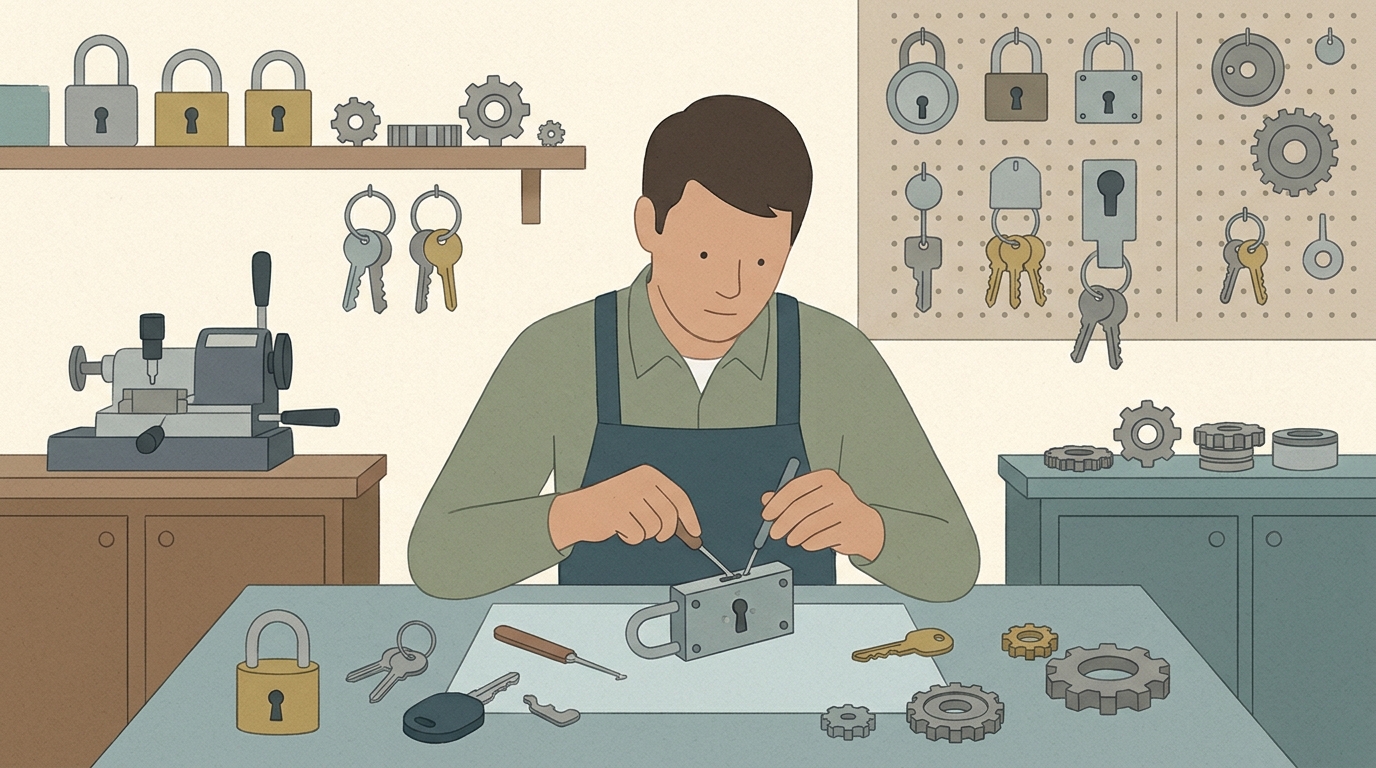
You do not need a degree to work as a locksmith. O*NET OnLine (U.S. Department of Labor) classifies locksmiths and safe repairers as Job Zone 1-2, usually requiring a high school diploma or GED plus a few days to one year of on-the-job training. What replaces a degree is supervised hours, a clean background check and, in some places, a licence or an industry certification.
The legal requirement is local, not universal. Roughly 15 U.S. states require a dedicated locksmith licence while most do not (StartPermit, 2025), and the formal requirement elsewhere ranges from none to a college diploma plus apprenticeship time (Wikipedia, undated). Check your own jurisdiction before you spend anything.
Who Successfully Makes This Transition
Three backgrounds move into locksmithing repeatedly, because the trade is taught by supervision rather than by lecture.
Carpenters, joiners and door or window installers. You already hang doors, chisel mortices and drill accurately into hardwood and steel frames. Most locksmith work is door hardware work: strikes, closers, mortice cases, multipoint locks. The National Careers Service (UK government) lists carpentry as useful practical experience for people applying directly to locksmith firms as trainees.
Vehicle technicians and auto electricians. Automotive locks, transponder keys and programming sit inside a lot of mobile locksmith revenue. If you have stripped door cards and used diagnostic software, a shop owner can put you on car work within weeks. ALOA Security Professionals Association offers roughly 35 elective examination categories for its entry-level certification (ALOA, undated), several of them automotive, so your prior trade converts into a credential.
Alarm, access control and electrical installers. Electronic access control and keyless entry run through registered apprenticeship outlines — New York State's time-based outline allots about 3,500 hours to locks, closers, doors and keyless entry (New York State Department of Labor, 2016). Electronics is named by the National Careers Service as a helpful entry route in the UK.
Eligibility matters as much as the trade skill: the baseline is being at least 18 and passing a criminal background check, with no strict formal education requirement, though many employers prefer trainees holding a high school diploma or GED (Ernie's Lock & Key, undated). You will hold keys to other people's homes, so a clean record counts for more than a transcript.
Traditional Path vs. Alternative Path
The "traditional" path here is rarely a university degree — it is a registered apprenticeship or college diploma route, which some countries require by law (Wikipedia, undated).
| Path | Time to Entry | Upfront Cost | Credential Required | Typical Starting Pay |
|---|---|---|---|---|
| Formal route: registered trade apprenticeship or mandated diploma | Alberta's locksmith apprenticeship runs three periods, each 1,560 hours on the job plus eight weeks of classroom instruction (Government of Alberta, Tradesecrets, undated) — about three years; New York State's time-based outline totals 8,000 hours plus related instruction (New York State Department of Labor, 2016) | Classroom fees, tools and exam fees; the employer carries the on-the-job cost because you are paid while training. Fee schedules sit on the provincial or state apprenticeship authority's site | Completion of the registered apprenticeship; Alberta names English 10-2 and Math 10-3 or a GED as minimum entrance requirements | Hourly apprentice pay from day one, stepped up by period, then a journeyperson rate. Check Job Bank and Statistics Canada, or your state apprenticeship agency, for current rates |
| Alternative route: trainee job plus certification | 1 to 6 months for a classroom or online training program, an apprenticeship of 6 months to 2 years, and several more months if a state licence is required (Jobber Academy, undated; FieldPulse, undated) | Tuition set by private training providers or a professional body such as the Master Locksmiths Association (National Careers Service, undated); ALOA membership dues, a prerequisite for certification eligibility (StartPermit, 2025); licensing, fingerprinting and insurance fees in states such as California, Texas, Illinois and New Jersey (ServiceAgent.ai, 2026) | None in most U.S. states — only about 15 require a locksmith licence (StartPermit, 2025); none in the UK. ALOA's CRL is voluntary but widely recognised | Hourly trainee pay, rising with certification, licence status and out-of-hours call-outs. Check the BLS Occupational Employment and Wage Statistics in the US, or the National Careers Service in the UK |
The difference is sequencing, not ceiling. On the formal route you enrol before you are competent; on the alternative route you are hired first and certified afterwards.
Step-by-Step Alternative Path
- Check what your jurisdiction requires, in writing. About 15 U.S. states require a locksmith licence and most do not, with local jurisdictions sometimes adding their own rules (StartPermit, 2025); California, Texas, Illinois and New Jersey require fingerprinting, insurance and background checks (ServiceAgent.ai, 2026). In New York City, anyone training under a licensed locksmith must hold a Locksmith Apprentice licence from the Department of Consumer and Worker Protection, and that training should not exceed 36 months (Workiz, undated).
- Clear the eligibility basics. Be 18 or over and able to pass a criminal background check, and get your high school diploma or GED if you do not hold one, since employers commonly prefer it even where it is not legally required (Ernie's Lock & Key, undated).
- Take a short entry-level course. A classroom or online locksmith training program runs 1 to 6 months (Jobber Academy, undated). In the UK, beginner to advanced courses come from private training providers and the Master Locksmiths Association (National Careers Service, undated). This gets you an interview, not a trade.
- Get taken on as a trainee or apprentice. The National Careers Service route is applying directly to local locksmith companies. In the U.S., look for registered apprenticeships through your state labor department; New Jersey allows licensure after three years of supervised work averaging at least 20 hours a week, or a two-year apprenticeship approved by the U.S. Department of Labor, plus a background check and exam (New Jersey Board of Examiners of Electrical Contractors, via Wikipedia).
- Log your hours by category. Registered outlines break the work down for you: roughly 4,000 hours on keys and locks, 3,500 on locks, closers, doors and keyless entry, and up to 500 on safes (New York State Department of Labor, 2016). Keep your own dated record — it is what a licensing board or new employer will ask for.
- Sit the ALOA Certified Registered Locksmith (CRL) exam. ALOA, founded in 1955, represents more than 6,000 locksmiths in the United States, Canada and elsewhere and runs the certification program (Wikipedia, undated). The CRL needs the mandatory exam plus two elective categories from roughly 35 (ALOA, undated); membership is a prerequisite (StartPermit, 2025).
- Stack credentials and keep them current. Certified Professional Locksmith requires 12 further electives at 70% or higher, and Certified Master Locksmith requires passing 90 percent of available elective categories (Stratford Career Institute Blog, citing ALOA requirements). Louisiana accepts ALOA certifications or a Department of Labor apprenticeship certificate as qualifying training and requires 24 hours of continuing education every three years at renewal (Locksmith Ledger International, 2024).
What to Have Ready Instead of a Degree
- A dated hours log, split the way registered apprenticeships split it: keys and locks, locks/closers/doors/keyless entry, and safes (New York State Department of Labor, 2016).
- Proof of supervised employment — payroll records or a signed employer letter. New Jersey counts three years of supervised work averaging at least 20 hours a week toward licensure (via Wikipedia, citing the New Jersey Board of Examiners of Electrical Contractors).
- An ALOA credential, CRL at entry, with your passed elective categories listed by name (Locksmith Ledger International, 2024).
- A clean criminal background check and fingerprint clearance, required in states including California, Texas, Illinois and New Jersey (ServiceAgent.ai, 2026).
- Your apprentice licence where one exists — New York City requires one to train under a DCWP-licensed locksmith (Workiz, undated).
- A high school diploma or GED certificate, preferred by many employers (Ernie's Lock & Key, undated) and named with English 10-2 and Math 10-3 as Alberta's apprenticeship entrance requirement (Government of Alberta, Tradesecrets, undated).
- A short photo portfolio: a master key system you charted, a mortice lock retrofit, a door closer adjustment, a safe opening, a transponder key programmed.
- Two trade references — the licensed locksmith who supervised you, plus a commercial customer or property manager.
- Course certificates from a private provider or the Master Locksmiths Association in the UK (National Careers Service, undated), plus a driving licence, hand tools and proof of insurance.
Frequently asked questions
Will employers take me seriously without a degree?
In most markets a degree is not part of the conversation. O*NET OnLine (U.S. Department of Labor) places locksmiths and safe repairers in Job Zone 1-2, and the preference employers express is for a high school diploma or GED (Ernie's Lock & Key, undated). What they scrutinise instead is whether you can be bonded, insured and trusted alone in a customer's property.
Is ALOA certification worth getting if my state does not license locksmiths?
Yes, because it is the only portable signal of competence you have. Louisiana treats ALOA certifications as qualifying training for licensure (Locksmith Ledger International, 2024), so moving to a regulated state does not mean starting over. It also reassures commercial and institutional customers before they hand over a master key system.
Does the no-degree route pay less?
Earnings track your licence status, certifications and the type of work — emergency call-outs, automotive and commercial access control are priced differently from domestic lock changes. There is no separate pay scale for degree holders in this trade. For current figures, check the Occupational Employment and Wage Statistics from the U.S. Bureau of Labor Statistics, the National Careers Service in the UK, or Job Bank in Canada.
Can I work in another country on the same training?
Not automatically — the legal education requirement ranges from none at all to an employer training certificate to a full engineering-college diploma plus apprenticeship time, depending on the country (Wikipedia, undated). Check the licensing or trade authority in the destination and ask whether your hours and certifications are recognised. Who may legally work there is a matter for the relevant official authority.
Sources
- O*NET OnLine (U.S. Department of Labor) — 49-9094.00 - Locksmiths and Safe Repairers
- ALOA Security Professionals Association — ALOA Certification

Written by
Wyatt covers work outside the office: construction, logistics, repair, and the people who keep things running. He's skeptical of career advice that assumes everyone sits at a desk.


