How to Become a Radiologic Technologist
Imaging work sits behind a two-year accredited degree, a credential exam and a state licence in most places — here is the order to tackle them in.
Quick answer
- The fastest common route in the United States is a two-year accredited associate's degree in radiography, then the ARRT primary eligibility pathway, which covers education, ethics and examination requirements (American Registry of Radiologic Technologists).
- Typical entry-level education is an associate's degree, and new hires are reported to need an associate's or other 2-year degree (U.S. Bureau of Labor Statistics, 2025; O*NET OnLine, 2025); expect about two to two and a half years from first class to first job.
- Certification is effectively mandatory in practice: most states require radiologic technologists to be licensed or certified, and employers typically require or prefer certified technologists regardless of state rules (U.S. Bureau of Labor Statistics, 2025).
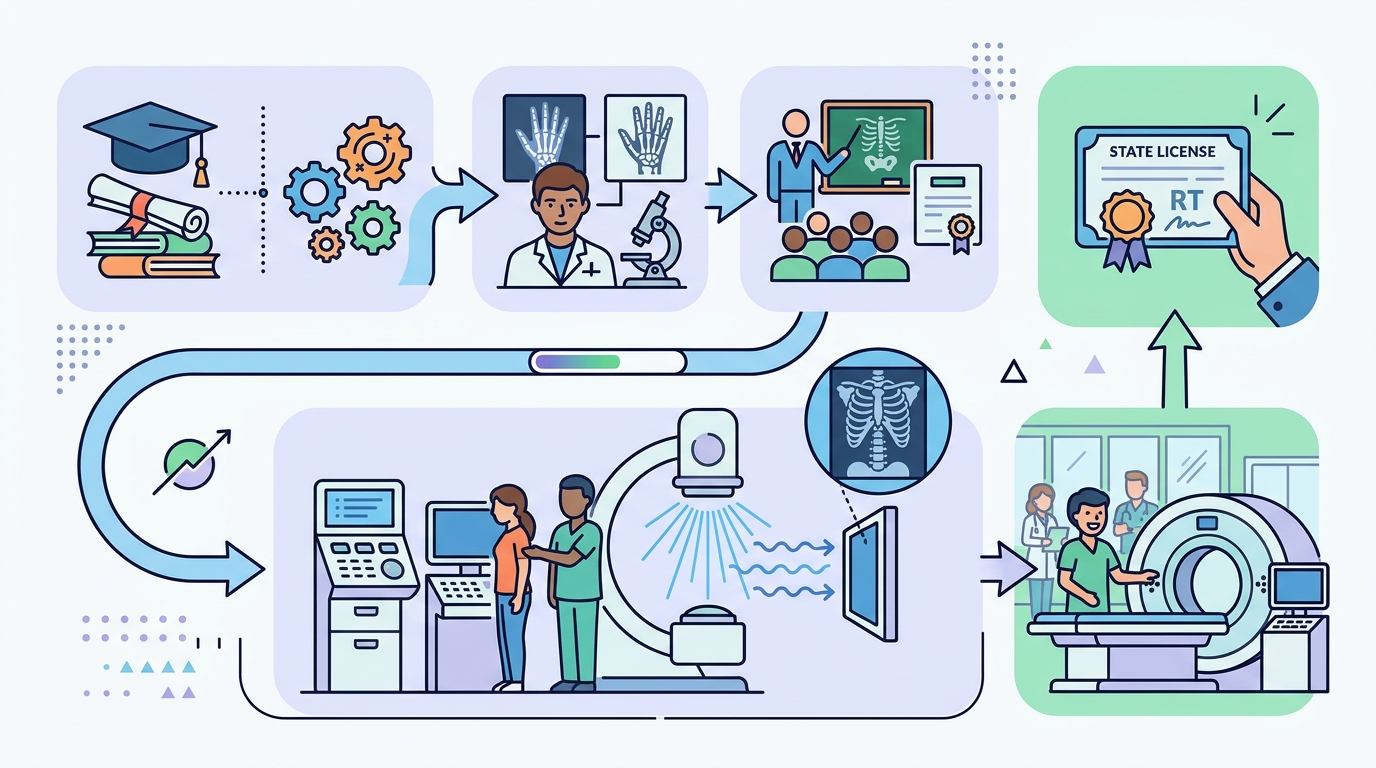
Radiologic technologists produce X-ray and other diagnostic images, positioning patients and equipment, operating computerised imaging systems and keeping detailed patient records (U.S. Bureau of Labor Statistics, 2025). In the United States, the typical entry-level education is an associate's degree (U.S. Bureau of Labor Statistics, 2025), followed by certification — most commonly ARRT certification and registration in Radiography — and a state licence, which most states require (U.S. Bureau of Labor Statistics, 2025).
Plan on roughly two years of accredited study plus a few months for the ethics review, exam and licence application before you start work. Outside the United States, imaging practitioners are registered through national or state regulators, so check the registration body that covers the country you intend to work in before you enrol anywhere.
What This Job Involves Day to Day
Most of the job happens in an imaging room with a patient in front of you and a worklist that does not stop. Radiologic technologists and technicians held about 234,200 jobs in 2025, with 60% of them in hospitals — state, local and private (U.S. Bureau of Labor Statistics, 2025) — so shift work, weekends and on-call rotations are common, alongside roles in physicians' offices and outpatient imaging centres.
Four tasks fill most of a shift:
- Positioning patients and equipment so the requested anatomy appears correctly on the image, then adjusting and maintaining the imaging equipment itself (U.S. Bureau of Labor Statistics, 2025).
- Operating computerised imaging equipment and processing exposed radiographs, checking each image for diagnostic quality before the radiologist reads it (U.S. Bureau of Labor Statistics, 2025; O*NET OnLine, 2025).
- Explaining the procedure and observing the patient throughout the scan to keep them safe and comfortable, including preparing contrast material or radiopharmaceuticals under a radiologist's direction (O*NET OnLine, 2025).
- Keeping detailed patient records of what was imaged, how and with what settings (U.S. Bureau of Labor Statistics, 2025).
Radiation safety is part of the routine, not an add-on. Technologists must wear badges that measure radiation exposure levels, and detailed records are kept of cumulative lifetime dose (U.S. Bureau of Labor Statistics, 2025). Expect a lot of standing, lifting and transferring patients, and a lot of short, repeated explanations to people who are anxious or in pain.
Step-by-Step Path to Get Started
- Finish secondary school with maths, biology and physics where you can — 1 to 2 years if you are still studying. Accredited radiography programmes are competitive on prerequisite science grades, and anatomy and physiology will reappear immediately in year one.
- Enrol in an accredited radiography programme leading to an associate's degree — about 2 years full time. Typical entry-level education for this occupation is an associate's degree (U.S. Bureau of Labor Statistics, 2025), and new hires are reported to need an associate's or other 2-year degree (O*NET OnLine, 2025). Before you pay a deposit, confirm the programme meets the education requirements of the ARRT primary eligibility pathway (American Registry of Radiologic Technologists).
- Complete the didactic and clinical competency requirements during the programme — spread across the full 2 years. The ARRT publishes Didactic and Clinical Competency Requirements setting out the coursework and the clinical procedures you must document for the Radiography credential (American Registry of Radiologic Technologists). Keep your competency log current each term; reconstructing it at the end is slow and often impossible.
- Obtain CPR or basic life support (BLS) certification — a one-day course, renewed every 2 years. Employers may require or prefer that prospective technologists hold CPR or BLS certification (U.S. Bureau of Labor Statistics, 2025). Many hospitals will not let you start clinical placement without it, so do it in your first term.
- Apply for ARRT certification and registration in Radiography through the primary eligibility pathway — allow 2 to 3 months around graduation. The pathway covers education, ethics and examination requirements (American Registry of Radiologic Technologists). The ethics requirement includes a review of any criminal or disciplinary history, and a pre-application ethics review can be submitted earlier if you have something to declare.
- Sit the ARRT Radiography examination — scheduled within the eligibility window set when your application is approved. Study time of 6 to 10 weeks alongside final-year clinical hours is realistic for most candidates.
- Apply for a state licence where your state requires one — typically 4 to 8 weeks for processing. Most states require radiologic technologists to be licensed or certified, and to be licensed you usually must graduate from an accredited programme and either pass a state certification exam or obtain certification from a credentialing organisation (U.S. Bureau of Labor Statistics, 2025). Few states require licensure for MRI technologists, and requirements differ state by state, so check your own state's radiation control or health department board directly.
- Apply to hospitals first, then outpatient imaging — 1 to 3 months of applications. With 60% of jobs in hospitals (U.S. Bureau of Labor Statistics, 2025), your clinical placement site is the single most useful application you will send. Expect on-the-job training after hire (U.S. Bureau of Labor Statistics, 2025); the occupation sits in Job Zone Three, where employees usually need one or two years of training combining on-the-job experience and informal training with experienced workers (ONET OnLine, 2025). Once you are working, add a modality over 6 to 18 months through a Registered Apprenticeship title recognised for this occupation and approved by the U.S. Department of Labor, such as Computed Tomography (CT) Technician or Mammography Technologist (ONET OnLine, 2025).
Education, Certification, and Cost Requirements
Published prices change every intake and differ sharply between in-district community colleges, out-of-state students and private programmes, so check the figure at the source before you budget. The column below tells you exactly which page to read.
| Requirement | Where to Get It | Typical Cost | Typical Time |
|---|---|---|---|
| Associate's degree in radiography (accredited) | Community colleges, technical colleges and hospital-based schools offering programmes that meet ARRT education requirements | Per-credit tuition plus uniform, badge and liability fees, listed on each college's published tuition schedule; in-district rates at public community colleges are the lowest band | 2 years full time |
| ARRT Didactic and Clinical Competency Requirements | Completed inside your radiography programme and documented by your programme director | Included in programme tuition | Spread across the 2-year programme |
| CPR / basic life support (BLS) certification | Hospital education departments and accredited training providers used by your clinical site | Course fee set by the training provider; ask your clinical coordinator which provider the hospital accepts | 1 day; renew every 2 years |
| ARRT certification and registration in Radiography (primary eligibility pathway) | American Registry of Radiologic Technologists | Application fee published by the ARRT; university radiography programmes also list it in their programme financial information (UNC School of Medicine, Department of Radiologic Science) | 2 to 3 months from application to results |
| State licence or state certification exam | Your state's radiologic health, radiation control or health professions board | Application and licence fee set by each state board | 4 to 8 weeks processing |
| Post-primary modality (CT, mammography) | Registered Apprenticeship titles approved by the U.S. Department of Labor, including Computed Tomography (CT) Technician and Mammography Technologist (O*NET OnLine, 2025), or employer-sponsored training | Often employer-funded when done as an apprenticeship | 6 to 18 months |
Before You Apply
Have these ready before you send the first application, not after an interview invitation:
- Your ARRT credential number, or a dated statement of your exam date and eligibility window if results are pending. Employers typically require or prefer to hire technologists who are certified, regardless of state licensing requirements (U.S. Bureau of Labor Statistics, 2025).
- Your state licence number, or confirmation that your state does not require one for radiography — written where the recruiter can see it, on the first line under your name.
- Your clinical competency record: the list of procedures you documented under the ARRT Didactic and Clinical Competency Requirements, with totals by exam type (chest, extremity, spine, trauma, portable, theatre).
- A one- to two-page resume in reverse-chronological order with a modality line: equipment and systems you have used, including the radiography units, PACS and RIS at your clinical site.
- Current CPR or BLS card with the expiry date, scanned.
- Immunisation and health screening records — typically hepatitis B, MMR, varicella, TB screening and annual flu — which hospital occupational health departments check before your start date.
- Criminal background check clearance and drug screen consent, since the ARRT ethics requirement and hospital credentialing both review this.
- Your radiation dose history if you have already worked in a monitored role. Badges measuring exposure are mandatory and cumulative lifetime dose records follow you between employers (U.S. Bureau of Labor Statistics, 2025).
- Two clinical references: your programme's clinical coordinator and a lead technologist from the department where you placed.
- Availability in writing for nights, weekends and on-call, since most openings are in hospitals (U.S. Bureau of Labor Statistics, 2025).
Frequently asked questions
Can I qualify without an associate's degree?
Some hospital-based certificate programmes also meet the ARRT education requirement, and they are usually the route for people who already hold a degree in another field. For everyone else, an associate's or other 2-year degree is what new hires are reported to need (O*NET OnLine, 2025). Confirm with the ARRT that any programme you are considering satisfies its education requirement before enrolling.
How long from starting the programme to a first paid shift?
Budget two years of full-time study, then about three months for the certification application, exam and any state licence processing, then a month or two of applications. That puts most people at roughly two and a half years. Applying to your clinical placement department while still enrolled is what usually compresses the last stage.
Do I still need certification if my state does not licence radiographers?
In practice, yes. Employers typically require or prefer certified technologists regardless of what the state demands (U.S. Bureau of Labor Statistics, 2025), and an uncertified applicant is competing against a credentialed one for the same vacancy. Certification also travels if you move to a state that does regulate the role.
What should I expect to spend overall?
The three cost blocks are programme tuition, the ARRT application fee and your state licence fee, plus smaller charges for uniforms, dosimetry badges, immunisations and the background check. Get the tuition number from the college's published fee schedule for your residency status, the exam fee from the ARRT, and the licence fee from your state board. University programmes often publish a full itemised list in their programme financial information (UNC School of Medicine, Department of Radiologic Science).
Does training continue after I am hired?
On-the-job training is typically required after hire (U.S. Bureau of Labor Statistics, 2025), and the occupation sits in Job Zone Three, where one or two years of combined on-the-job experience and informal training with experienced workers is normal (O*NET OnLine, 2025). Expect several weeks shadowing on each room and modality before you work unsupervised. Credential maintenance through continuing education runs for the rest of your career.
How do I move into CT or MRI later?
Most technologists add a modality while employed, often by cross-training in their own department during quieter shifts. Registered Apprenticeship titles approved by the U.S. Department of Labor include Computed Tomography (CT) Technician and Mammography Technologist (O*NET OnLine, 2025). Note that few states require licensure for MRI technologists specifically, and the requirements differ by state (U.S. Bureau of Labor Statistics, 2025).
Sources
- U.S. Bureau of Labor Statistics — Radiologic and MRI Technologists : Occupational Outlook Handbook (2025)
- O*NET OnLine (U.S. Department of Labor) — 29-2034.00 - Radiologic Technologists and Technicians (2025)

Written by
Marisol steers Jobladderhq's coverage of hiring trends and the strange rituals of modern recruiting. She's drawn to the gap between what job ads promise and what the work actually feels like. Her editing hand favors clarity over jargon, always.