How to Become an Occupational Therapist
Occupational therapy mixes clinical reasoning with hands-on work — here is the training, supervised fieldwork, exam and licensing reality behind the role.
Quick answer
- Minimum credential: an entry-level occupational therapy degree from an ACOTE-accredited program is required to sit the OTR certification exam (NBCOT, undated).
- Fastest route into the field is the assistant pathway — an ACOTE-accredited occupational therapy assistant program qualifies you for the COTA exam (NBCOT, 2025).
- Typical timeline: around 6 to 7 years from school leaving to licensed practice as a therapist, including supervised fieldwork — one licensure chart entry sets a minimum of 928 hours (Nebraska Department of Health and Human Services, compiled with AOTA State Affairs Group data, undated).
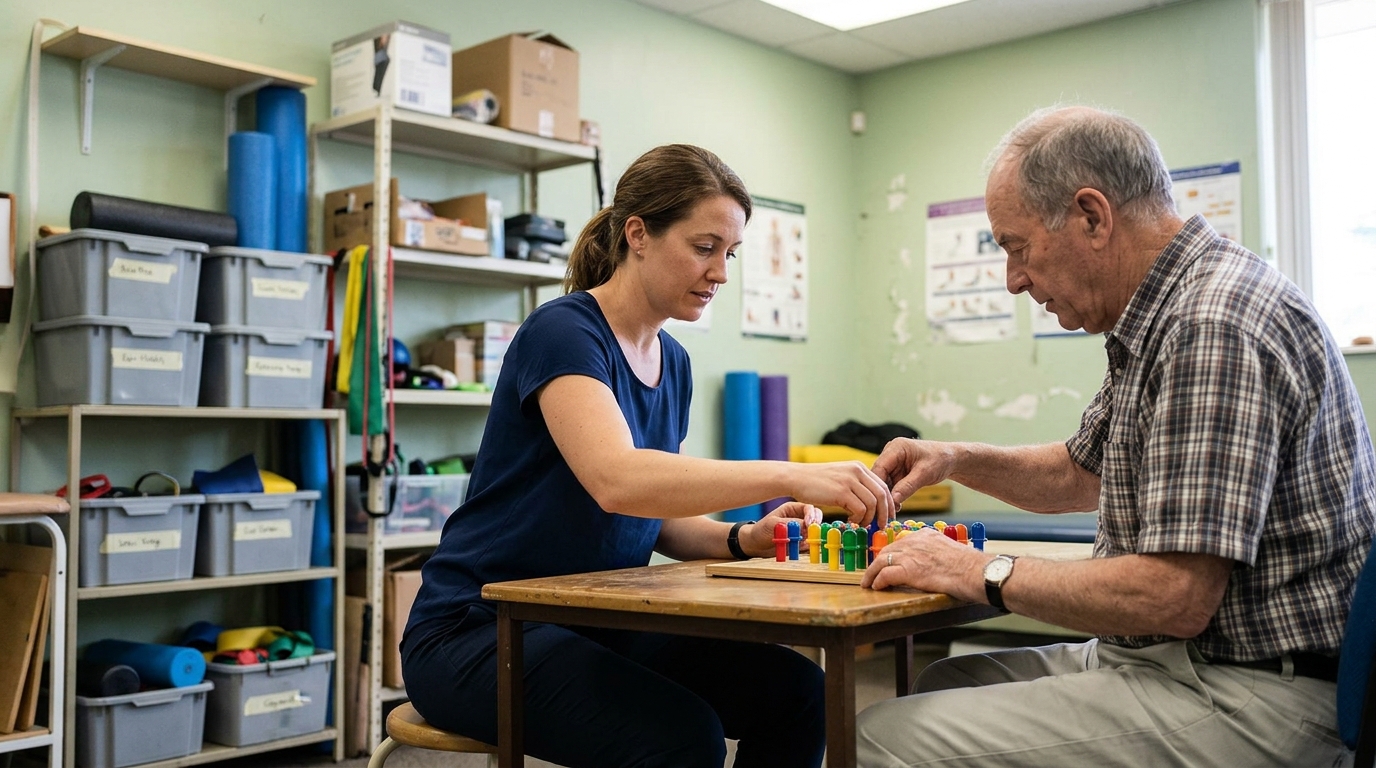
Becoming an occupational therapist means completing an accredited entry-level occupational therapy degree, finishing a long block of supervised fieldwork, passing a national certification exam and then registering or licensing with the authority that governs practice where you want to work. In most countries that is a four-to-seven year path from the start of undergraduate study, depending on whether you enter at master's or doctoral level.
The detail varies by country and, in federal systems, by state or province. The route below describes the widely used certification model administered in the United States by the National Board for Certification in Occupational Therapy, and flags where you should check your own regulator instead.
Is This Career Right for You?
The work is physical more often than people expect. You transfer patients from bed to chair using a gait belt or sling hoist, kneel on the floor during paediatric play-based sessions, carry assessment kits and adaptive equipment between home visits, and spend long stretches standing. Lifting limits, back strain and your own tolerance for close physical contact are all worth weighing honestly before you commit to years of study.
Hours depend on the setting. Hospital and inpatient rehabilitation posts can include weekend, holiday and on-call rotations. School-based practice follows the academic calendar and usually keeps weekday hours. Home health and community roles mean driving between addresses in all weather, working alone, and adapting to kitchens and bathrooms that were never designed for therapy.
The pressure points are specific: productivity targets in private rehabilitation settings, documentation deadlines in electronic health records that often spill past the end of a shift, and caseloads where progress is slow or a client declines. Working with people in pain, grief or cognitive decline asks for emotional steadiness.
It suits people who like problem-solving with their hands, who can hold a plan loosely when a client has a bad day, and who want to work with the same people over weeks rather than minutes. It suits poorly anyone who needs predictable sitting-down desk work, dislikes writing detailed notes, or wants a role with no lifting or personal care.
Steps to Becoming an Occupational Therapist
- Get observation hours in at least two settings (a few weeks to a few months). Most entry-level programs ask for documented hours shadowing a qualified therapist. Doing this in a hospital and a school or community service shows you what the job is really like and strengthens an application. Usually unpaid.
- Complete prerequisite undergraduate study (typically 3–4 years). Anatomy, physiology, psychology, human development and statistics are the common requirements. Cost depends entirely on the country and institution; check published tuition before you commit.
- Enrol in an ACOTE-accredited entry-level occupational therapy program (about 2–3 years). Candidates for the OTR certification exam must graduate from an ACOTE-accredited OT program (National Board for Certification in Occupational Therapy (NBCOT), undated). If you are aiming for the assistant role instead, the COTA exam requires an entry-level degree from an ACOTE-accredited occupational therapy assistant program (NBCOT, 2025).
- Complete supervised fieldwork (around 6 months full time). One state licensure chart entry requires a minimum of nine hundred twenty-eight (928) hours of supervised fieldwork as determined by the supervising institution, organization or sponsor, while another entry sets a minimum of 6 months for therapists and 2 weeks or 140 hours for assistants (Nebraska Department of Health and Human Services, compiled with AOTA State Affairs Group data, undated). Some jurisdictions also require verification of at least 60 hours of occupational therapy service in your fieldwork documentation (Nebraska Department of Health and Human Services, 2024).
- Apply for the certification exam yourself (allow 2–3 months). Once submitted, an NBCOT exam application is valid for 90 days, and the Authorization to Test letter is active for 90 days, during which you must test (NBCOT, 2025). Submit it personally: applications completed or submitted by third parties such as family members, recruiters, program directors, fieldwork coordinators or professors are not valid, and the candidate is deemed ineligible for three months with application fees forfeited (NBCOT, 2025).
- Sit the exam. Pearson is NBCOT's exclusive test administration partner for scheduling and taking the certification exam (NBCOT, 2025). Arrive 30 minutes before your appointment and bring two forms of identification — one primary and one secondary, or two primary IDs (NBCOT, 2025).
- Apply for a licence or registration before you practise. Requirements are set state by state in the United States and nationally elsewhere; expect to supply transcripts, fieldwork verification and exam results, and to pay an application fee set by the regulator. Confirm the current fee and processing time with the authority directly.
- Take an entry-level post and build caseload skills (first 1–2 years). New graduates typically carry a smaller caseload, work under mentorship, and focus on routine assessment and treatment — grading self-care tasks, fitting adaptive equipment, documenting sessions. Experienced therapists take on complex or high-acuity cases, supervise occupational therapy assistants and students, fabricate custom orthoses, lead home-modification recommendations and sit on multidisciplinary planning meetings.
- Specialise or move into leadership (3+ years in). Common directions include hand therapy, paediatrics, neurological rehabilitation, mental health, fieldwork education, clinical lead roles and research. Advanced certifications, where they exist, are awarded by professional bodies and carry their own fees and practice-hour thresholds.
Education and Certification Options
| Path | Typical time | Approximate cost | Required or preferred |
|---|---|---|---|
| ACOTE-accredited entry-level master's in occupational therapy | About 2–3 years after a bachelor's degree | Tuition varies widely by institution and country — check the program's published fees | Required to sit the OTR certification exam (NBCOT, undated) |
| ACOTE-accredited entry-level doctoral program (OTD) | About 3 years after a bachelor's degree, including a doctoral capstone | Higher than master's at most institutions; confirm with the program | Also satisfies the OTR exam requirement for an ACOTE-accredited entry-level degree (NBCOT, undated); preferred rather than required by many employers |
| ACOTE-accredited occupational therapy assistant (OTA) program | Commonly about 2 years | Usually the lowest-cost accredited route; check the college's fee schedule | Required for the COTA exam (NBCOT, 2025); does not qualify you for the therapist exam |
| Occupational Therapist Eligibility Determination (OTED) review for internationally educated applicants | Add several months to your timeline for document review | Review fees are set by NBCOT; check the current schedule | Required if your entry-level master's or doctoral degree was not earned at a U.S.-accredited college or university (NBCOT, undated) |
| Exam administration and admin fees | Application valid 90 days; ATT letter active 90 days (NBCOT, 2025) | $35 USD for a duplicate MyNBCOT account; $35 USD per Score Transfer or Eligibility Confirmation Notice request; $115 USD to reissue an ATT letter after a no-show, arrival more than 15 minutes late, or cancellation within 48 hours (NBCOT, 2025) | Required to test |
| On-the-job training with no accredited degree | n/a | n/a | Not a valid route to therapist certification — the accredited entry-level degree is mandatory (NBCOT, undated) |
Where to Find Occupational Therapist Jobs
- Your national professional association's job board. In the United States, the American Occupational Therapy Association and its State Affairs Group also publish licensure information alongside member resources; elsewhere, the equivalent national association usually runs a vacancies page and a special-interest network.
- Hospital and health system career portals. Acute care, inpatient rehabilitation and outpatient clinics post directly rather than through aggregators, and many ring-fence new-graduate rotations.
- School districts and education authorities. School-based occupational therapy posts are usually advertised through the education employer's own HR portal on an academic-year hiring cycle.
- Skilled nursing, aged care and long-term care operators. These employers hire therapists and occupational therapy assistants in volume and often advertise site by site.
- Home health and community rehabilitation agencies. Caseloads are geographic, so look for agencies covering the area you can realistically drive.
- Travel and locum therapy staffing agencies. Short contracts in under-served areas, often with relocation support; verify that the licence or registration you hold covers the jurisdiction before signing.
- University fieldwork networks and clinical educators. Many first jobs come from a fieldwork placement site. Tell your fieldwork coordinator and practice educators where you want to work before you graduate.
- Regulator and certification directories. Your licensing authority's verification tools and NBCOT's certificant resources are used by employers to check standing; keeping your record current makes you easier to hire.
Frequently asked questions
What does it actually cost to get certified, beyond tuition?
The exam application and administrative fees are separate from your degree. NBCOT charges $35 USD if you create a duplicate MyNBCOT online account, $35 USD each for a Score Transfer or Eligibility Confirmation Notice request after your application is submitted, and $115 USD to reissue an Authorization to Test letter after a no-show, arriving more than 15 minutes late, or cancelling or rescheduling within 48 hours of the exam (NBCOT, 2025). Budget separately for your state or national licence application fee, which the regulator sets.
How long does the whole path take?
Plan on roughly six to seven years from starting undergraduate study to practising as a licensed therapist: three to four years of prerequisite study, two to three years in an ACOTE-accredited entry-level program, and around six months of supervised fieldwork, with one licensure chart entry setting a minimum of 928 hours (Nebraska Department of Health and Human Services, compiled with AOTA State Affairs Group data, undated). After graduation, the exam application is valid for 90 days and the Authorization to Test letter for another 90 days (NBCOT, 2025), so the certification stage is usually a matter of months, not years.
I trained outside the United States. Can I still certify there?
Candidates who did not earn an entry-level master's or doctoral degree in occupational therapy from a U.S.-accredited college or university must apply through the Occupational Therapist Eligibility Determination (OTED) process (NBCOT, undated). That adds a document review stage before you can apply to test. Immigration status and work authorisation are separate matters handled by other authorities, not by the certification body.
Can my university or a recruiter submit my exam application for me?
No. Exam applications completed or submitted by third parties — including family members, recruiters, program directors, fieldwork coordinators and professors — are not valid, and the candidate is deemed ineligible for three months with application fees forfeited (NBCOT, 2025). Complete and submit everything from your own account, and bring two forms of identification, one primary and one secondary or two primary IDs, to the test centre 30 minutes before your appointment (NBCOT, 2025).
How should I research pay before committing?
Occupational therapy pay is usually structured as a salary in hospitals, schools and public health services, and as an hourly rate or per-visit rate in home health, contract and travel work, sometimes with productivity bonuses. Rates differ sharply by setting, jurisdiction and whether you are certified as a therapist or an assistant. Check your national statistics agency's current occupational earnings data and your professional association's most recent workforce survey, and compare against live advertised rates in the specific region you plan to work.
Sources
- National Board for Certification in Occupational Therapy (NBCOT) — Get Certified
- NBCOT — NBCOT Certification Examination Handbook for OTR and COTA Candidates (2025)

Written by
Noor writes personal essays and interviews about career changes, burnout, and starting over. She's interested in the stories people tell themselves about what a job is supposed to mean.