How to Get Your ASE Certification
ASE tests are open before you finish the hands-on hours, but the certificate only arrives once your work experience is on file — here is the order to do it in.
Quick answer
- ASE sets no minimum schooling, but certification requires documented work experience — 1, 2 or 3 years as a Repair Technician, or 2 years as a Parts Specialist, Collision Damage Estimator or Service Consultant (ASE, undated), with formal training substituting for part of it.
- Tests are named by series and area, such as A1 – Engine Repair (45 scored questions) and A6 – Electrical/Electronic Systems (50 scored questions) (ASE, 2026-08-19), and the pass mark is a scaled score of 70 (Easy Prep, undated).
- ASE is a United States credential: technicians must retest every five years to stay certified (ASE, 2026-08-19), and in Canada a valid provincial automotive trade certificate counts as evidence of the Repair Technician experience requirement (ASE, undated).
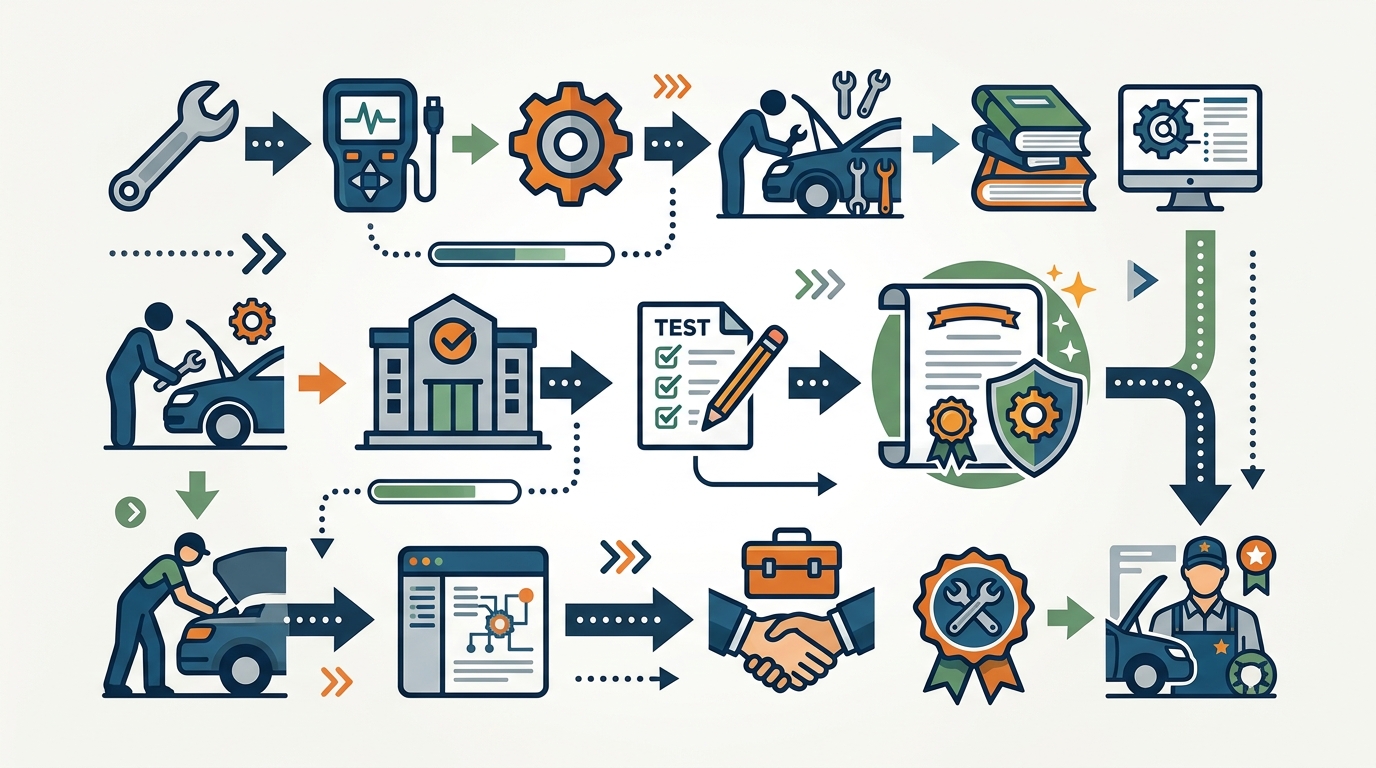
ASE certification is a voluntary, test-based credential for automotive technicians, parts specialists, service consultants and collision estimators, awarded by ASE, the National Institute for Automotive Service Excellence, a non-profit formed on June 12, 1972 (Wikipedia, undated). To earn it you register for specific tests such as A1 – Engine Repair, pass them, and document the required hands-on work experience.
Tests are sat at a Prometric test center or online from home or work, registration runs in fixed seasonal windows, and every certification must be renewed by retesting every five years (ASE, undated).
Why This Credential Matters
ASE certification is issued by ASE, the National Institute for Automotive Service Excellence, a United States non-profit established on June 12, 1972 (Wikipedia, undated). It is not a government licence. No state issues it, and passing an ASE test does not by itself let you do anything you could not do before — it is an industry-wide signal that you have been tested against a common standard.
That signal matters most where a hiring manager cannot watch you work before deciding. New-car dealership service departments, independent repair shops, national tyre and service chains, municipal and delivery fleet maintenance departments, and collision and refinish shops all commonly use ASE status in job adverts, pay tiers and shop marketing. Many shops advertise how many ASE-certified technicians they employ, which is why the credential tends to sit in promotion and pay-grade structures rather than in minimum hiring rules.
The headline status is Master Automobile Technician, awarded to technicians certified in tests A1 through A8; A9 – Light Vehicle Diesel Engines is not required for it (ASE, 2026-08-19). Parallel series cover other trades, including the Collision Repair and Refinish (B series) tests, which carry the same five-year retest cycle (ASE, undated).
Pay is not set by ASE. Technician earnings are usually structured as an hourly rate, a flat-rate (per billed hour) system, or a base plus productivity bonus, and they move with employer type, region and the certifications you hold. For current figures, check the Bureau of Labor Statistics in the United States, or Statistics Canada if you work in Canada.
Step-by-Step Path to Certification
- Work out which experience route you are on. ASE lets candidates claim experience as a Repair Technician for 1, 2 or 3 years, or as a Parts Specialist, Collision Damage Estimator or Service Consultant for 2 years (ASE, undated). Relevant formal training — a secondary or post-secondary automotive programme, or manufacturer training — can be substituted for part of the requirement (ASE, undated). In Canada, a valid provincial automotive trade certificate is accepted as evidence of the Repair Technician 1-year and 2-year requirements (ASE, undated).
- Choose your tests. Pick the areas you actually work in, such as A1 – Engine Repair or A6 – Electrical/Electronic Systems, and decide whether you are building toward Master Automobile Technician status, which needs A1 through A8 (ASE, 2026-08-19). The Advanced Level tests L1 to L4 are separate and priced differently.
- Create a myASE account and register inside a window. The 2026 windows are Winter (January 10 to March 31), Spring (April 10 to June 30), Summer (July 10 to September 30) and Fall (October 10 to December 31) (ASE, 2026).
- Pay the registration and test fees. ASE charges a $34 registration fee per order, with general certification tests at $62 each and Advanced Level tests L1 to L4 at $124 each (ASE, undated). Ordering several tests at once means paying the $34 once rather than per test.
- Pick how you will sit the test: in-person at a Prometric test center, online remote testing at home or work if you are eligible, or the ASE Renewal App for recertifying A-Series certifications (ASE, undated).
- Prepare with the official ASE Study Guide for each area, which lists the task areas and question counts, and work through live repairs in those systems at your shop so the scenarios are familiar.
- Pass, then complete the experience file. You need a scaled score of 70 to certify (Easy Prep, undated). You may register and sit tests — except X1 — before finishing the required work experience, but no certification or certificate is issued until that requirement is fulfilled (ASE, undated), so submit your documentation as soon as you qualify.
Exam and License Details
| Detail | Specification |
|---|---|
| Exam names | Series tests by area, e.g. A1 – Engine Repair and A6 – Electrical/Electronic Systems; A1–A8 together give Master Automobile Technician status (ASE, 2026-08-19) |
| Number of questions | 45 scored questions on A1; 50 scored questions on A6 (ASE, 2026-08-19) |
| Passing score | Scaled score of 70 (Easy Prep, undated) |
| Registration fee | $34 per order, however many tests are in that order (ASE, undated) |
| Test fees | $62 per general certification test; $124 per Advanced Level test, L1 to L4 (ASE, undated) |
| Retake policy | Register again in myASE during an open window and pay again — $34 per order plus $62 for a general test (ASE, undated) |
| Renewal requirement | Retest every five years; recertification tests A1R–A9R and B2R–B5R are about half the length of the initial tests (ASE, 2026-08-19 and undated) |
| Recertification cost cap | Capped at $186 of tests per order, so $220 maximum including the registration fee (ASE, undated) |
| Renewal App option | $52 annually for technicians certified in A1–A9, one recertification question per area per month (ASE, undated) |
| Testing formats | Prometric test center, online remote testing for eligible candidates, or the ASE Renewal App (ASE, undated) |
Realistic Timeline
This assumes you are already working in a shop, or starting a job alongside study. The pace is set by the experience requirement and by which registration window is open when you begin.
- Month 1: Confirm which experience category you are claiming and how much you already have. Gather pay records, employer letters, training certificates or — in Canada — your provincial automotive trade certificate. Open a myASE account.
- Month 1–2: Choose your first one or two tests. Most technicians start with the area they touch daily, such as A6 – Electrical/Electronic Systems, rather than attempting A1 through A8 at once. Download the matching ASE Study Guide and study 3 to 5 hours a week.
- Month 2–3: Register and pay during the open window — Winter, Spring, Summer or Fall in 2026 (ASE, 2026) — then book a Prometric slot or set up remote testing.
- Month 3–4: Sit the test. Results tell you whether you reached the scaled score of 70 (Easy Prep, undated). If you fall short, re-register in the next window.
- Month 4–12: Add two or three more tests per registration window if Master Automobile Technician status is the goal, grouping them in one order to pay the $34 registration fee once (ASE, undated).
- Month 12–36: Finish the work experience you are claiming, and expect certificates once that documentation is accepted (ASE, undated). If the A1–A8 set is complete by then, Master Automobile Technician status follows (ASE, 2026-08-19).
- Month 60: Recertify, either through the shorter A1R–A9R tests or by subscribing to the ASE Renewal App at $52 a year (ASE, undated).
Frequently asked questions
Is ASE certification a legal requirement anywhere?
ASE is an industry credential from a private non-profit, not a licence granted by a state, province or national government. Separate state-level permits can apply to specific activities such as emissions or safety inspections, and those are handled by state motor vehicle or environmental agencies. Check directly with the agency in the state where you work to see what applies to your role.
Can I get my money back if I register and then cannot sit the test?
ASE refunds any untaken, unexpired test that is cancelled within 90 days of the original purchase (ASE, undated). After that period the purchase is used up, so act early rather than letting a booked test sit idle. Cancellations are handled through your myASE account.
How does training count toward the experience requirement?
ASE allows credit for part of the experience requirement by substituting relevant formal training, so a technical school programme or manufacturer course can reduce what you owe in shop hours (ASE, undated). How much credit applies depends on the length and content of the programme and the category you are claiming. Queries about this can go to ASE Customer Service on 1-800-390-6789, 8 a.m. to 5 p.m. Eastern time, Monday to Friday (ASE, undated).
Will ASE certification be recognised if I move to another country?
ASE is a United States credential, and its clearest cross-border link is with Canada, where a valid provincial automotive trade certificate is accepted as evidence of the Repair Technician experience requirement (ASE, undated). Elsewhere, employers tend to work from national or regional trade qualifications, so treat ASE as supporting evidence of skill rather than a transferable licence. Check the trade regulator in the country you are moving to before assuming anything carries over.
Sources
- ASE (National Institute for Automotive Service Excellence) — Automobile & Light Truck Certification Tests, A Series: A1-A9 | ASE (2026-08-19)
- ASE (National Institute for Automotive Service Excellence) — Collision Repair & Refinish Certification Tests, B Series | ASE

Written by
Noor writes personal essays and interviews about career changes, burnout, and starting over. She's interested in the stories people tell themselves about what a job is supposed to mean.