
How to Get Your FAA Part 107 Drone Pilot License
A federal credential issued by the FAA, valid in every US state, with one written exam, one online application, and a security check before it arrives.
Quick answer
- There is no degree or training requirement: you must be at least 16 years old, able to read, speak, write and understand English, and in a physical and mental condition to fly safely (Federal Aviation Administration (FAA), 2026-06-09).
- You pass by scoring at least 70% on the Unmanned Aircraft General – Small (UAG) knowledge exam, which is 42 of 60 scored questions correct (Drone U, 2026).
- The certificate is issued by the US Federal Aviation Administration and applies nationwide, not state by state; currency is kept by taking a free online recurrent course every 24 calendar months (Federal Aviation Administration (FAA), 2026-06-09).
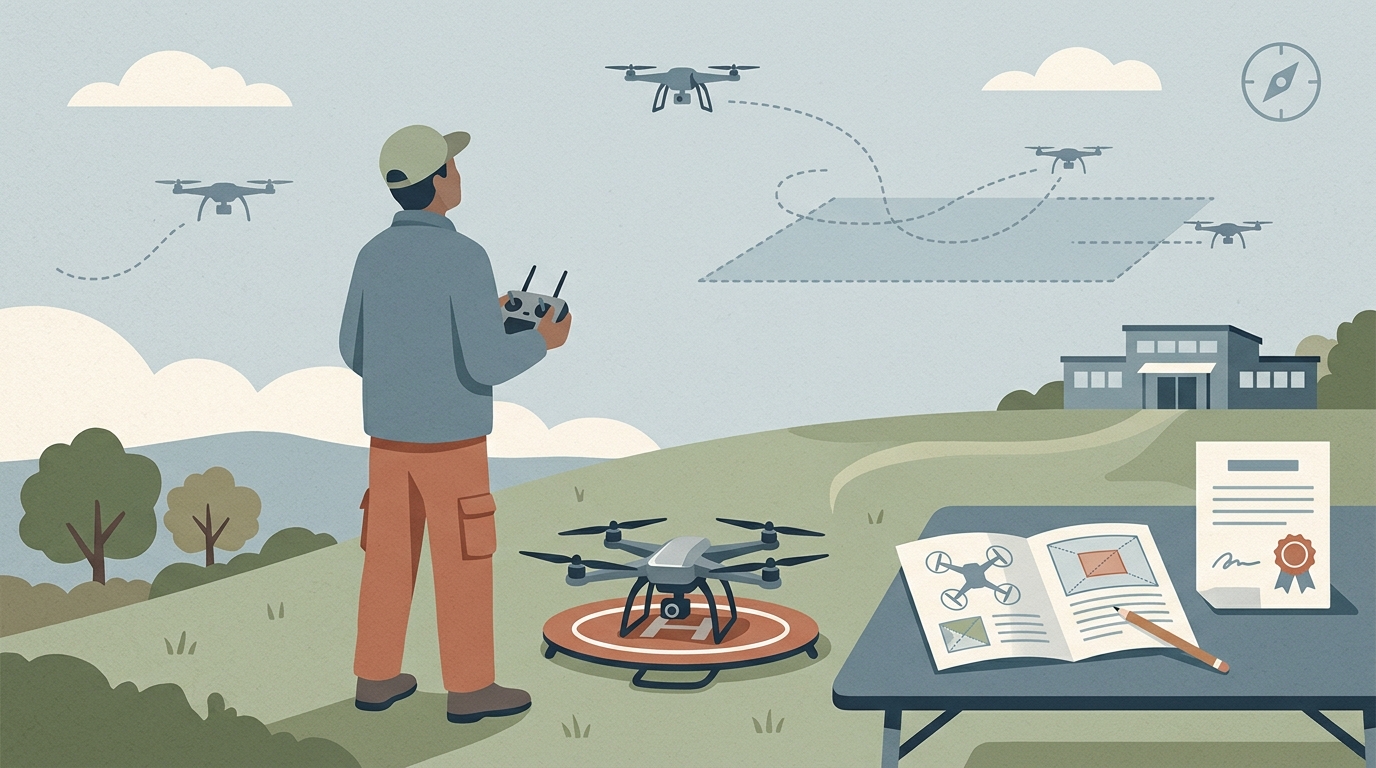
The FAA Part 107 Remote Pilot Certificate is the credential you need to fly a small drone for work in the United States. You qualify by meeting basic eligibility rules, passing a written exam called the Unmanned Aircraft General – Small (UAG) (Federal Aviation Administration (FAA), 2026-06-09), applying through the FAA's IACRA system, and clearing a TSA security background check.
There is no flight test and no training course you are required to buy. Most of the cost sits in the $175 exam fee (Drone U, 2026) and whatever study material you choose.
Why This Credential Matters
The Remote Pilot Certificate under Part 107 is issued by the Federal Aviation Administration (FAA), the US civil aviation regulator. It is the credential that separates recreational flying from flying a small drone as part of a job or business in US airspace.
It is a federal certificate, so it is not tied to a particular state. A certificate issued to someone living in Ohio is the same certificate held by someone working in Nevada. That is different from most licensed trades in the US, where you re-license when you move. It also means the certificate carries no weight outside the United States — other countries run their own drone authorisation schemes through their own civil aviation authorities, and you would need to apply separately there.
The employers and clients who ask for it cluster in a few places:
- Real estate and marketing agencies buying aerial photography and video.
- Surveying, construction and civil engineering firms using drones for site progress and volumetrics.
- Utility, telecom and energy companies inspecting lines, towers, solar arrays and roofs.
- Agriculture businesses doing crop scouting and field mapping.
- Public safety agencies — police, fire and search-and-rescue units — running their own drone programmes.
- Film and television production, insurance claims adjusting, and media newsrooms.
To a hiring manager, the certificate signals something narrower than piloting skill. It says you have been tested on applicable regulations, airspace classification and flight restrictions, aviation weather effects, loading and performance, emergency procedures, crew resource management, radio communication procedures, the physiological effects of drugs and alcohol, aeronautical decision-making, airport operations, maintenance and preflight inspection, and night operations (Federal Aviation Administration (FAA), 2026-06-09). In other words, it says you can read a sectional chart, recognise when a job site sits under controlled airspace, and know when not to fly. Flying ability itself still has to be demonstrated through a portfolio or a trial job.
If you already hold a part 61 pilot certificate and have completed a flight review within the previous 24 months, you do not sit the written exam at all. You instead complete the Part 107 Small UAS Initial (ALC-451) online training course on the FAASafety.gov (FAASTeam) website (Federal Aviation Administration (FAA), 2026-06-09).
Step-by-Step Path to Certification
- Check that you meet the eligibility rules. You must be at least 16 years old, able to read, speak, write and understand English, and in a physical and mental condition to safely fly a drone (Federal Aviation Administration (FAA), 2026-06-09). There is no education prerequisite and no minimum flight hours.
- Create an IACRA profile and get your FAA Tracking Number (FTN). This is step 1 of the FAA's own process and must be done before you register for a knowledge test (Federal Aviation Administration (FAA), 2026-06-09). You will quote the FTN when you book the exam, so set it up first.
- Study the UAG topic areas. The FAA publishes the knowledge areas, and the heaviest weighting falls on operations and regulations: in the practice question blueprint, Operations accounts for 25% of content, or 15 of 60 questions, and Regulations and Operations together make up 73% of scored content (Exams.academy, undated). Free study material is published on FAASafety.gov, and the FAA's own airman testing pages carry the sample questions and the airman knowledge testing supplement with the charts you will be asked to read.
- Schedule an appointment at an FAA-approved Knowledge Testing Center and bring a government-issued photo ID to the test (Federal Aviation Administration (FAA), 2026-06-09). Testing centres sit inside flight schools, community colleges and commercial testing sites; the FAA lists approved locations, and you book directly with the centre's testing provider.
- Sit and pass the Unmanned Aircraft General – Small (UAG) exam. First-time applicants must pass this initial aeronautical knowledge exam (Federal Aviation Administration (FAA), 2026-06-09). You need at least 70%, which is 42 of 60 scored questions (Drone U, 2026).
- Complete FAA Form 8710-13 electronically in IACRA, entering the 17-digit Knowledge Test Exam ID. That ID may take up to 48 hours from the test date to appear in IACRA, so do not panic if the form rejects it on the same afternoon (Federal Aviation Administration (FAA), 2026-06-09).
- Wait for the TSA security background check, then print your temporary certificate. A confirmation email arrives when the check is complete, with instructions for printing a temporary remote pilot certificate from IACRA (Federal Aviation Administration (FAA), 2026-06-09). The permanent certificate is mailed once the remaining FAA-internal processing is finished (Federal Aviation Administration (FAA), 2026-06-09).
Exam and License Details
| Detail | Specification |
|---|---|
| Exam name | Unmanned Aircraft General – Small (UAG), the initial aeronautical knowledge exam for first-time remote pilots (Federal Aviation Administration (FAA), 2026-06-09) |
| Number of questions | 60 multiple-choice questions (Drone U, 2026); the current test is described as 60 scored questions plus 5 unscored validation questions (Exams.academy, undated) |
| Time allowed | 120 minutes (Drone U, 2026) |
| Passing score | 70%, equal to at least 42 of 60 correct (Drone U, 2026) |
| Exam fee | $175 per attempt (Drone U, 2026) |
| Retake policy | Retest permitted after 14 calendar days if you fail (Drone U, 2026) |
| Where it is taken | An FAA-approved Knowledge Testing Center, with a government-issued photo ID (Federal Aviation Administration (FAA), 2026-06-09) |
| Application document | FAA Form 8710-13, completed electronically in IACRA with the 17-digit Knowledge Test Exam ID (Federal Aviation Administration (FAA), 2026-06-09) |
| Temporary certificate | Printed from IACRA after the TSA check, valid for up to 120 days (Drone U, 2026) |
| Renewal requirement | Online recurrent training every 24 calendar months — the Part 107 Small UAS Recurrent (ALC-677) course, or ALC-515 for part 61 pilots with a current flight review (Federal Aviation Administration (FAA), 2026-06-09) |
| Renewal fee | $0 — recurrent training on FAASafety.gov is free (Drone U, 2026) |
Realistic Timeline
- Month 1 — eligibility and setup. Confirm you meet the age, English-language and fitness conditions (Federal Aviation Administration (FAA), 2026-06-09). Create your IACRA profile and record your FTN. Start on the knowledge areas, beginning with regulations and operations, since together they carry 73% of scored content (Exams.academy, undated). Plan to study across the whole of this month if you are new to aviation.
- Month 2 — chart reading and booking. Work through airspace classification, weather, loading and performance, and the sectional-chart questions, which are the ones most people lose marks on. Book your appointment at an FAA-approved Knowledge Testing Center once you are answering practice questions correctly without guessing, and pay the $175 fee (Drone U, 2026). Lead times differ between metro and rural testing centres, so check availability before you fix the rest of your schedule.
- Month 3, week 1 — sit the UAG exam. 60 questions in 120 minutes, 70% to pass (Drone U, 2026). You get your result before you leave the testing centre.
- Month 3, weeks 1–2 — apply in IACRA. Allow up to 48 hours after the test date for the 17-digit Exam ID to appear, then submit FAA Form 8710-13 (Federal Aviation Administration (FAA), 2026-06-09).
- Month 3 to Month 4 — security check and temporary certificate. When the TSA background check clears, the confirmation email tells you how to print the temporary certificate from IACRA (Federal Aviation Administration (FAA), 2026-06-09). It is valid for up to 120 days (Drone U, 2026), and you can legally fly commercially from that point.
- Month 4 onwards — permanent certificate by mail. The plastic certificate arrives once FAA-internal processing finishes (Federal Aviation Administration (FAA), 2026-06-09).
- Every 24 calendar months thereafter. Complete the free Part 107 Small UAS Recurrent (ALC-677) course on FAASafety.gov to keep your aeronautical knowledge recency current (Federal Aviation Administration (FAA), 2026-06-09).
If you already hold a part 61 certificate with a flight review in the previous 24 months, the ALC-451 online course replaces months 1 to 3 and can be finished in a single sitting (Federal Aviation Administration (FAA), 2026-06-09).
Frequently asked questions
What does the whole process cost me?
The unavoidable outlay is the $175 test fee (Drone U, 2026), charged each time you sit the exam. Study material is optional — the FAA publishes free resources on FAASafety.gov, while commercial prep courses are an additional purchase you choose or skip. There is no application charge for submitting Form 8710-13 and no charge for the certificate itself.
Is my certificate recognised outside the United States?
No. It is granted under US federal aviation regulations and applies to flights in US airspace only. If you want to fly commercially in another country, you apply to that country's civil aviation authority under its own rules, and you should check their requirements directly before accepting work abroad.
Do I need a separate certificate for each state I work in?
No — one federal certificate covers work anywhere in the US, and moving between states does not trigger a new application. State, municipal and park authorities can still restrict where you take off and land, and some property owners impose their own conditions, so check local rules for each job site on top of your federal privileges.
What happens if I let my recurrent training lapse?
Your certificate does not expire, but your aeronautical knowledge recency does, and you cannot exercise your privileges without it being current. The fix is to sit the relevant free online course on FAASafety.gov, which you can start and finish the same day you notice. Diary the date 24 calendar months ahead each time you complete it (Federal Aviation Administration (FAA), 2026-06-09).
Sources
- Federal Aviation Administration (FAA) — Become a Certificated Remote Pilot (2026-06-09)
- Drone U — FAA Drone License: How to Get Your Part 107 (2026) (2026)
Written by
Marisol steers Jobladderhq's coverage of hiring trends and the strange rituals of modern recruiting. She's drawn to the gap between what job ads promise and what the work actually feels like. Her editing hand favors clarity over jargon, always.


