
How to Get Your NCCCO Crane Operator Certification
What the CCO Core and specialty exams cover, how the written and practical tests fit together, and how long the whole process realistically takes.
Quick answer
- Eligibility is simple on paper: you must be at least 18 years of age, comply with CCO's Substance Abuse Policy and Code of Ethics, and pass both written and practical examinations (NCCCO, January 2025).
- The Mobile Crane Operator written test is a Core Examination of 90 multiple-choice questions with 90 minutes allowed (NCCCO, June 2023), plus at least one specialty: Lattice Boom (LAT), Telescopic Boom—Swing Cab (TLL), Telescopic Boom—Fixed Cab (TSS) or Service Truck Cranes (STC) (NCCCO, January 2024).
- CCO certification is valid for five years (NCCCO, August 2018); it is a US program tied to the federal OSHA rule, and some states and cities require their own crane operator licence on top of it.
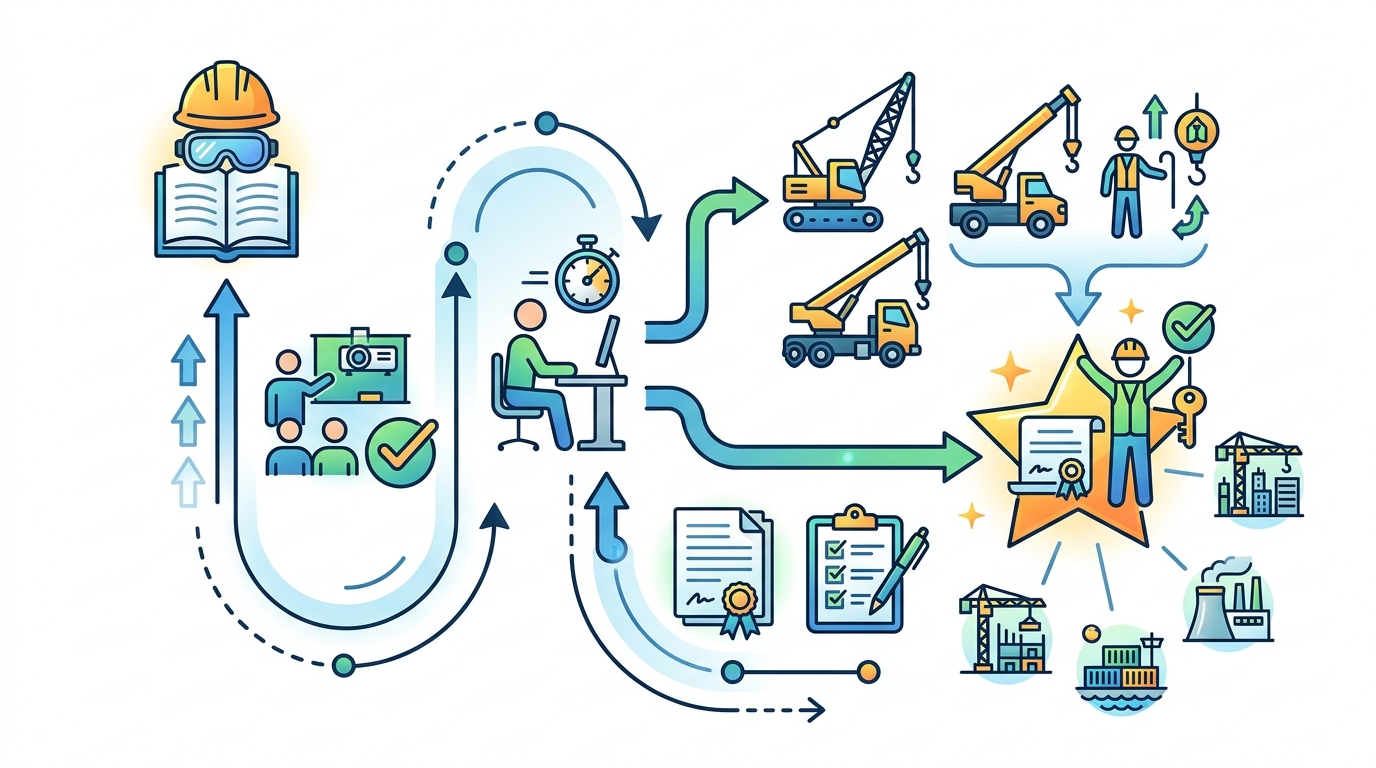
CCO crane operator certification is awarded by the National Commission for the Certification of Crane Operators (NCCCO), a nonprofit formed in January 1995 and headquartered in Murray, Utah (Wikipedia, undated). To earn it you must be at least 18, comply with CCO's Substance Abuse Policy and Code of Ethics, pass written examinations, and pass practical examination(s) (NCCCO, January 2025).
In the United States, OSHA requires employers to ensure crane operators are certified under 29 CFR 1926.1427, which mandates both written and practical testing (OSHA, 31 August 2012). CCO is the route most construction employers use to meet it.
Why This Credential Matters
If you want to run a crane on a US construction site, certification is not optional. OSHA requires employers to ensure that their crane operators are certified under 29 CFR 1926.1427, which mandates that the operator demonstrate sufficient knowledge and skill through both written and practical tests (OSHA, 31 August 2012). The employer's older duty to assess operator competence under §1926.1427(k)(2)(i) ended in November 2018, after which operator certification became the required way to assess operator safety qualification (Federal Register / OSHA, 9 November 2018).
NCCCO issues the CCO credential. Its Mobile Crane Operator certification is described as a nationally recognized and internationally accredited program developed by crane industry experts representing construction, steel erection, utilities, crane rental, and petrochemical operations (NCCCO, undated), and it was nationally accredited by the National Commission for Certifying Agencies (NCCA) in 1998 (Wikipedia, undated). NCCCO's 2019 candidate handbook states that Section 1926.1427 requires operators to be certified by a nationally accredited crane operator testing organization, and that NCCCO administers a nationwide program for that purpose (NCCCO, December 2019).
That accreditation is what a hiring manager is buying. A CCO card tells a crane rental company, steel erector or refinery contractor that an independent testing organization — not the employer — watched you read a load chart and set a load. NCCCO's 2021 handbook notes that certification was voluntary until recently unless required by local jurisdictions or specific employers, and describes capacity-in-construction equipment as needing either certification by an accredited testing organization such as NCCCO or qualification through an audited employer program (NCCCO, July 2021).
Two caveats. The federal rule is the floor: some states and municipalities run their own licensing schemes, and a general requirements summary notes that OSHA guidelines require holding a crane operating licence for each type of crane operated through an accredited testing organization (American Crane School, undated). And CCO is written around US regulation — abroad, the local regulator decides what it accepts.
Step-by-Step Path to Certification
- Confirm eligibility. For CCO Mobile Crane Operator certification you must be at least 18 years of age, comply with CCO's Substance Abuse Policy, comply with CCO's Code of Ethics, pass written examinations, and pass practical examination(s) (NCCCO, September 2023). Both policy declarations are signed with your exam application, so read them first.
- Pick the crane family and specialty you will be paid to operate. Certification requires competency in the Core and one or more Specialty designation(s) (NCCCO, undated): Lattice Boom (LAT), Telescopic Boom—Swing Cab (TLL), Telescopic Boom—Fixed Cab (TSS) and Service Truck Cranes (STC) (NCCCO, January 2024). CCO Tower Crane Operator and CCO Overhead Crane Operator are separate certifications with their own exams (NCCCO, undated). Operators holding full TSS certification — Core plus TSS specialty written plus TSS practical — need not separately certify for service truck cranes (NCCCO, undated).
- Download the current NCCCO candidate handbook for your crane type. It is the document that carries the exam content outline, the application form and the current fee schedule.
- Get seat time through a named program. An International Union of Operating Engineers (IUOE) apprenticeship, an employer-run program at a crane rental company, or a commercial crane school that hosts CCO testing. Ask any provider whether it is an NCCCO test site and which specialties it tests.
- Apply to NCCCO and schedule the written examinations. Written exams run at public test sites and at employer- or training-provider-hosted sites; you select Core plus each specialty on one application.
- Pass Core and at least one specialty written exam, then book the practical. For Tower Crane and Overhead Crane certification the written and corresponding practical must be passed within a 12-month timeframe of each other (NCCCO, undated), so book as soon as results arrive.
- Collect your CCO card and check who pays. Where certification is required under §1926.1427, the employer must provide it at no cost to operators employed by that employer on 8 November 2010 (Code of Federal Regulations, govinfo.gov, 2018). Later hires should ask about sponsorship before paying.
Exam and License Details
| Detail | Specification |
|---|---|
| Certifying body | NCCCO, a 501(c)(6) nonprofit formed in January 1995, based in Murray, Utah (Wikipedia, undated) |
| Credential names | CCO Mobile Crane Operator, CCO Tower Crane Operator, CCO Overhead Crane Operator (NCCCO, undated) |
| Minimum age | 18 years (NCCCO, January 2025) |
| Core written exam | 90 multiple-choice questions, 90 minutes allowed (NCCCO, June 2023) |
| Specialty written exams | Core plus up to four specialties: LAT, TLL, TSS, STC (NCCCO, January 2024) |
| Pass requirement | Competency in the Core and one or more Specialty designation(s), plus the matching practical examination(s) (NCCCO, undated) |
| Written-to-practical window | Both must be passed within 12 months of each other (NCCCO, undated) |
| Conduct requirements | CCO Substance Abuse Policy and Code of Ethics (NCCCO, September 2023) |
| Exam fees | Published by NCCCO in the current candidate handbook; the total rises with the number of specialty written exams, the number of practical exams, and whether you test at a public or employer-hosted site. Check nccco.org before applying |
| Retake policy | Retest under NCCCO's published retake rules; if the 12-month link lapses, that written-practical pairing is sat again (NCCCO, undated) |
| Validity | Five years (NCCCO, August 2018) |
| Recertification | OSHA requires the testing organization to have recertification procedures confirming continued technical knowledge and skills under 1926.1427(j)(1) and (2), without specifying a practical retest (OSHA, 31 August 2012) |
Realistic Timeline
- Month 1 — eligibility and paperwork. Confirm you are 18 or older, read CCO's Substance Abuse Policy and Code of Ethics, and download the handbook for your crane type. Choose between LAT, TLL, TSS and STC based on the machines local employers run.
- Months 1–3 — seat time and study. Arrange hours through an IUOE apprenticeship, an employer training program, or a crane school that is also an NCCCO test site. Most study time goes on load charts, signals, setup and site hazards.
- Month 3 — apply and book. Submit the NCCCO application for Core plus your specialty and reserve a written date. Employer-hosted sites run on fixed dates, so book early.
- Month 4 — sit the written exams. Core is 90 questions in 90 minutes (NCCCO, June 2023), with specialties in the same session or shortly after.
- Months 4–6 — sit the practical. Practicals depend on crane and examiner availability, so allow several weeks; the written and corresponding practical must be passed within 12 months of each other (NCCCO, undated).
- Months 5–7 — card in hand. NCCCO issues the CCO certification once both halves are passed, and you can be assigned as a certified operator under 29 CFR 1926.1427 (OSHA, 31 August 2012).
- Year 5 — recertification. Certification is valid for five years (NCCCO, August 2018); start roughly 6 months before the expiry date on your card.
Already running cranes under supervision? The written and practical can be compressed into 2–3 months. From zero seat time, 6–12 months is the honest estimate.
Frequently asked questions
What will the whole thing cost me?
NCCCO sets and publishes its charges on nccco.org and in the handbook, and your bill moves with how many specialty papers you add, how many machines you are tested on, and the kind of site you book. Tuition at a crane school is billed separately by the school, not by NCCCO. The federal rule obliges employers to supply required certification free to operators on their payroll on 8 November 2010 (Code of Federal Regulations, govinfo.gov, 2018), so later hires should ask about sponsorship first.
Will my CCO card be accepted in every state?
The OSHA obligation in 29 CFR 1926.1427 applies nationally, and NCCCO describes its program as nationwide for that purpose (NCCCO, December 2019). Separately, certain states and cities run licensing of their own, and NCCCO's 2021 handbook acknowledges that requirements can come from local jurisdictions or particular employers (NCCCO, July 2021). Call the state labor department or municipal buildings department covering your job sites and ask what else they demand.
Is CCO recognised outside the United States?
NCCCO describes the Mobile Crane Operator certification as nationally recognized and internationally accredited (NCCCO, undated), and some international contractors accept it on that basis. Each country sets its own rules for who may operate lifting equipment, and a CCO card does not override a national regulator. Ask the prospective employer and the relevant national safety authority before assuming it transfers.
Do I have to take the practical test again after five years?
The card lasts five years (NCCCO, August 2018) and NCCCO sets the renewal procedure. OSHA's wording asks the testing organization to maintain recertification procedures confirming continued technical knowledge and skills, without naming a practical retest (OSHA, 31 August 2012). Confirm the exact steps and application window on nccco.org early, because an expired card can mean repeating the full process.
Sources
- National Commission for the Certification of Crane Operators (NCCCO) — Mobile Crane Operator Certification
- NCCCO — Mobile Crane Operator Candidate Handbook (MCO CH REV 01/25) (2025-01)

Written by
Wyatt covers work outside the office: construction, logistics, repair, and the people who keep things running. He's skeptical of career advice that assumes everyone sits at a desk.


