How to Start a Career as a Lineman
Powerline work is an earn-while-you-learn trade built on a registered apprenticeship, a head for heights, and a tolerance for storm callouts.
Quick answer
- The fastest route in is a registered apprenticeship that pays you while you train, combining on-the-job training with technical instruction and sometimes run jointly by the employer and the union representing the workers (U.S. Bureau of Labor Statistics, 2025).
- Entry qualifications may include a high school diploma or equivalent, 1 year of high school algebra or the college-level equivalent, a qualifying score on an aptitude test, and passing a substance abuse screening (U.S. Bureau of Labor Statistics, 2025).
- Certification is available but not mandatory, with details published by CareerOneStop; a state-issued commercial driver's license is usually needed to drive heavy vehicles, and an interstate CDL regulated by the Federal Motor Carrier Safety Administration to drive crews across state lines (U.S. Bureau of Labor Statistics, 2025).
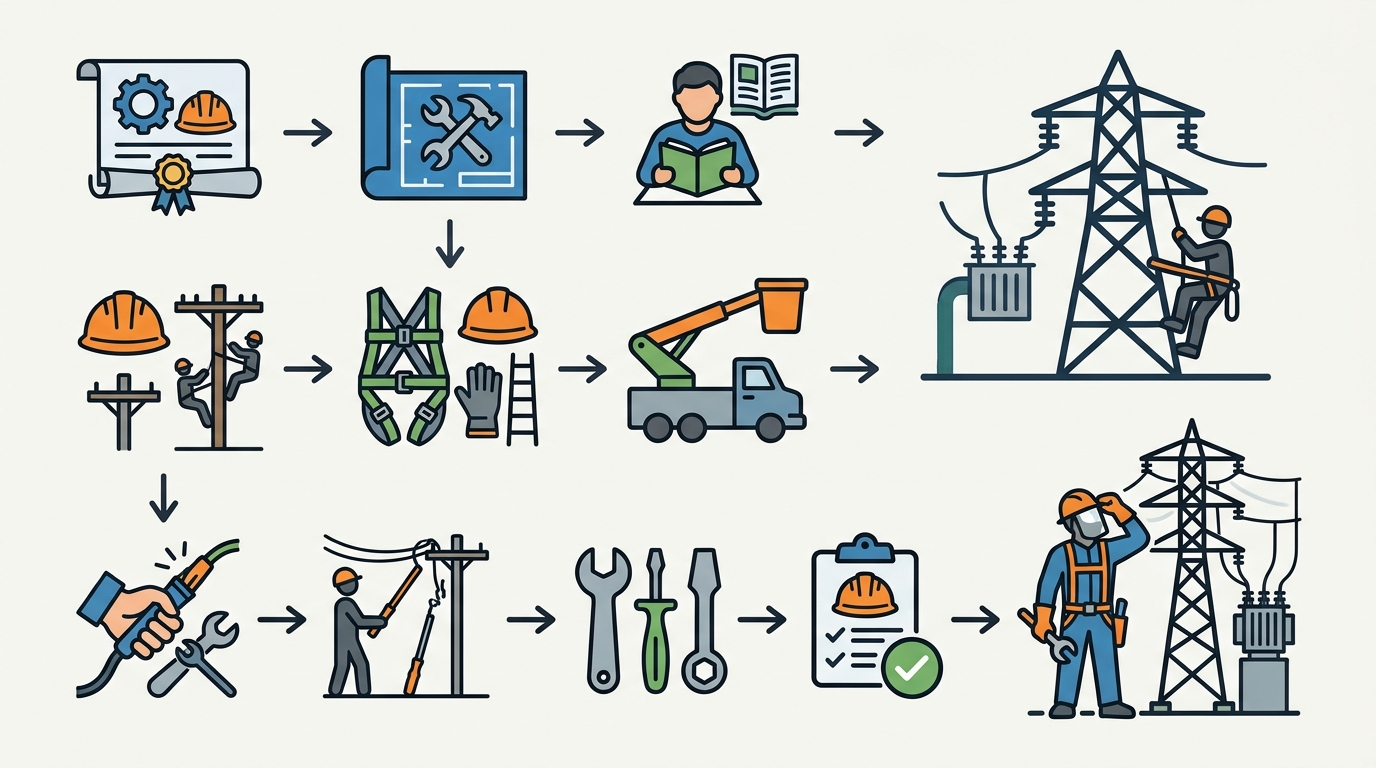
Linemen install, maintain and repair the overhead and underground lines that carry electricity to homes and businesses. The usual way in is an apprenticeship: the U.S. Bureau of Labor Statistics (2025) reports that apprenticeships combine on-the-job training with technical instruction and may be administered jointly by the employer and the union representing the workers, and that typical entry-level education sits below degree level.
This guide follows the U.S. occupation of electrical power-line installer and repairer. Elsewhere, the equivalent is a utility or distribution-line apprenticeship run by a national apprenticeship authority or the network operator, so check your own country's apprenticeship register.
What This Job Involves Day to Day
A shift usually starts with a safety check and a drive. ONET lists driving vehicles equipped with tools and materials to job sites among the occupation's core tasks, along with adhering to safety practices such as checking equipment and erecting barriers (ONET OnLine, U.S. Department of Labor). Before anyone touches a conductor, someone opens switches or attaches grounding devices to remove electrical hazards.
The work itself falls into a few repeating jobs. You string electrical cable and wires between poles, towers and buildings; you identify defective devices, voltage regulators, transformers and switches; and you inspect and test power lines and auxiliary equipment (U.S. Bureau of Labor Statistics, 2025). Reaching that equipment means climbing poles and transmission towers or working from a truck-mounted bucket.
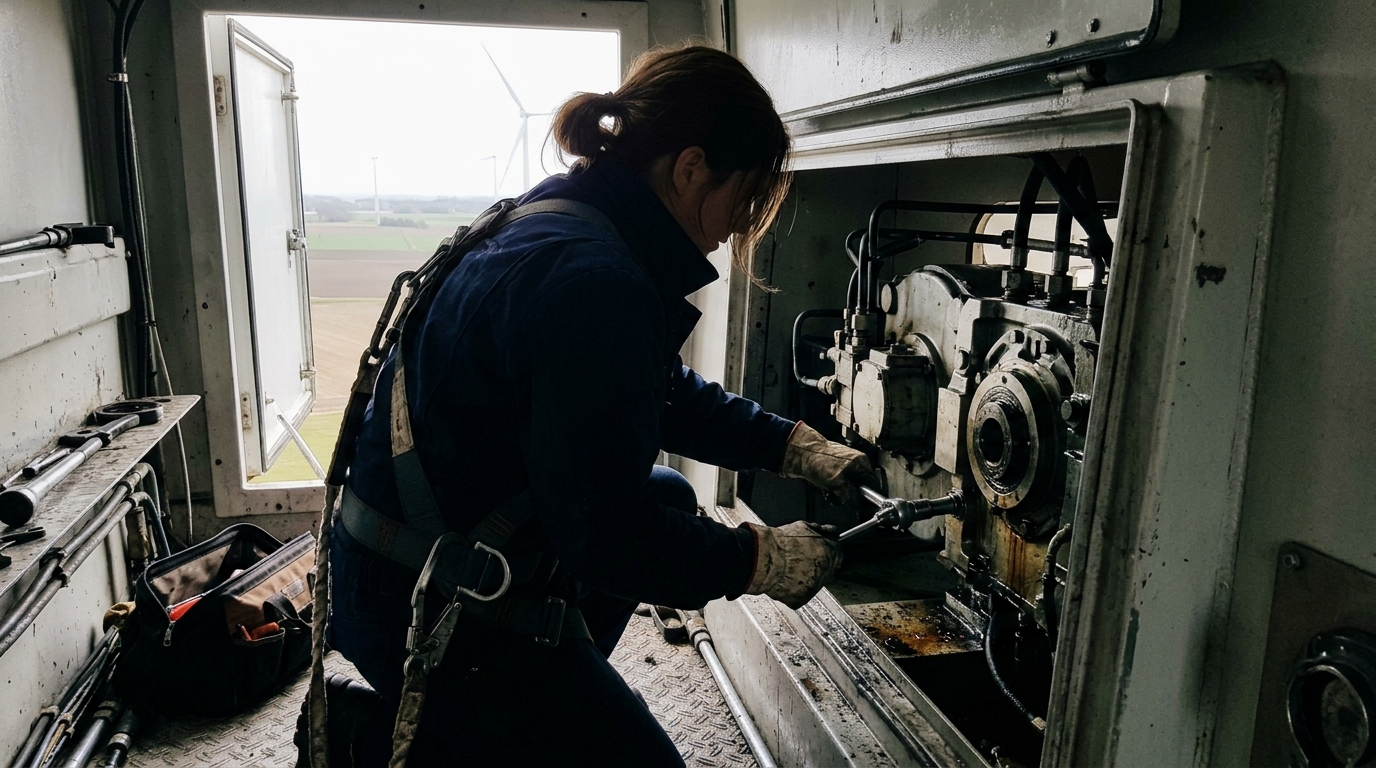
The setting is outdoors in all weather. The Bureau of Labor Statistics (2025) notes that workers must be comfortable at great heights and in confined spaces, often drive utility vehicles, and may travel long distances as part of interstate crews. Most work full time, some over 40 hours a week, and hours get long after storms.
When searching job boards, check the sample of reported job titles O*NET publishes for the occupation — employers advertise the same work under several names.
Step-by-Step Path to Get Started
- Finish high school, or an equivalency, and take algebra. Apprenticeship entry may require a high school diploma or equivalent plus 1 year of high school algebra or the college-level equivalent (U.S. Bureau of Labor Statistics, 2025). A single community college algebra course covers the same ground in one term.
- Get a clean driver's licence and start on the CDL. Workers who drive heavy vehicles usually need a state-issued commercial driver's license, and those driving crews across state lines need an interstate CDL regulated by the Federal Motor Carrier Safety Administration (U.S. Bureau of Labor Statistics, 2025). Apply through your state driver licensing agency and allow several weeks for test appointments.
- Consider a community college line program first. Some community colleges run programs covering electrical distribution, line construction, and pole top and bucket rescue, sometimes including an internship or hands-on fieldwork (U.S. Bureau of Labor Statistics, 2025). Check the length published in the college catalogue before enrolling.
- Find registered apprenticeships. O*NET publishes example Registered Apprenticeship job titles for this occupation, vetted by industry and approved by the U.S. Department of Labor. Search apprenticeship.gov and CareerOneStop for sponsors in your state and note each application window — many open once a year.
- Sit the aptitude test and pass the screening. Expect a qualifying score on an aptitude test and a substance abuse screening as part of selection (U.S. Bureau of Labor Statistics, 2025). Book your test as soon as the sponsor offers a date.
- Take a line-crew entry role while you wait. Labouring and helper jobs with line-construction contractors and electric utilities put you on site with a supervisor who can speak for you at interview. The Bureau of Labor Statistics (2025) publishes the work experience in a related occupation required to enter the job — read that entry first.
- Complete the apprenticeship, then consider certification. Apprentices reach journey level after the term set in the sponsor's standards, and can then perform most tasks without supervision (U.S. Bureau of Labor Statistics, 2025). Certification is available but not mandatory, with information from CareerOneStop; O*NET also lists national industry associations for the occupation.
Education, Certification, and Cost Requirements
No single figure covers these costs: tuition, test fees and licence fees are set separately by each college, each state licensing agency and each apprenticeship sponsor. Check the published rate from the body named in the middle column before budgeting.
| Requirement | Where to Get It | Typical Cost | Typical Time |
|---|---|---|---|
| High school diploma or equivalent | Public or private high school; your state's equivalency testing agency | No tuition at a public high school; equivalency exams carry a per-subject fee set by each state agency | 4 years of high school, or the preparation period your testing agency recommends |
| 1 year of algebra or college equivalent | High school maths department, or a community college | Included in high school enrolment; at college, the institution's per-credit tuition rate | 1 school year, or one college term for the equivalent course |
| Community college line program (optional) | Colleges teaching electrical distribution, line construction, pole top and bucket rescue | Per-credit tuition set by the college, plus boots, climbing gear and tools | The semesters stated in that college's catalogue, plus internship or fieldwork |
| Apprenticeship aptitude test | The sponsor, often employer and union jointly | Sitting fee set by the sponsor; confirm when you apply | One scheduled session within the sponsor's annual intake cycle |
| Substance abuse screening | Clinic nominated by the sponsor or employer | Commonly paid by the sponsor; where you pay, the clinic sets the fee | Results normally returned within days |
| Commercial driver's license (CDL) | State driver licensing agency; interstate CDLs regulated by the Federal Motor Carrier Safety Administration | Knowledge test, skills test and issue fees set by your state; CDL school tuition charged separately | Several weeks of training, plus the wait for a state test appointment |
| Registered Apprenticeship | U.S. Department of Labor Registered Apprenticeship sponsors on apprenticeship.gov and CareerOneStop | Apprentices are paid while training; sponsors may charge for books, tools and climbing gear | The term set in the sponsor's standards, through to journey level |
| Certification (optional) | Certifying bodies in the CareerOneStop certification finder | Exam and renewal fees set by the certifying body | The exam and preparation schedule published by that body |
Before You Apply
Have these ready before the sponsor's application window opens:
- A one or two page resume listing outdoor, construction or heavy-equipment work first, with job sites named and crew sizes given.
- Your high school transcript showing 1 year of algebra, or a community college transcript for the equivalent course (U.S. Bureau of Labor Statistics, 2025).
- Your driving record, plus your CDL class and endorsements if you hold one, and whether it covers interstate driving under Federal Motor Carrier Safety Administration rules.
- Proof of any pole top and bucket rescue, CPR, first aid or flagger training, with the issuing body and card number on the resume.
- A certificate or transcript from a community college line program, including internship or fieldwork hours.
- Confirmation you can pass a substance abuse screening and whatever background check the utility or contractor requires for site access.
- Evidence you can work at height and in confined spaces — climbing school hours, tower work or rope access (U.S. Bureau of Labor Statistics, 2025).
- The deadline and test date for each sponsor, taken from apprenticeship.gov or CareerOneStop rather than a third-party job ad.
- A straight answer on travel: interstate crews and storm restoration mean nights away and hours beyond 40 a week.
Frequently asked questions
Do I need a college degree to become a lineman?
No. The Bureau of Labor Statistics (2025) publishes the typical entry-level education for electrical power-line installers and repairers, and it sits below degree level; O*NET also surveys the education employers say they want for new hires. Read both before paying for any course, since a line program is optional preparation rather than a requirement.
How long before I can work without supervision?
You work under supervision until you reach journey level, the point at which you can perform most tasks on your own (U.S. Bureau of Labor Statistics, 2025). The exact term is written into your sponsor's apprenticeship standards, so ask for a copy at interview. The Bureau also publishes the typical on-the-job training needed for proficiency.
Do I need the CDL before I apply, or can I get it during training?
Many sponsors accept applicants holding only a regular driver's licence and expect the commercial licence to follow during training, because driving utility vehicles is part of the work rather than a precondition. Ask the sponsor directly, as some contractors running interstate crews want it sooner. The licence is issued by your state agency, with interstate driving regulated federally.
Is certification worth paying for if it isn't mandatory?
Certification is available but not required to work in this occupation (U.S. Bureau of Labor Statistics, 2025). Treat it as something to add once employed, when your employer may contribute to the fee. Use the CareerOneStop certification finder to see which credentials exist for power-line work and what each tests.
What should I expect to earn, and how many openings are there?
Pay is normally an hourly rate that rises at set points through the apprenticeship, with premiums for overtime, storm work and travel away from your home yard. Union-sponsored programs publish the rate schedule in the collective agreement, so ask for it before accepting a place. For current figures, check the median annual wage and the 2025–35 projections in the Bureau of Labor Statistics Occupational Outlook Handbook, plus the national employment trends on the O*NET page.
Sources
- U.S. Bureau of Labor Statistics — Electrical Power-Line Installers and Repairers : Occupational Outlook Handbook (2025)
- O*NET OnLine (U.S. Department of Labor) — 49-9051.00 - Electrical Power-Line Installers and Repairers - Summary Report

Written by
Priya tracks wages, layoffs, and the slow shifts in what counts as a stable job. She writes for readers trying to make sense of numbers that rarely match their own experience.