
Is Becoming a Dog Groomer a Good Career Change?
A hands-on trade you can learn in months rather than years, with pay structures and physical demands most office workers have never had to plan around.
Quick answer
- Entry requirements are low: O*NET puts Animal Caretakers in Job Zone 1-2, usually a high school diploma or GED, with training from a few days to one year on the job (O*NET OnLine, U.S. Department of Labor, undated).
- Demand supports a late switch — U.S. employment was 365,300 in 2025, growth for 2025-2035 is projected "much faster than average (7% or higher)" and 62,800 openings are forecast (O*NET OnLine, U.S. Department of Labor, 2025).
- Plan for an income gap of roughly 6 to 12 months while you train and build a client book, plus the up-front cost of your own shears, clippers and dryer.
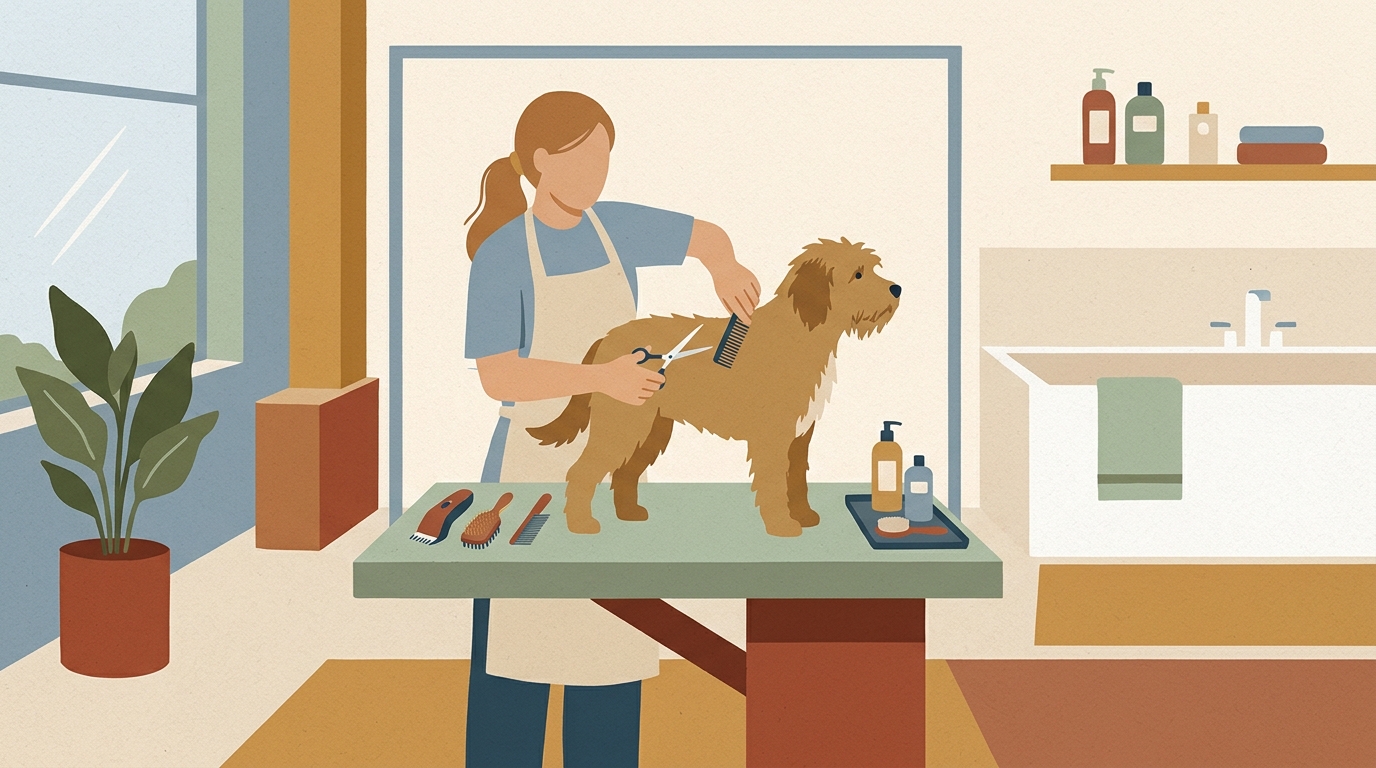
Dog grooming is one of the few skilled trades you can enter in your forties, fifties or later without a degree or a long apprenticeship. ONET classifies the Animal Caretakers occupation — which covers reported job titles including Dog Groomer, Pet Groomer, Pet Stylist and Dog Bather — in Job Zone 1-2, "Very Little to Some Preparation Needed", usually requiring a high school diploma or GED, with on-the-job training ranging from a few days to one year (ONET OnLine, U.S. Department of Labor, undated).
The trade-off is physical, and the money is slow at the start. Budget 12 to 24 months from your first bathing shift to steady full-time income.
What the Work Actually Involves
A salon groomer's day is a sequence of booked appointments, not a job list. A full groom on a medium, coated dog runs 1.5 to 2.5 hours: 15 to 20 minutes of pre-work (brush-out, nail trim, ear clean, sanitary trim), 20 to 30 minutes bathing and double-shampooing, 20 to 40 minutes on a high-velocity dryer and finishing brush, then 30 to 60 minutes of clipper and scissor work. Experienced groomers handle 4 to 8 dogs a day; a new groomer may manage 2 to 3 and need help with the difficult ones.
Around that, expect 20 to 40 minutes a day on the phone and booking system — confirming appointments, quoting matted coats, explaining why a shave-down is the kind option — and 30 to 45 minutes at close sanitising tubs, blades, tables and floors. Blade maintenance, kit repairs and laundry take a few more hours a week.
The work-context data is worth taking seriously before you commit. Among surveyed workers in this occupation, 56% said they stand continually or almost continually, 45% reported being exposed to disease or infections every day, and 56% reported working outdoors exposed to all weather conditions every day — that last figure reflects the kennels, shelters and mobile work included in the group (ONET OnLine, U.S. Department of Labor, undated). You also make constant judgement calls: 61% of respondents reported making decisions every day (ONET OnLine, U.S. Department of Labor, undated). Whether a senior dog can tolerate a full groom, whether a coat is too matted to save, whether a dog is about to bite — those calls are yours, usually within seconds.
Who This Career Change Suits
- Hairdressers and barbers. You already have scissor and clipper control, an eye for symmetry, and a body conditioned to standing. The relearning is working on a subject who moves.
- Veterinary receptionists and veterinary assistants. You read animal body language, you can restrain a frightened dog, and you know the vocabulary owners use. ONET lists Veterinary Assistants and Laboratory Animal Caretakers as a related occupation (ONET OnLine, U.S. Department of Labor, undated).
- Nurses, healthcare assistants and care workers. Gentle handling of fragile bodies, infection control and long shifts on your feet all transfer — relevant when 45% of surveyed workers report daily exposure to disease or infections (O*NET OnLine, U.S. Department of Labor, undated).
- Retail and hospitality managers. Booking systems, add-on sales, handling an angry customer and ordering stock are the business half of self-employed grooming.
- Chefs and line cooks. Timed, repetitive, standing work under a ticket system is close to the rhythm of a salon with six dogs booked in.
- Dog walkers, kennel assistants and shelter volunteers. You have already proved you can be around 30 dogs without getting rattled, which is what most career changers discover too late.
- Tradespeople who want off ladders and roofs. Grooming is physical but not load-bearing, which matters if you are in your fifties and your knees or shoulders have had enough.
- People who would rather be judged on the result than on office politics. The dog either looks right or it does not, and the owner tells you within ten seconds.
Transferable Skills That Carry Over
| Prior Career | Skill | How It Applies Here |
|---|---|---|
| Hairdresser or barber | Shear and clipper technique, blending, consultation | Breed trims, scissoring a straight leg line, agreeing a style before you start |
| Nurse or healthcare assistant | Safe handling, infection control, reading distress | Restraining arthritic dogs, spotting lumps and ear infections, sanitising tubs and tools |
| Retail or hospitality manager | Scheduling, stock control, upselling, complaint handling | Filling a diary, pricing matted coats fairly, keeping clients when a groom goes wrong |
| Chef or line cook | Working to time under pressure, standing stamina | Keeping a six-dog day on schedule without rushing the finish |
| Teacher or childcare worker | Explaining decisions calmly to anxious adults | Telling an owner their dog must be shaved, and keeping them as a customer |
| Delivery driver or courier | Route planning, vehicle upkeep, lone working | Mobile grooming rounds from a fitted van, managing your own day |
| Office administrator or bookkeeper | Invoicing, record-keeping, tax returns | Running the self-employed side: deposits, no-show policies, expense records |
How to Get Started
- Spend a day in a salon before you spend any money. Ask a local grooming business for an observation day or a weekend bathing shift. One two-hour doodle groom and one dog that snaps at the dryer tell you more than any brochure.
- Check what your jurisdiction actually requires. Grooming itself is unlicensed in many places, but animal-establishment permits, business registration, zoning and insurance rules differ by state, province and country, and by city within them. Ask your local authority or business licensing office directly.
- Take a bathing job first. Dog Bather is among the reported job titles for this occupation (ONET OnLine, U.S. Department of Labor, undated), and paid bathing is the normal entry point. ONET puts related experience for this job zone at anywhere from none to about a year, with training from a few days to one year on the job (O*NET OnLine, U.S. Department of Labor, undated).
- Choose a structured training route. Options are an apprenticeship, a grooming school programme, or a salon that formally trains. In the United States, Pet Groomer is listed as an example apprenticeship title vetted by industry and approved by the U.S. Department of Labor for use in a Registered Apprenticeship Program (O*NET OnLine, U.S. Department of Labor, undated); elsewhere, check your national apprenticeship register for the equivalent.
- Work toward a recognised certification. The National Dog Groomers Association of America is listed by ONET as a national professional association for this occupation (ONET OnLine, U.S. Department of Labor, undated); outside the US, look for the equivalent national association and its assessed qualifications. Certification is rarely compulsory but shortens the trust-building with employers and clients.
- Buy your kit in stages. Start with one clipper, a small set of blades, a straight shear, a slicker brush and nail clippers. Add a high-velocity dryer and curved and thinning shears once you groom solo. Price everything locally first.
- Build a before-and-after portfolio, then take paid work the low-risk way. Groom friends' and rescue dogs at cost until you have 20 to 30 clean examples across coat types. Most career changers then work employed or on commission in an established salon for 6 to 18 months before moving to booth rental, mobile or their own premises.
Costs and Time Commitment
Costs are not comparable across countries, so treat the time column as the reliable part and price the money column locally.
| Item | Typical Cost | Typical Time |
|---|---|---|
| Grooming school or academy programme | Varies widely by country and provider — get written quotes from two or three schools | 8 to 24 weeks full time, or 6 to 12 months part time |
| Apprenticeship or paid salon training | Usually no tuition; you earn a trainee rate while learning | A few days to one year of on-the-job training for this job zone (O*NET OnLine, U.S. Department of Labor, undated) |
| Certification through a national grooming association | Assessment and membership fees, set by the body in your country | 1 to 2 days of testing, after months of practice |
| Starter kit: clipper, blades, shears, dryer, table | Your single biggest up-front outlay — price locally before enrolling | Buy over 3 to 6 months as your skills need each piece |
| Income gap while retraining | Plan for 6 to 12 months of reduced earnings, longer if you go self-employed immediately | 12 to 24 months from first bathing shift to steady full-time income |
| Insurance, registration, van fit-out (mobile only) | Recurring; mobile fit-out is a major capital cost | 1 to 3 months to arrange before you can trade |
If you are leaving a salaried office role, expect to earn less for at least the first year. Pay in this trade is usually structured as an hourly trainee rate for bathers, then commission on each groom (a percentage of the ticket) for experienced groomers, or full self-employed takings minus booth rent and supplies. Check current published rates for Animal Caretakers with your national statistics agency — BLS Occupational Employment and Wage Statistics in the United States, ONS in the United Kingdom, Statistics Canada, or the ABS in Australia — rather than relying on figures quoted by training providers.
Frequently asked questions
Am I too old to start grooming at 50?
Grooming is one of the more realistic late switches because entry does not depend on a degree or a graduate hiring pipeline: O*NET places the occupation in Job Zone 1-2, usually requiring only a high school diploma or GED (O*NET OnLine, U.S. Department of Labor, undated). The hiring doubt career changers aged 45 to 60 report in office work shows up differently here — salon owners worry about stamina and speed, not years since graduation, and 56% of surveyed workers stand continually or almost continually (O*NET OnLine, U.S. Department of Labor, undated). Answer that concern directly by offering a paid trial bathing shift.
Do I need a formal qualification to work as a dog groomer?
In most places, no — training for this job zone ranges from a few days to one year on the job, and prior experience ranges from none to about a year depending on the role (O*NET OnLine, U.S. Department of Labor, undated). What varies is business-side regulation: permits, zoning and insurance requirements differ by state, province, city and country, so check with your local licensing authority. Certification from a national body such as the National Dog Groomers Association of America, listed by O*NET as a professional association for this occupation (O*NET OnLine, U.S. Department of Labor, undated), is optional but speeds up client trust.
How secure is the work compared with the job I'm leaving?
U.S. employment in the Animal Caretakers group stood at 365,300 in 2025, with growth for 2025-2035 categorised as "much faster than average (7% or higher)" (O*NET OnLine, U.S. Department of Labor, 2025). That is a healthier outlook than many administrative roles, though grooming income is seasonal and discretionary — bookings dip when household budgets tighten. Employed salon work is steadier than self-employment in your first two years.
What if my body can't take it after a few years?
It is a genuine risk: alongside the standing demand, 45% of surveyed workers report daily exposure to disease or infections (O*NET OnLine, U.S. Department of Labor, undated), and repetitive shear work is hard on wrists and shoulders. Many groomers move sideways rather than out — O*NET lists Animal Trainers, Veterinary Assistants and Laboratory Animal Caretakers, and Veterinary Technologists and Technicians as related occupations, the latter two flagged as "Bright Outlook" (O*NET OnLine, U.S. Department of Labor, undated). Others shift to salon ownership or training new groomers after 5 to 10 years on the table.
Sources
- O*NET OnLine (U.S. Department of Labor, Employment and Training Administration) — 39-2021.00 - Animal Caretakers

Written by
Wyatt covers work outside the office: construction, logistics, repair, and the people who keep things running. He's skeptical of career advice that assumes everyone sits at a desk.


