Loan Officer vs. Mortgage Broker: Pay, Duties, and Day-to-Day Differences
One works inside a single lender and approves files against its rules; the other shops the same file to many lenders and is paid when it closes.
Quick answer
- The biggest practical difference is who decides: a loan officer can approve or refer an application under their employer's criteria, while a broker submits the same file to outside lenders and never issues the decision.
- The employed loan officer path front-loads more schooling, because a bachelor's degree is the typical entry-level education for loan officers (U.S. Bureau of Labor Statistics, 2025); the Mortgage Loan Originator (MLO) licence both sides need — prelicensing courses, a national exam, background and credit checks, renewed annually (U.S. Bureau of Labor Statistics, 2025) — takes weeks, not years.
- Pay sits above the all-occupations median of $50,980 but below financial specialists overall at $84,680 (U.S. Bureau of Labor Statistics, May 2025), with a wide spread of $39,430 to $153,180, and growth is thin: 1 percent from 2025 to 2035, about 17,100 openings a year mostly from replacement (U.S. Bureau of Labor Statistics, 2025).
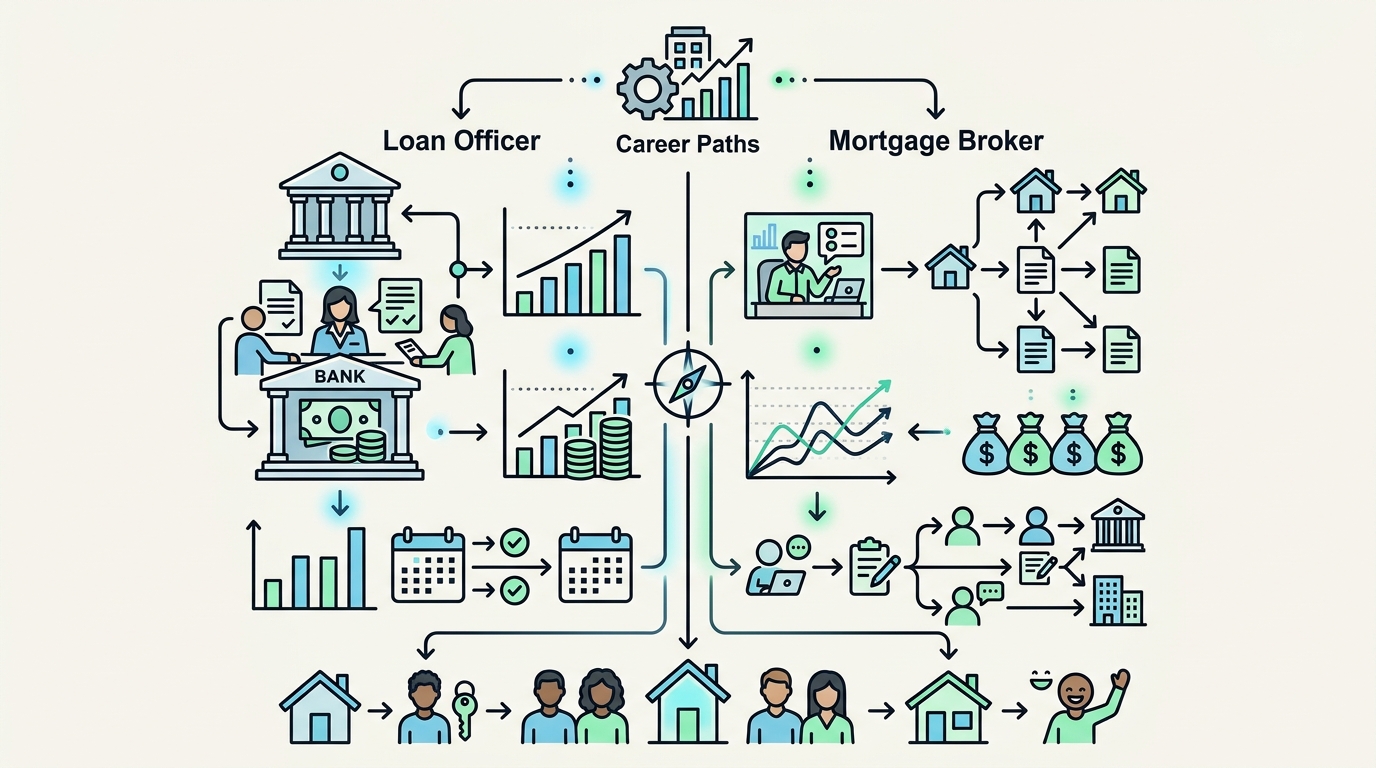
A loan officer works for one lender and sells that lender's loan products, verifying applicants' finances and approving or referring files against in-house criteria. A mortgage broker is an intermediary: the borrower is the client, but the loan comes from whichever lender on the broker's panel will take the file, and the broker is paid per completed deal rather than on a salary line.
In United States data, mortgage brokers are largely counted inside the loan officer occupation, so the pay and outlook figures below come from the same series: the median annual wage for loan officers was $76,690 in May 2025 (U.S. Bureau of Labor Statistics, 2025). If you are outside the US, check your own national statistics agency and financial-conduct regulator, because licensing rules and broker pay models differ sharply by country.
Head-to-Head Comparison
All pay and outlook figures below are United States national figures from the U.S. Bureau of Labor Statistics (2025); state and metro pay vary, and the Bureau does not publish a separate wage series for mortgage brokers because most are counted within the loan officer occupation. Readers elsewhere should substitute their own national statistics body.
| Dimension | Loan officer (employed by a lender) | Mortgage broker (independent intermediary) |
|---|---|---|
| Typical entry requirement | A bachelor's degree is the typical entry-level education (U.S. Bureau of Labor Statistics, 2025), normally three to four years full time, plus less than five years of experience in a related occupation and moderate-term on-the-job training (U.S. Bureau of Labor Statistics, 2025). Some enter without the degree on the strength of related banking experience (U.S. Bureau of Labor Statistics, 2025). | Same occupational baseline, but the credential that actually gates the work is the Mortgage Loan Originator (MLO) license: prelicensing courses, a national exam, and background and credit checks, renewed annually, with states free to add requirements (U.S. Bureau of Labor Statistics, 2025). That course-and-exam sequence is measured in weeks, not years, so degreeless entrants more often land here. |
| Median pay | Median annual wage of $76,690 in May 2025 (U.S. Bureau of Labor Statistics), against $50,980 for all occupations and $84,680 for financial specialists overall in the same month and source. Commonly a base salary plus commission on funded volume. | No separate published median; the $76,690 loan officer median (U.S. Bureau of Labor Statistics, May 2025) is the nearest benchmark. Pay is usually commission per closed loan with little or no base, so brokers cluster nearer the ends of the published range: under $39,430 for the lowest 10 percent and over $153,180 for the highest 10 percent in May 2025 (U.S. Bureau of Labor Statistics). |
| Physical and schedule demands | Most loan officers work full time and some work more than 40 hours per week (U.S. Bureau of Labor Statistics, 2025). Consumer loan work is office-based; mortgage and commercial officers may work outside the office and meet clients at homes or businesses (U.S. Bureau of Labor Statistics, 2025). Light physically, heavy on screen time and deadline pressure. | Same long full-time hours, but weighted toward evenings, weekends and driving, because showings, open houses and signings run on the buyer's schedule. Self-employed brokers also carry their own admin, renewals and slow months. |
| Five-year outlook | Employment is projected to grow 1 percent from 2025 to 2035 — about 3,100 added jobs on a base of roughly 283,000 in 2025 (U.S. Bureau of Labor Statistics, 2025). The first five years sit inside that near-flat trend. About 17,100 openings a year are projected over the decade, mostly replacing people who leave (U.S. Bureau of Labor Statistics, 2025). | Drawn from the same 2025-2035 projection, so the headline is identical: 1 percent growth and 17,100 annual openings (U.S. Bureau of Labor Statistics, 2025). Broker demand is more rate-sensitive than lender demand, because refinance volume swings harder than a bank's overall loan book. |
The tradeoffs are real on both sides. Employed loan officers trade commission upside for a base salary and a single product menu they cannot step outside. Brokers trade stability for choice: income tracks closings, and a quiet quarter is felt immediately. Credit intermediation — commercial banks, savings institutions and mortgage companies — employed about 80 percent of loan officers (U.S. Bureau of Labor Statistics, 2025), so if you want an employer-paid seat, that is where most of them are.
On growth, a 1 percent rise over 2025-2035 means most hiring is replacement hiring rather than new headcount (U.S. Bureau of Labor Statistics, 2025). Entry is therefore less about a booming field and more about licensing, referral relationships and timing.
Day-to-Day Differences
Take the same Tuesday in the same mid-sized town.
The loan officer starts in a branch or lending office. The morning is contacting businesses and individuals about loan products, then talking with applicants to gather information, explaining which loan types and terms they qualify for, and obtaining and verifying financial information — pay records, tax documents, credit pulls (U.S. Bureau of Labor Statistics, 2025). Late morning, a file from last week is ready for decision. The officer reviews the agreement for compliance with the lender's rules and applicable regulation, then approves it or refers it onward to a credit committee or underwriter (U.S. Bureau of Labor Statistics, 2025). That decision authority is the task a broker never has: brokers recommend and submit, they do not approve.
If this officer is on the consumer side, the whole day runs from a desk; mortgage and commercial officers more often work outside the office and meet clients at their homes or businesses (U.S. Bureau of Labor Statistics, 2025). Afternoon is pipeline: chasing missing documents, answering an underwriter's conditions, logging progress in the lender's origination system, and a 5:30 internal call about next quarter's product changes. Hours run full time, sometimes past 40 in a week (U.S. Bureau of Labor Statistics, 2025).
The mortgage broker's Tuesday has no branch. Morning is a borrower consultation — self-employed buyer, two years of fluctuating income — followed by the task the employed officer never performs: taking that one file and comparing it against several different lenders' current rate sheets and credit appetites to decide where to place it. One lender is slow on self-employed income; another takes it but prices higher. The broker makes the case for a placement and explains the tradeoff to the borrower.
Midday is relationship work. Mortgage specialists often build relationships with real estate companies to generate client referrals (U.S. Bureau of Labor Statistics, 2025), so the broker sits in on an agent's office meeting, then drives to a listing to meet a buyer. The afternoon is submissions and chasing: packaging a file for a lender's portal, answering that lender's conditions, and handling license admin — the MLO license renews annually and states may add their own requirements (U.S. Bureau of Labor Statistics, 2025). Evening is a 7pm call with a buyer who cannot talk during work hours. Nothing closed today, and nothing was paid today either, because the commission lands at completion.
Who Thrives in Each Path
Loan officer (employed by a lender)
- You came from branch banking, teller supervision or collections, so you already read a customer's finances fast — that related work experience can substitute for the bachelor's degree that is typical entry-level education for loan officers (U.S. Bureau of Labor Statistics, 2025).
- You are comfortable saying no. Approving or referring applications and reviewing agreements for regulatory compliance (U.S. Bureau of Labor Statistics, 2025) means telling people they do not qualify, in person, repeatedly.
- You want predictable income before the pipeline builds. A base plus commission smooths the gap that a commission-only broker absorbs, which matters when the published pay range runs from under $39,430 to over $153,180 (U.S. Bureau of Labor Statistics, May 2025).
- You prefer depth over breadth: learning one lender's product set, credit policy and origination system thoroughly, rather than tracking a dozen lenders' rate sheets.
Mortgage broker
- You have a real estate, title, appraisal or insurance background with existing agent contacts, because mortgage specialists often rely on relationships with real estate companies for referrals (U.S. Bureau of Labor Statistics, 2025).
- You enjoy puzzle files — self-employed income, thin credit files, unusual properties — and want the freedom to move a borrower to a different lender rather than decline them.
- You can run yourself as a small business: tracking annual MLO license renewal and any added state requirements (U.S. Bureau of Labor Statistics, 2025), your own marketing, and months when nothing closes.
- You want to work where the clients are rather than at a desk, since mortgage work routinely means meeting people at homes or businesses outside the office (U.S. Bureau of Labor Statistics, 2025).
Frequently asked questions
I'm a bank loan officer. How do I switch to broking mid-career?
The licensing work is largely already done: keep your Mortgage Loan Originator (MLO) license current, since it renews annually and states may add requirements (U.S. Bureau of Labor Statistics, 2025). Move your license sponsorship from the bank to a brokerage, get approved with several lenders, and build referral relationships with real estate companies, which mortgage specialists commonly use to generate clients (U.S. Bureau of Labor Statistics, 2025).
Which path needs more schooling before I can start?
The employed loan officer route usually does. A bachelor's degree is the typical entry-level education for loan officers (U.S. Bureau of Labor Statistics, 2025), typically three to four years, plus moderate-term on-the-job training and under five years of related experience (U.S. Bureau of Labor Statistics, 2025). The MLO license — prelicensing courses, national exam, background and credit checks — is measured in weeks (U.S. Bureau of Labor Statistics, 2025).
Do brokers really earn more than loan officers?
Not reliably. The U.S. Bureau of Labor Statistics does not publish a separate broker median; brokers sit inside the loan officer occupation, whose median was $76,690 in May 2025. The published spread runs from under $39,430 to over $153,180 in the same month and source. Commission-only brokers fall toward both ends depending on closed volume and the rate cycle.
Is this a growing field worth entering now?
Growth is slow. Employment of loan officers is projected to rise 1 percent from 2025 to 2035, an increase of about 3,100 jobs on a 2025 base of roughly 283,000 (U.S. Bureau of Labor Statistics, 2025). Most hiring is replacement: about 17,100 openings a year over the decade (U.S. Bureau of Labor Statistics, 2025). Openings exist, but expect competition.
Where do I check licensing rules for my state or country?
For the United States, mortgage loan originators must hold an MLO license, and state board requirements differ — CareerOneStop is the resource the Bureau points to for state-by-state license lookups (U.S. Bureau of Labor Statistics, 2025). Outside the US, check your national financial-conduct regulator and statistics agency, since broker registration, disclosure rules and commission structures are set nationally.
Sources
- U.S. Bureau of Labor Statistics — Occupational Outlook Handbook: Loan Officers (2025)

Written by
Wyatt covers work outside the office: construction, logistics, repair, and the people who keep things running. He's skeptical of career advice that assumes everyone sits at a desk.