Personal Trainer vs. Massage Therapist: Which Career Change Is Right for You
Two hands-on second careers, side by side: training and licensing gates, booking patterns, body strain, and the thin-income months most switchers face.
Quick answer
- Faster to start: personal training — certification plus CPR, first aid and AED can be done in months, while massage therapy requires an approved program and a licensing exam in regulated states (U.S. Bureau of Labor Statistics, 2025).
- Lower upfront cost: personal training, because massage tuition, exam and licence fees are all paid before your first paid hour. Compare the published medians for both occupations in the BLS 2025 data before you commit.
- Harder on the body: massage therapy, where repetitive-motion problems and fatigue from standing are the most common issues (U.S. Bureau of Labor Statistics, 2025). Training is kinder on the hands, worse on the calendar — nights, weekends and holidays are common.
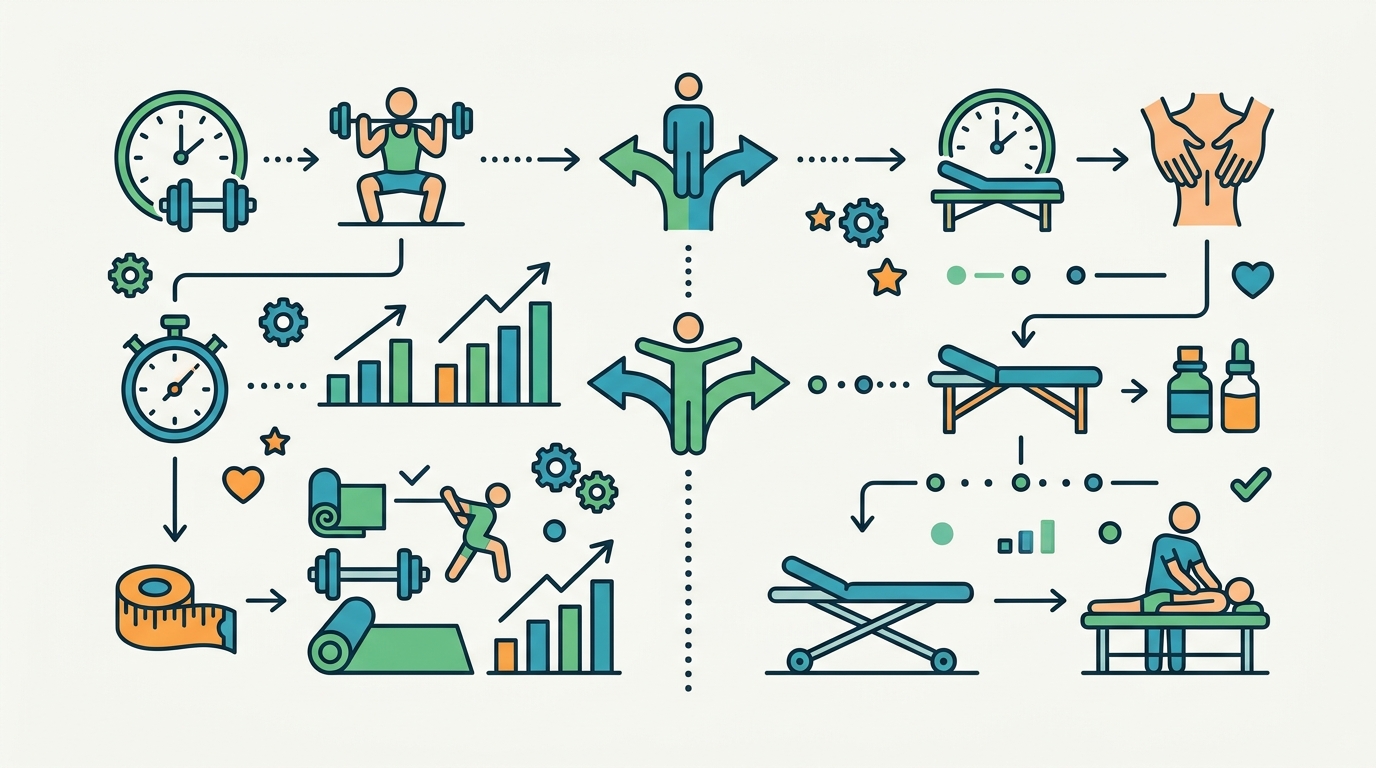
Both careers let you leave a desk, work hands-on with people, and build a book of repeat clients without a four-year degree. The difference is the gate: massage therapy usually means an approved program and a licensing exam before you touch a paying client, while personal training usually means a certification plus CPR, first aid and AED cards (U.S. Bureau of Labor Statistics, 2025).
If you are switching from a full-time job, plan on 6 to 18 months to qualify and another 6 to 12 months to rebuild income — a year or two of lower earnings, not a clean swap.
Side-by-Side Comparison
The Bureau of Labor Statistics publishes median annual and hourly pay for both occupations in its 2025 data — look the current figures up directly. Outside the US, use your national statistics body (ONS in the UK, Statistics Canada, the ABS in Australia), because pay, licensing and even job titles differ.
| Dimension | Personal trainer (fitness trainer/instructor) | Massage therapist |
|---|---|---|
| Time to qualify | Certification before working with clients, plus CPR, first aid and AED certification (BLS, 2025) — commonly 2 to 6 months part-time | Approved program plus a licensing exam where states regulate practice; some states add background checks, liability insurance and CPR (BLS, 2025) — commonly 9 to 18 months |
| Entry-level education | No degree beyond secondary school in most cases; the certification is the gate (BLS, 2025) | A postsecondary massage program is the typical credential (BLS, 2025) |
| Median pay | Published as an annual and hourly median for fitness trainers and instructors (BLS, 2025); usually paid per session or class, often with the gym taking a share | Published as an annual and hourly median for massage therapists (BLS, 2025); usually paid per hour of table time, plus tips or minus booth rent |
| Physical demand | Demonstrating, spotting and standing all day; strain is cumulative | Physically demanding, with repetitive-motion problems and fatigue from standing for extended periods the most common issues (BLS, 2025) |
| Schedule | Variable or part-time hours, often nights, weekends or holidays (BLS, 2025) | Appointment-based; part-time work is common and weekly hours vary considerably (BLS, 2025) |
| Where the jobs are | Gyms, studios, recreation centres, employer wellness programs | Spas, chiropractic and physician offices, franchised clinics, self-employment (BLS, 2025) |
| Typical starting age for switchers | Late 20s to late 40s; entrants in their 50s usually do best in a niche | 30s to 50s; entrants in their 50s and 60s are unremarkable in clinical settings |
What Each Job Looks Like Day to Day
As a personal trainer you sell attention as much as exercise. A day might open at 5:30am with two sessions before clients leave for work, then a gap until an evening block, so you write programs and chase renewals in the dead hours. You run intake assessments, fix someone's deadlift setup by hand, count tempo out loud and log every lift so next week progresses. Converting a free induction into a paying client is part of the job in most gyms. Variable and part-time schedules including nights, weekends and holidays are common (U.S. Bureau of Labor Statistics, 2025), and the split day is what pushes some people back out.
As a massage therapist the day is quieter and more contained. You take a short intake, ask about pain and contraindications, then work 50 or 80 minutes with the door closed, adjusting pressure and noting which structures you treated so the next appointment builds on it. Between clients you strip and remake the table, launder linens, sanitise, write a treatment note and rebook. Renting a room adds supplies, insurance and a no-show policy. The work is physically demanding, with repetitive-motion problems and fatigue from standing the most common issues (U.S. Bureau of Labor Statistics, 2025), so most experienced therapists cap their hands-on hours.
Which Fits Your Background
- Retail or restaurant manager: personal training. You already open early, close late, hit sales targets and talk to strangers all day — most of what a commercial gym floor asks for.
- Elementary or secondary teacher: personal training. Cueing a movement, breaking a skill into steps and managing a group are classroom instincts; group fitness is often the fastest paid entry.
- Nurse, aide or physical therapy assistant: massage therapy. Comfort with bodies, hygiene, consent and documentation transfers directly, and chiropractic and physician offices are among the larger employers of massage therapists (U.S. Bureau of Labor Statistics, 2025).
- Hairdresser, barber or esthetician: massage therapy. You already understand booking, rebooking, tips, booth rent and the economics of an hour of chair time — the hardest part for newcomers.
- Ex-military, police officer or tradesperson: personal training, especially with tactical or return-to-work clients, where your prior field is a credential people recognise.
- Career changer aged 50 to 65: both are realistic, but the ageism differs. Big-box gyms skew young and some managers assume a trainer in their 50s cannot demo hard lifts; specialising in older adults or post-rehab turns that around. Massage clinics rarely treat age as a problem — the limit is your hands and shoulders.
How to Decide and Test the Waters
- Buy the cheapest credential first. CPR, first aid and AED certification is needed by most fitness trainers and instructors anyway (U.S. Bureau of Labor Statistics, 2025), and several states fold CPR into massage licensing alongside background checks and liability insurance. One weekend, useful on either path.
- Shadow both in the same week. Ask a gym for two early-morning sessions and a clinic for a half-day at the front desk. You are testing whether the 5:30am-to-8pm split day is survivable and whether a closed treatment room feels calm or claustrophobic.
- Book the work as a customer. Pay for three trainer sessions and three massages with different practitioners. Ask each one their weekly hands-on hour cap, their rebooking rate, and what they wish they had known in year one.
- Check your own state's rules and pay. Massage therapy practice is regulated by states, and approved-program and exam requirements differ (U.S. Bureau of Labor Statistics, 2025). Pull current median pay for both occupations from the BLS 2025 data, or your national statistics agency.
- Trial it part-time, then price the gap. Certify as a trainer in 2 to 6 months and take evening clients while employed; massage programs are harder around a job, so confirm evening cohorts exist. Then total tuition, exam and licence fees, insurance, equipment and 6 to 12 months of reduced income. If savings won't cover it, stay employed until you hold 10 regular clients.
Frequently asked questions
Which career lets me quit my current job sooner?
Personal training, usually. Certification plus CPR, first aid and AED can be done in 2 to 6 months part-time while you keep working evenings. Massage therapy typically needs an approved program and a licensing exam, more often 9 to 18 months, and in regulated states you cannot work on paying clients until the licence issues (U.S. Bureau of Labor Statistics, 2025). Either way, allow 6 to 12 months after qualifying before income steadies.
Which one pays better?
Check the published medians rather than the anecdotes: the Bureau of Labor Statistics publishes median annual and hourly pay for both massage therapists and fitness trainers and instructors in its 2025 data, and state figures vary widely. The structure differs more than the headline. Massage therapists are paid per hour of table time, plus tips or minus booth rent, and most cap at roughly 4 to 6 hands-on hours a day because the work is physically demanding (U.S. Bureau of Labor Statistics, 2025). Trainers are paid per session or class, often with the gym taking a share, so earnings track how many of your 10 to 25 weekly slots fill.
Am I too old to start at 52?
Not unusual in either field, but the obstacles differ. Massage clinics routinely hire therapists in their 50s and 60s, and appointment-based, often part-time schedules (U.S. Bureau of Labor Statistics, 2025) make a staged entry easy; the real limit is repetitive-motion strain on hands and shoulders. Commercial gyms skew younger and some managers hesitate over trainers aged 50-plus, which is why switchers that age do better with older-adult or post-rehab clients. Plan 1 to 2 years either way before income recovers.
Sources
- U.S. Bureau of Labor Statistics — Massage Therapists : Occupational Outlook Handbook (2025)
- U.S. Bureau of Labor Statistics — Fitness Trainers and Instructors : Occupational Outlook Handbook (2025)

Written by
Priya tracks wages, layoffs, and the slow shifts in what counts as a stable job. She writes for readers trying to make sense of numbers that rarely match their own experience.