
Speech-Language Pathologist vs. Occupational Therapist: Key Differences Explained
Two therapy careers that overlap in schools and hospital wards but differ in caseloads, physical demands, certification routes and the tools used each day.
Quick answer
- Different scope day to day: a speech-language pathologist treats speech, language and swallowing; an occupational therapist treats the ability to carry out daily activities such as dressing, cooking and returning to work.
- Different physical demands: BLS (2025) describes occupational therapists as standing for long periods and sometimes lifting or moving clients, while its speech-language pathology entry emphasises the range of settings rather than lifting.
- Different credentials: ASHA's CCC-SLP requires a minimum of 400 clock hours of supervised clinical experience, while the OTR credential comes from passing NBCOT's national certification exam and keeping 'Active in Good Standing' status.
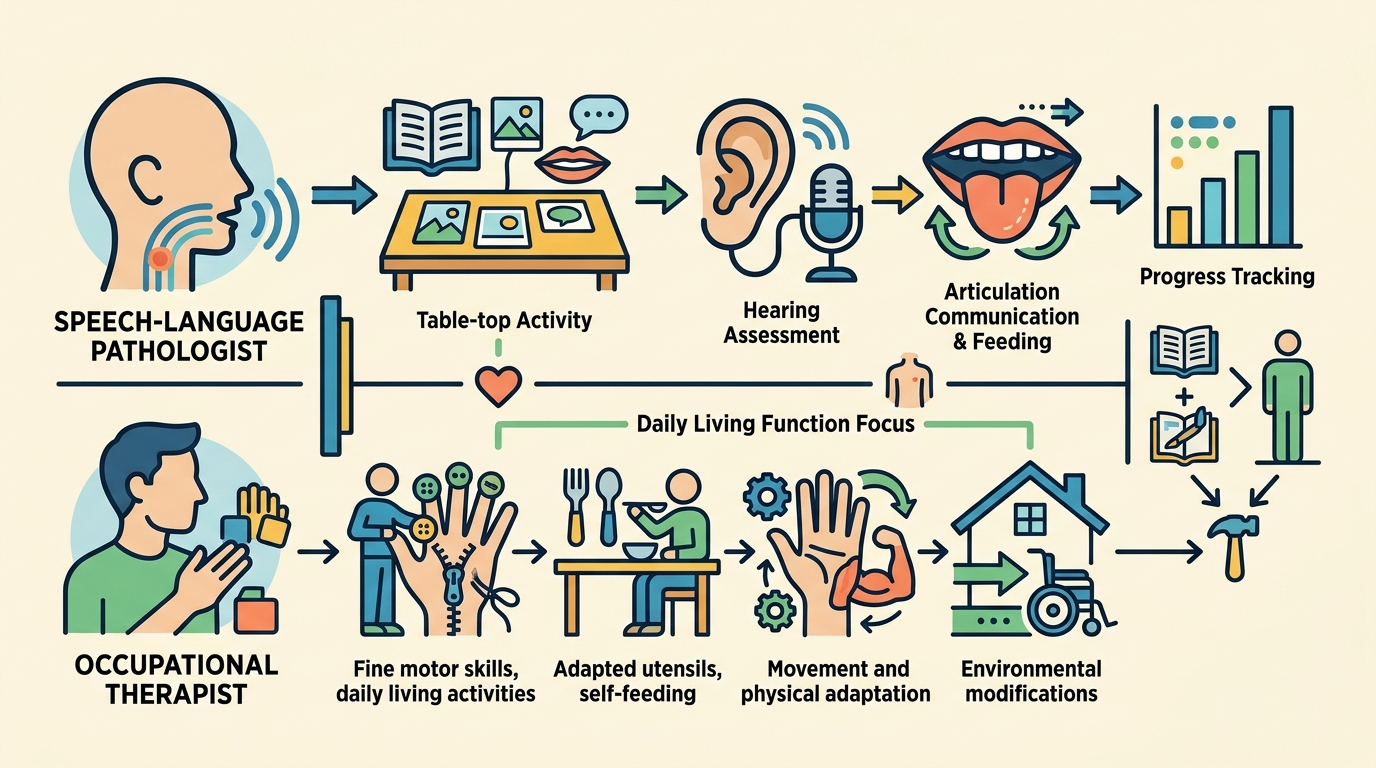
Speech-language pathologists work on communication and swallowing; occupational therapists work on the everyday activities a person needs to do, from dressing to returning to a job. In the United States, every state requires a license for both occupations (U.S. Bureau of Labor Statistics, 2025), and each has its own national credential — the ASHA Certificate of Clinical Competence for speech-language pathologists and NBCOT certification for occupational therapists.
This guide uses U.S. occupational titles and data (Bureau of Labor Statistics and O*NET). Outside the U.S., both roles exist under similar names but with different regulators, training routes and pay structures, so check your national health professions regulator before planning a route in.
Side-by-Side Comparison
The table below uses the same five categories for both occupations. Where the published value is a live figure that changes with each release, the table names the source and year so you can read the current number yourself rather than a stale one.
| Category | Speech-Language Pathologist | Occupational Therapist |
|---|---|---|
| Median pay | Median annual wage published by the U.S. Bureau of Labor Statistics (2025) in the Occupational Outlook Handbook entry for speech-language pathologists | Median annual wage published by the U.S. Bureau of Labor Statistics (2025) in the Occupational Outlook Handbook entry for occupational therapists |
| Typical education and credential | Typical entry-level education listed by BLS (2025); ASHA's Certificate of Clinical Competence in Speech-Language Pathology (CCC-SLP) requires a minimum of 400 clock hours of supervised clinical experience; O*NET assigns the occupation a Job Zone classification | Typical entry-level education listed by BLS (2025); NBCOT-certified OTR professionals have completed occupational therapy education and passed a national certification exam, and only those holding 'Active in Good Standing' status may use the OTR credential; O*NET assigns the occupation a Job Zone classification |
| Licensure | All states require licensure; requirements vary by state but typically include clinical experience and passing an exam (BLS, 2025) | All states require occupational therapists to be licensed (BLS, 2025) |
| Physical demands and setting | Some work in schools, others in private practice, hospitals, or nursing and residential care facilities (BLS, 2025) | Work in settings such as hospitals, schools and outpatient clinics; stand for long periods and may need to lift or move clients (BLS, 2025) |
| Schedule type | Most work full time, but part-time work is common (BLS, 2025) | Hours follow the setting — hospital, school or outpatient clinic (BLS, 2025); check the current Handbook entry for the published full-time and part-time pattern |
| Growth outlook | BLS publishes a 2025–35 job outlook, a projected employment change and a 2025 employment count; O*NET publishes projected job openings for 2025–2035 | BLS publishes a 2025–35 job outlook, a projected employment change and a 2025 employment count; O*NET publishes projected job openings for 2025–2035 |
Read both Handbook entries in the same sitting. Medians cover all workers in the occupation, including people with decades of experience, so they tell you about the middle of the field rather than what a first post pays.
Day-to-Day Differences
Compare the first hour of a shift.
A school-based speech-language pathologist starts by checking the day's caseload schedule against students' individualised education programmes, then sets up for the first group — articulation cards or picture prompts, a mirror for showing tongue placement, or an augmentative and alternative communication device that needs charging and the right vocabulary page loaded. The first session might be four students pulled from class for twenty minutes of sound production practice, scored as correct or incorrect per trial.
An occupational therapist on a hospital unit starts at the chart instead: reviewing overnight notes, weight-bearing restrictions and precautions after hip surgery, then collecting a gait belt and adaptive equipment such as a reacher, a sock aid or a long-handled sponge. The first contact is often a patient getting out of bed to wash and dress, with the therapist grading how much help was needed and documenting it.
Entry-level staff in both jobs carry a smaller caseload, write notes under supervision, and follow treatment plans set with a senior colleague. Experienced clinicians run evaluations independently — a swallowing assessment with a radiologist in the case of speech-language pathology, a home safety assessment before discharge in occupational therapy — supervise students, and take on complex cases such as custom splinting or AAC device selection.
Which Career Is Right for You
- Choose occupational therapy if you are comfortable with work that involves standing for long periods and lifting or moving clients, which BLS (2025) names directly in its description of the role.
- Choose speech-language pathology if part-time or term-time work matters to you: BLS (2025) notes that most speech-language pathologists work full time but that part-time work is common, and school posts follow the academic calendar.
- Choose occupational therapy if you want to work on practical physical tasks — transfers, dressing, hand strength, adaptive equipment and getting someone back to driving or work — rather than on speech sounds, language and swallowing.
- Choose speech-language pathology if you are willing to complete a minimum of 400 clock hours of supervised clinical experience for ASHA's CCC-SLP, and you want a caseload built around repeated short sessions with the same clients over a school year.
- Choose occupational therapy if you prefer a credential route that centres on a single national certification exam from NBCOT, with 'Active in Good Standing' status required to keep using the OTR credential.
- Choose either only if you can meet state licensure requirements where you intend to work: all states license both occupations, and speech-language pathology requirements vary by state but typically include clinical experience and passing an exam (BLS, 2025).
Frequently asked questions
Which one pays more starting out?
The Bureau of Labor Statistics publishes a 2025 median annual wage for each occupation separately, and those medians cover all workers rather than new graduates. Compare the two Occupational Outlook Handbook entries directly, then look at the state and industry wage tables, because pay differs sharply between school districts, hospitals and nursing and residential care facilities. Neither credential guarantees a higher offer than the other in a given setting.
Which field is growing faster?
BLS publishes a 2025–35 job outlook and a projected numeric employment change for both speech-language pathologists and occupational therapists, alongside 2025 employment counts for each. O*NET also publishes projected job openings for 2025–2035 for both. Check the two figures together: a larger percentage growth on a smaller base can mean fewer actual openings than slower growth in a bigger occupation.
Can I switch from one to the other later?
Not without starting the education again. The credentials do not transfer: speech-language pathology leads to ASHA's CCC-SLP, which requires a minimum of 400 clock hours of supervised clinical experience, while occupational therapy leads to NBCOT certification through a national certification exam. You would also need a separate state license, since all states license both occupations (BLS, 2025).
Which job is harder on the body?
BLS (2025) states that occupational therapists stand for long periods and may need to lift or move clients, which is a specific physical demand of the role. Its speech-language pathology entry instead highlights the range of settings — schools, private practice, hospitals, and nursing and residential care facilities. Speech-language pathologists in medical settings still assist with positioning and feeding, so the gap narrows outside schools.
Sources
- U.S. Bureau of Labor Statistics — Speech-Language Pathologists : Occupational Outlook Handbook (2025)
- U.S. Bureau of Labor Statistics — Occupational Therapists : Occupational Outlook Handbook (2025)

Written by
Priya tracks wages, layoffs, and the slow shifts in what counts as a stable job. She writes for readers trying to make sense of numbers that rarely match their own experience.


