Teacher Interview Questions: What to Expect and How to Prepare
From the observed demo lesson to the safeguarding question, here is how teaching panels actually run and what hiring heads listen for in each answer.
Quick answer
- Expect to teach: prepare one adaptable short lesson you can run with an unfamiliar class, plus a written plan you can hand to observers.
- Have three stories ready — a behaviour turnaround, an assessment-driven intervention and a difficult parent conversation — each with a result you can explain.
- Rehearse a plain answer to the child protection question: what you noticed, who you told, how quickly, and what you wrote down.
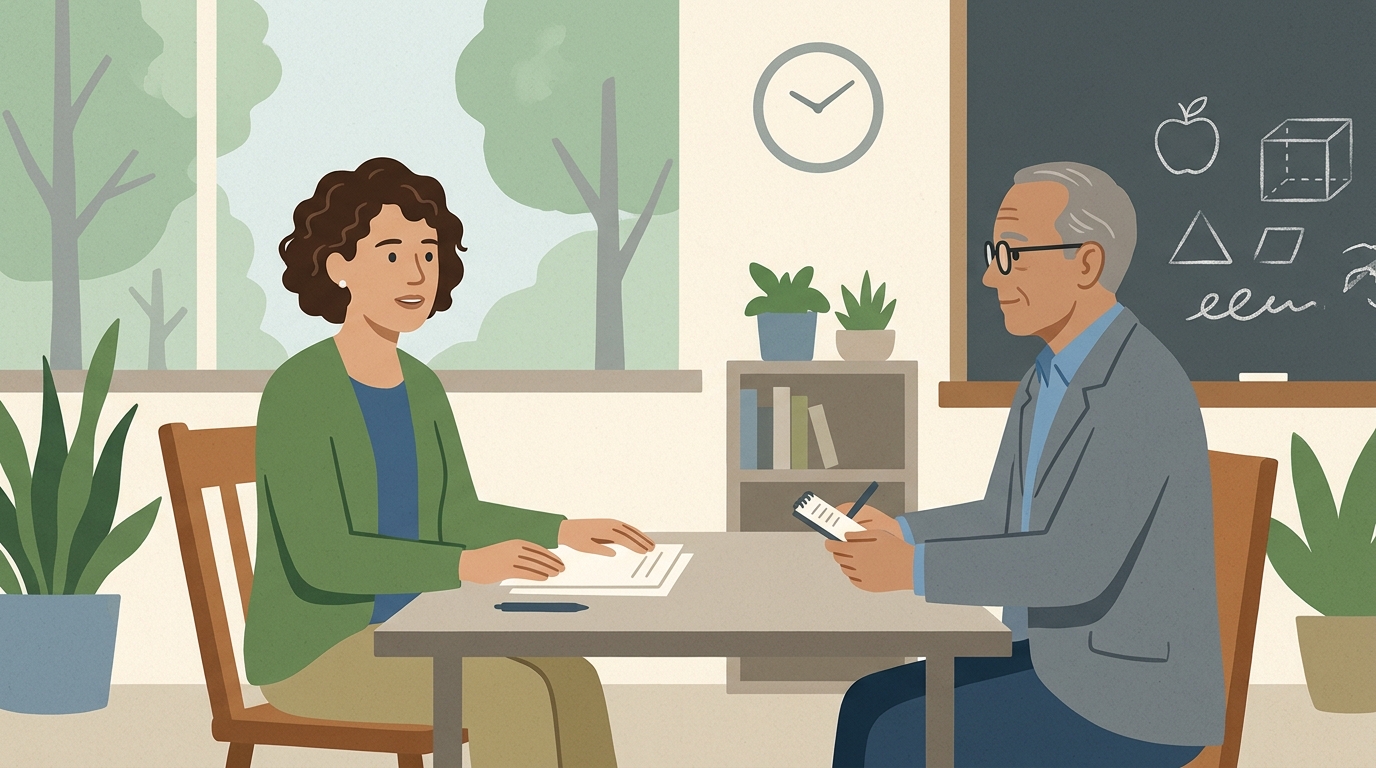
Teaching interviews rarely stop at a conversation. Most schools want to see you with students — a demonstration lesson, a planning or data task, and a panel that usually includes a head of department and a senior leader — before they decide.
This guide walks through the format you can expect, the questions that come up again and again, model answers built on the Situation–Task–Action–Result pattern, and the specific habits that lose otherwise strong candidates the post. Exact stages vary by employer, state and country, so read the invitation email closely and ask what each stage involves.
What This Interview Usually Covers
Most teaching posts are filled over a half or full day in the school, not in a single meeting. A typical day includes a tour, a demonstration lesson with a class you have never met, and a formal panel interview. Panels are usually small: the principal or head, a head of department or year leader, and sometimes a board member, governor or senior teacher. Some schools add a student panel, a written task (marking a sample script, responding to a parent email, or planning from a set of assessment data), and an informal lunch that is more observed than it looks.
In systems where a district, trust or ministry recruits centrally, you may face a pool or screening interview first and a school-level interview second. Child protection and safeguarding questions are standard almost everywhere, as are questions about inclusion and adapting work for different learners. Decisions are often made the same day, with an offer conditional on references and background checks. The number of rounds, the length of the demo lesson and whether you are paid for the day vary by employer, state and country — ask the person arranging your visit, in writing, what each stage involves and how long the lesson should run.
Common Questions and Sample Answers
How do you manage behaviour in your classroom?
Sample answer
A lower-secondary class of mine took most of the opening of every period to settle. My task was to recover teaching time without relying on sanctions. I built a short entry routine — a question on the board, books out, silent start — taught it explicitly over a fortnight, and logged settling times on my seating plan so I could see whether it was working. I phoned home about the students who shifted first rather than only about those still off task. By the end of the half term the class was working before the register finished, and referrals dropped to the occasional one.
How do you adapt a lesson for a wide range of abilities?
Sample answer
I inherited a mixed class with a reading-age spread of several years. I needed one lesson that worked for all of them, not separate lessons. I planned from a single core task with three entry points: a scaffolded text with glossed vocabulary, the standard text, and an extension source, all sharing the same success criteria sheet. I used mini-whiteboards at set checkpoints to see who needed pulling back. By the end of term most of the class met the core criteria independently, up from around half at the start.
Tell us about a lesson that did not go well.
Sample answer
I planned a practical group investigation for a Friday afternoon class with one set of equipment between six groups. The task was measurement error; the reality was queueing and off-task talk. I stopped the activity halfway, demonstrated one trial at the front, and had groups record from my data instead. Afterwards I rewrote the plan as a carousel of stations with a timer. When I taught it again the following year, every group completed their trials and the exit tickets showed nearly all students could name a source of error.
How do you use assessment to plan your teaching?
Sample answer
After a mid-year test my class average looked acceptable, but I wanted to know what was hiding underneath it. I built a question-level analysis in a spreadsheet, tagging each question by topic. Two topics — fractions of amounts and ratio — accounted for most of the lost marks. I rebuilt the following lessons around those two, revisited them weekly in low-stakes starters, and re-tested with the same question types. On the retest those topics moved from the weakest section of the paper to in line with the rest.
Describe a time you worked with a parent or caregiver about a struggling student.
Sample answer
A student in my form group had missed a large part of the term and was falling behind in three subjects. My task was to get the family on side rather than issue warnings. I called home with two positives first, then asked what mornings looked like, and learned the student was caring for a younger sibling. We agreed a check-in with me before registration, a catch-up folder from each subject teacher, and a fortnightly call. Attendance improved steadily and the student passed every subject they had fallen behind in.
What would you do if a student disclosed something that worried you?
Sample answer
A student stayed behind after class and mentioned something at home that concerned me. My responsibility was to listen without promising confidentiality and without questioning her further. I let her speak, told her plainly that I had to pass it on to keep her safe, and took it to the designated child protection lead the same lesson. I wrote my record that afternoon in the school's reporting system using her words rather than my interpretation, and did not discuss it with colleagues. I would follow whatever reporting procedure this school uses, and I would ask for that policy on day one.
How do you support students with additional needs or who are learning the language of instruction?
Sample answer
I had three new arrivals with limited English in a mainstream class. The task was access to the curriculum, not a separate curriculum. I pre-taught key vocabulary with images at the start of each unit, provided sentence starters and a bilingual glossary, and paired each student with a buddy for the first half term. I met the support teacher fortnightly to agree next steps. By the end of the unit all three were writing full paragraphs using the target vocabulary, and one presented his work to the class.
What would you contribute beyond your own classroom?
Sample answer
My department had no shared resources for a new syllabus unit, so everyone was planning alone. I offered to build a common bank. I created a shared folder with a knowledge organiser, a full set of lesson decks and a common assessment, then ran a twilight session so colleagues could adapt them. Nearly everyone in the department used the materials that term, and we moderated the assessment together for the first time. I would do the same here, and I also run a debating club I would like to continue.
Mistakes That Cost Candidates the Job
- Teaching the demo lesson at the class rather than with it — no questioning, no circulating, no check of who understood. Panels watch whether students work, not whether you perform.
- Answering the behaviour question with a list of sanctions and no routine, relationship or follow-up call home.
- Being vague on child protection: saying you would "talk to the student" or "keep it between us" instead of naming the designated lead and a same-day written record.
- Criticising a previous school or head when asked why you are leaving. Give a forward-looking reason — a phase, subject or leadership opportunity you want next.
- Describing differentiation as "easier worksheets for the lower group" rather than the same outcome reached through different scaffolds.
- Arriving with no questions, or asking only about free periods, parking and holidays. Ask about induction, the mentoring arrangement, or how the department moderates assessment.
- Quoting progress you cannot explain — saying a class "improved a lot" and then having no idea how it was measured when the head of department asks.
- Running over in the demo lesson so there is no plenary. Time it in advance and build a short finish you can drop in early.
Frequently asked questions
What should I wear to a teaching interview?
Dress a step smarter than the school's staff dress code, but wear something you can teach in: flat or low shoes, sleeves you can push up, nothing that swings when you lean over a desk. Check photographs on the school's website or its published staff handbook before you choose.
Should I bring anything with me?
Bring a printed copy of your demo lesson plan for every panel member, plus seating-plan notes, a one-page summary of a class's progress with names removed, or a short portfolio of student work. Pack your own board pens and a USB copy of your slides in case the room's tech fails.
When should I ask about pay?
Let the panel raise it, or ask once an offer is made. Before the day, look up the published teachers' pay scale on your state, provincial or national education department website and your teaching union's pay page, then work out where your qualifications and years of service place you on it.
How soon will I hear back?
School-based hiring is often decided the same day, sometimes before you reach home. Ask at the end: "What is your timeline, and how will you let candidates know?" If the day passes with no word, email the named contact after a couple of working days.
Should I send a follow-up email?
Yes — the same day or the next morning, to the person who arranged your visit. Keep it short: thank them, name one specific thing from the day (a student's answer, the department's approach to moderation), restate your interest, and offer to send anything still outstanding.
What if I only have practicum or placement experience?
Use it directly and precisely: name the year group, class size, subject and length of placement, and give one measurable outcome such as an assessment improvement or an attendance change. Say what your mentor's final report identified as your strength, and what you are working on next.

Written by
Wyatt covers work outside the office: construction, logistics, repair, and the people who keep things running. He's skeptical of career advice that assumes everyone sits at a desk.