Warehouse Resume Tips (With Examples)
How to turn picking, loading and forklift hours into a scannable resume that survives software filters and a supervisor's quick first skim.
Quick answer
- Put equipment and systems — forklift type, pallet jack, RF scanner, WMS — in the top third of page one, not buried in your oldest job.
- Give every bullet a number: units per hour, pick accuracy, trailers unloaded, days without an incident.
- Save as a PDF unless the posting names another format (CareerOneStop, U.S. Department of Labor, undated) and name the file with your name and the job title.
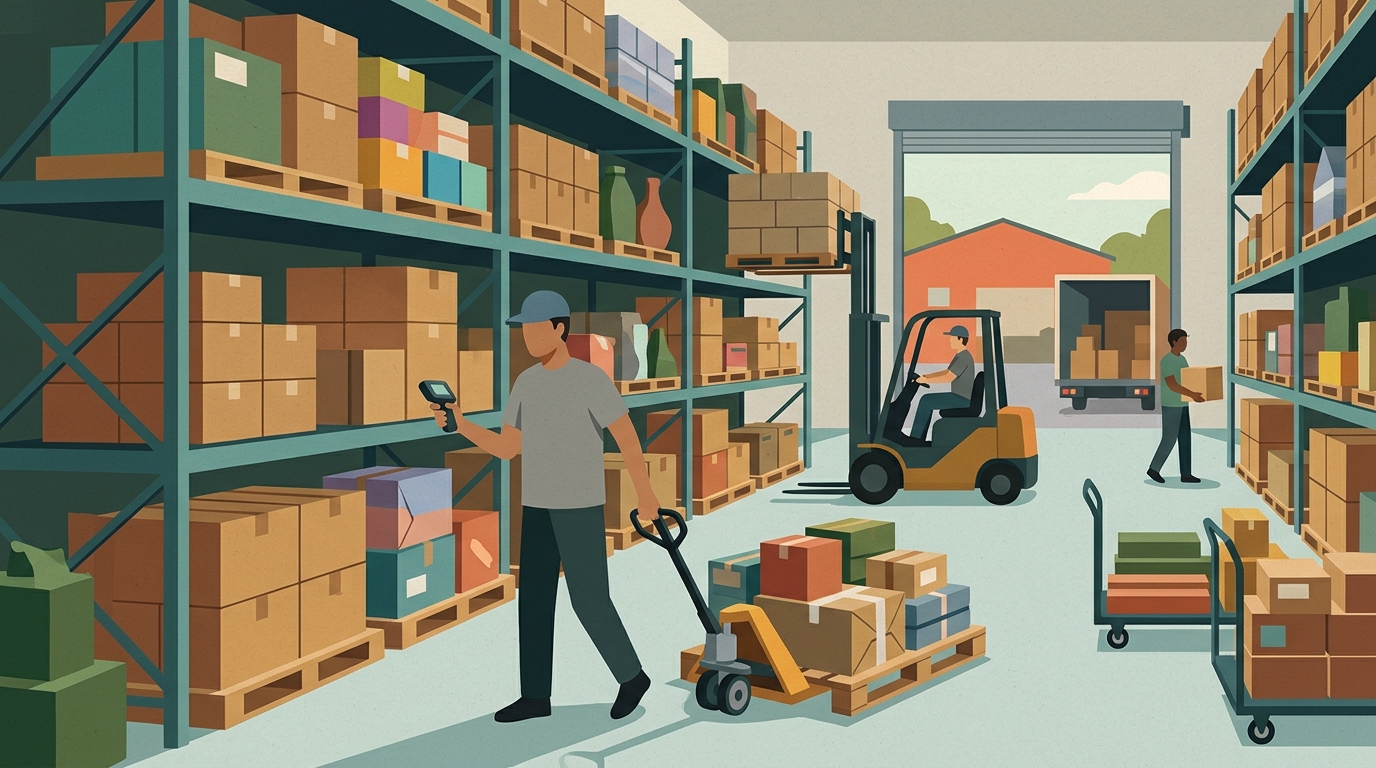
A warehouse resume is judged fast and on narrow grounds: can you move stock safely, hold a rate, and run the equipment the site already owns. Employers often spend less than 30 seconds on a resume in the first pass when deciding whether to keep or discard it (CareerOneStop, U.S. Department of Labor, undated), so your equipment, systems and numbers belong in the top third of page one.
Below: what goes in each section, sample bullets and cover letter lines you can adapt, and a checklist to run against your own file before you send it.
What Hiring Managers Look For
The first read is a skim. One eye-tracking study found recruiters spent an average of six seconds judging a candidate's fitness from a resume (Recruiter.com, undated), and a follow-up study by TheLadders put it at 7.4 seconds (Spectacle Talent Partners, undated). In that time a warehouse hiring manager looks for four things: your most recent job title, the equipment you have operated, the shift you are available for, and whether your dates run continuously.
Before a person sees it, software may filter it. Around 97.8 percent of Fortune 500 companies use an applicant tracking system or recruiting management system (Coursera, undated), and large distribution employers are often among them. Match the posting's own words. Sample reported job titles for this occupation include Laborer, Loader, Material Handler, Receiving Associate, Shipping and Receiving Materials Handler and Warehouse Worker (O*NET OnLine, U.S. Department of Labor, undated) — use the one in the advert rather than a title you made up.
The skills recruiters scan for on a warehouse associate resume include RF scanner operation, Warehouse Management Systems (WMS), order picking and packing, inventory management, forklift certification such as sit-down and reach, pallet jack operation, quality control and safety compliance (Indeed Flex Career Hub, 2026). Commonly listed technical skills also include forklift operation, hand truck operation and electric pallet jack operation (Indeed, undated). If you can do them, name them in those exact words.
How to Build It Section by Section
Commonly included resume sections are contact information, a job objective or summary of qualifications, work experience and accomplishments, and education or training (CareerOneStop, U.S. Department of Labor, undated). Build them in this order.
1. Header and target title. Name, phone, email and city at the top, then the advert's job title. - Before: Looking for warehouse work - After: Warehouse Worker — Reach Truck, RF Scanner, WMS 2. A four-line summary of qualifications, not an objective. Lead with years, equipment and one number. - Before: Reliable worker seeking a role in a busy depot. - After: Material handler, 4 years in third-party logistics. Sit-down and reach forklift, electric pallet jack, RF scanning. Averaged 165 picks per shift at 99.5% accuracy. 3. Experience newest first, with employer, site type and dates. Use Month, YYYY and avoid abbreviations such as '19 (CareerOneStop, undated): write March 2021 – Present, not 3/21–now. 4. Turn duties into measured bullets. A core task for the occupation is moving freight, stock or materials to and from storage, production areas, loading docks or vehicles, by hand or using trucks and other equipment (ONET OnLine, undated) — so quantify the volume. - Before: Loaded trucks and kept the area tidy. - After: Loaded 18–22 outbound pallets per hour on an electric pallet jack, supporting a 98% on-time dispatch rate. 5. Skills block in the posting's vocabulary. Replace good with machines with sit-down counterbalance forklift, reach truck, electric pallet jack, hand truck, RF scanner, WMS lookups, cycle counting. 6. Certifications and training line. Under U.S. OSHA's powered industrial truck standard, only trained and competent operators may operate a powered industrial truck, and all operators must be trained and certified by their organisation (OSHA, undated). Licensing differs by country, state and employer, so write what you hold and when: Forklift operator training (sit-down, reach), employer-certified, renewed June 2024*. 7. Format for the skim. Keep to 1–2 pages, 10–12 point type and roughly one-inch margins for white space (CareerOneStop, undated). Delete photos, columns and skill bars; tracking software cannot read them.
Sample Bullets and Cover Letter Lines
Adapt the structure and swap in your own true numbers.
Order picking
Resume bullet — picking rate
Picked and packed 180 orders per shift on an RF scanner, holding 99.6% pick accuracy across 12 months.
Forklift and unloading
Resume bullet — inbound
Operated a sit-down counterbalance forklift to unload 25–30 inbound trailers per week, clearing each dock bay within 45 minutes of arrival.
Inventory accuracy
Resume bullet — cycle counting
Cycle-counted 4,000 SKUs per quarter in the WMS and cut stock variance from 2.1% to 0.4% in six months.
Safety record
Resume bullet — safety
Filed 14 near-miss reports and co-led weekly toolbox talks on racking clearance, contributing to 400 consecutive days without a lost-time injury on nights.
Loading and dispatch
Resume bullet — outbound
Shrink-wrapped and staged 120 pallets per shift across 11 scheduled routes, keeping dispatch delays under 5 minutes per route.
Training others
Resume bullet — onboarding
Trained 6 seasonal hires on RF scanner and pallet jack use, cutting ramp-up to full pick rate from 3 weeks to 9 days.
Cover letter opening
Opening line
I am applying for your Receiving Associate opening. I have 4 years unloading containers and booking stock into a WMS, most recently averaging 28 trailers a week.
Cover letter proof line
Middle paragraph
Your advert asks for reach truck experience and accuracy under pressure: I hold employer-issued reach and sit-down training and finished last peak at 99.5% pick accuracy over 11 weeks of six-day working.
Cover letter close
Closing line
I am available for nights and weekends, can start within two weeks of an offer, and am happy to complete a practical equipment assessment on site.
Before You Submit
Open your file and answer yes or no to each.
- Is the document 1–2 pages, with no third page carrying a single line (CareerOneStop, U.S. Department of Labor, undated)?
- Is the body text 10–12 point, in one font throughout (CareerOneStop, undated)?
- Are the margins roughly one inch on all four sides (CareerOneStop, undated)?
- Do your name, phone, email and city sit in the body of page one, not inside a header or text box?
- Does the job title at the top match the advert word for word?
- Does every employment date use Month, YYYY or MM/DD/YYYY, with no entries like '19 (CareerOneStop, undated)?
- Does each bullet in your two most recent jobs contain a number — units, percentage, trailers, SKUs or days?
- Have you deleted every photo, logo, icon, column and skill bar?
- Does your skills block name the equipment and systems from the posting, such as RF scanner, WMS, pallet jack or forklift type (Indeed Flex Career Hub, 2026)?
- Does the certification line state the training, the issuer and the date?
- Is the file saved as a PDF unless the posting names another format (CareerOneStop, undated)?
- Is the file named Firstname-Lastname-Warehouse-Worker.pdf, and are you attaching only the documents the posting requested (CareerOneStop, undated)?
Frequently asked questions
How long should a warehouse resume be?
One to two pages (CareerOneStop, U.S. Department of Labor, undated). Under five years of experience, keep it to one page: give your most recent job five or six quantified bullets and older jobs one line each with title, employer and dates.
Which file format should I send?
Send a PDF unless the employer specifies otherwise, because it preserves formatting (CareerOneStop, undated). Where no format is named, Word, PDF or plain text are all acceptable (CareerOneStop, undated). For a plain-text paste box, change bullets to hyphens and remove tabs.
Do I need a forklift certificate before applying?
Not always, but state plainly what you hold. In the United States, OSHA's powered industrial truck standard requires operators to be trained and certified by their organisation (OSHA, undated). Rules differ by country and state, so list the training, issuer and date, and apply to roles offering on-site training.
What if I have no warehouse experience?
Lead with measurable transferable work: stockroom, retail delivery, kitchen or farm. Write "Unloaded and checked in 40 delivery cages per week against paperwork" rather than "helped with stock." Add one line stating the shifts you can cover.
How should I handle pay expectations?
Leave pay off the resume. Warehouse pay is usually hourly, with shift differentials and overtime, and varies by employer, site, state and country. Before the interview, check your national statistics or labour market agency for current rates in your region, then quote a range.
Sources
- CareerOneStop (U.S. Department of Labor) — Resume format
- Recruiter.com — TheLadders Reveals Research Reporting that Resumes Spend Six Seconds with a Recruiter

Written by
Marisol steers Jobladderhq's coverage of hiring trends and the strange rituals of modern recruiting. She's drawn to the gap between what job ads promise and what the work actually feels like. Her editing hand favors clarity over jargon, always.