What Does a Chef Do? Duties, Skills, and Salary Explained
A look inside the working life of a chef, from prep lists and knife work to rota planning, food safety checks and how kitchen pay is structured.
Quick answer
- Most chefs enter through cooking experience plus on-the-job training; some complete culinary programmes or apprenticeships (BLS, 2025).
- Check the median annual wage for chefs and head cooks (U.S. Bureau of Labor Statistics, May 2025).
- For demand, see the BLS 2025–35 employment projection and average annual openings for chefs and head cooks.
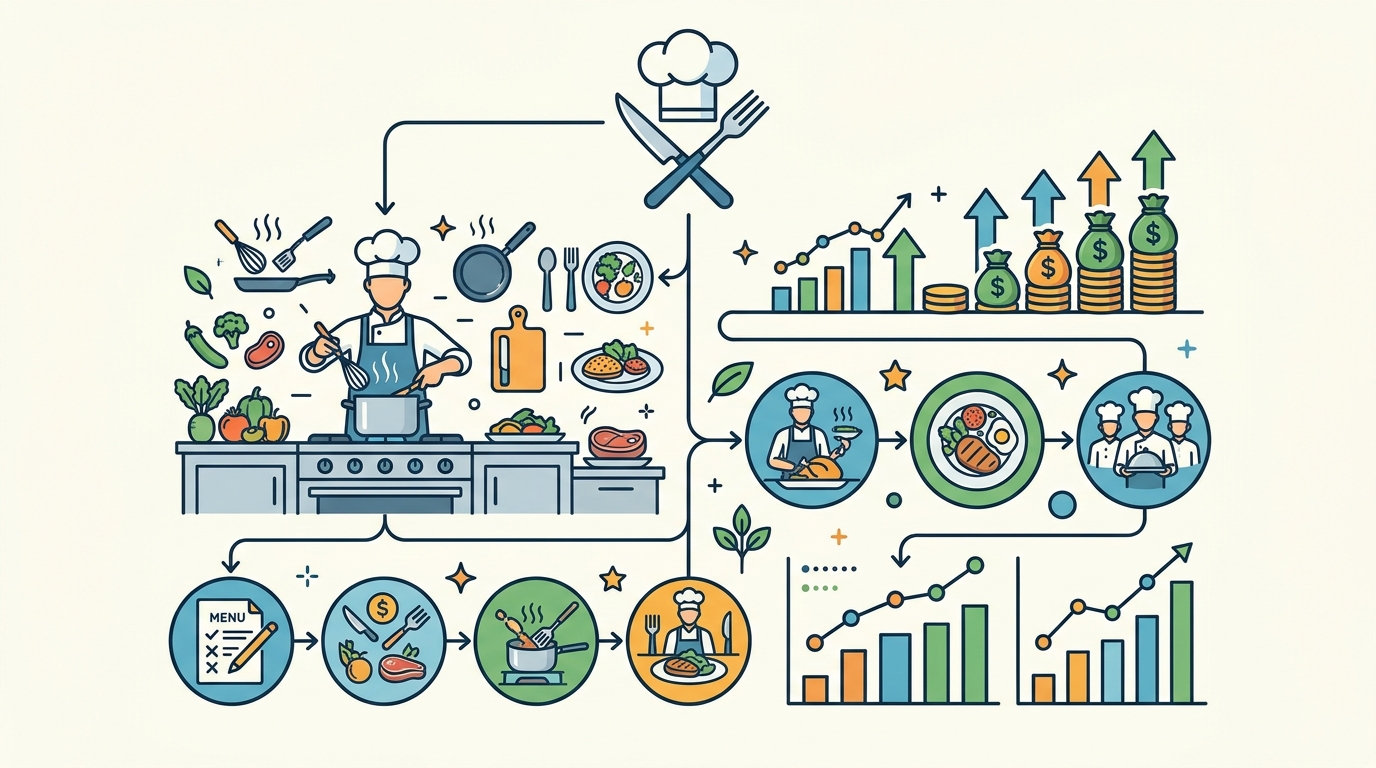
A chef runs the food side of a kitchen: planning menus, developing recipes, checking the freshness of ingredients, supervising cooks and monitoring sanitation practices (U.S. Bureau of Labor Statistics, 2025). The title covers everything from a sous chef who is the kitchen's second-in-command to a head chef who owns the menu, the costs and the standards (U.S. Bureau of Labor Statistics, 2025).
It is hands-on, standing work built around service times rather than office hours, and most chefs reach the role through years of cooking experience rather than a single qualification. Pay, licensing and job titles differ by country, state and employer, so check current local figures before you commit.
What This Job Involves Day to Day
A dinner-service chef's day often starts long before customers arrive.
7:30 a.m. You unlock the kitchen and go straight to the step-in cooler to check deliveries against the order sheet, smelling and inspecting fish, dairy and produce for freshness before anything is signed for. Anything questionable goes back on the van, not onto the pass.
8:30 a.m. Prep list. You break down proteins with your own high-quality knives, set the meat slicer up for charcuterie, and run trim through the grinder for the day's burger mix. Stocks go on. Temperatures and cooling times get logged.
10:30 a.m. Office time, usually in a cupboard beside the walk-in. You place orders and build next week's rota in whatever scheduling and purchasing software the business uses, cost a new special against the current invoice prices, and adjust the menu if a supplier price has jumped.
12:00 p.m. Lunch service. You expedite from the pass, calling tickets, checking plates for seasoning and presentation, and instructing cooks on garnish and plating as dishes go out.
3:00 p.m. Changeover. You taste the sauces, walk the line for cross-contamination risks, check hand-wash stations and fridge temperatures, and run a short briefing with the evening team on the specials and any allergen changes.
6:00 p.m. to close. Dinner service, then breakdown: wrapping, labelling, rotating stock, writing tomorrow's prep list and signing off the cleaning schedule.
The tradeoff is plain. These hours fall on evenings, weekends and holidays, and most chefs work full time (U.S. Bureau of Labor Statistics, 2025). Shifts are long and spent almost entirely standing, often an entire evening on your feet (U.S. Bureau of Labor Statistics, 2025).
Common Tasks and Responsibilities
- Check the freshness of food and ingredients on delivery and before service, rejecting anything below standard (U.S. Bureau of Labor Statistics, 2025).
- Plan menus around seasonality, equipment capacity and ingredient cost, then price dishes to hit a target margin.
- Develop and test recipes, recording quantities and method so any cook on the team can reproduce the dish exactly.
- Supervise cooks and other kitchen workers, assigning sections and setting the pace of prep and service (U.S. Bureau of Labor Statistics, 2025).
- Instruct cooks in the preparation, cooking, garnishing and presentation of food (O*NET OnLine, undated).
- Monitor sanitation practices, including hand-washing, storage, labelling and cleaning schedules (O*NET OnLine, undated; U.S. Bureau of Labor Statistics, 2025).
- Order stock and manage supplier relationships, tracking invoices and adjusting orders to control waste.
- Expedite service at the pass, checking every plate for portion, temperature and appearance before it leaves the kitchen.
- Run the kitchen in the head chef's absence if you are working as a sous chef, the kitchen's second-in-command (U.S. Bureau of Labor Statistics, 2025).
Salary and Job Outlook by Experience Level
Chef pay is usually a salary for senior roles and an hourly rate for junior ones, sometimes with service charge or tip pooling, a meal allowance and overtime rules that differ by country and state. Independent restaurants, hotels, contract caterers and institutional kitchens all pay differently, and location matters as much as job title.
The table below shows how the levels usually differ and where to look up the current figure rather than guessing at one.
| Level | Typical experience | How pay usually works | Where to check the current figure |
|---|---|---|---|
| Entry-level (commis, line cook moving up) | Cooking experience in a related kitchen role is typically needed before a chef title (U.S. Bureau of Labor Statistics, 2025) | Usually hourly, with overtime and sometimes shared service charge | Lowest wage decile for chefs and head cooks, BLS Occupational Employment and Wage Statistics, May 2025 |
| Mid-career (chef de partie, sous chef) | Several years on the line plus on-the-job training to reach competency (U.S. Bureau of Labor Statistics, 2025) | Hourly or salaried, section responsibility, occasional rota bonus | Median annual wage for chefs and head cooks, BLS, May 2025 |
| Experienced / senior (head chef, executive chef) | Long kitchen history plus budget and team management | Salaried, sometimes with a food-cost or profit bonus | Highest wage decile for chefs and head cooks, BLS, May 2025 |
Industry also moves the number: the U.S. Bureau of Labor Statistics publishes separate median annual wages for chefs and head cooks in traveler accommodation and in food services (May 2025).
On outlook, BLS reports the number of jobs held by chefs and head cooks, a projected employment change for 2025–35 and an estimate of average annual openings over that decade (U.S. Bureau of Labor Statistics, 2025).
Figures referenced: U.S. Bureau of Labor Statistics, Occupational Employment and Wage Statistics and Occupational Outlook Handbook, May 2025 data, published 2025. These are national U.S. figures; state and local pay vary. Outside the United States, use the national statistics agency for your country, such as the ONS in the UK, Statistics Canada, or the ABS in Australia.
Skills and Traits That Fit This Work
- Physical stamina. BLS lists it as an important quality for chefs and head cooks, who often work long shifts and sometimes spend an entire evening on their feet (U.S. Bureau of Labor Statistics, 2025); you will also lift stock and carry hot pans.
- Knife skills and speed. You need to break down a case of chicken or brunoise two kilos of shallots cleanly and quickly enough that prep is finished before the first ticket lands.
- Food safety discipline. You notice a fridge reading two degrees high at 9 a.m. and act on it, rather than finding out at 7 p.m. when the service is already running.
- Numeracy for costing. You can recost a dish when the price of butter rises and decide whether to change the portion, the supplier or the menu price.
- Supervisory judgement. You can correct a cook's plating mid-service in a way that fixes the dish without stalling the section.
- Palate memory and consistency. You can taste a sauce you last made three weeks ago and tell immediately that the reduction has gone too far.
- Composure under pressure. When a section goes down mid-service you re-deal the tickets and move someone across instead of letting the pass back up.
How to Get Started
- Get into a kitchen and learn the line. Chefs and head cooks typically need work experience in a related occupation plus on-the-job training to reach competency (U.S. Bureau of Labor Statistics, 2025). Apply through hospitality job boards, hotel and restaurant group career pages, and speculative CV drop-ins to kitchens you admire; commis chef, prep cook and line cook are the usual entry points.
- Check whether your area requires a food handler's certification. Some states and localities require chefs and head cooks to hold one (U.S. Bureau of Labor Statistics, 2025), and many employers require a food safety certificate regardless. Requirements differ by country, state and city, so confirm with your local health authority before accepting a role.
- Consider formal culinary training if the route suits you. Some chefs attend a culinary programme at a community college, technical school, culinary arts school or four-year college (U.S. Bureau of Labor Statistics, 2025). Certificate or diploma programmes commonly run from a few months to about a year, associate degrees about two years full time, and bachelor's degrees about four; confirm length and cost directly with the institution.
- Or apply to an apprenticeship. Apprenticeship programmes are a recognised path into the occupation (U.S. Bureau of Labor Statistics, 2025), combining paid kitchen work with structured training. Apply through national apprenticeship registers, employer schemes run by hotel and restaurant groups, and catering colleges.
- Target a sous chef position as your step into leadership. The sous chef is the kitchen's second-in-command, supervising cooks, preparing meals and running the kitchen in the head chef's absence (U.S. Bureau of Labor Statistics, 2025) — the usual proving ground before a head chef role.
Frequently asked questions
How does pay progress as you move up a kitchen?
Pay generally rises as you take on section, ordering and rota responsibility, with junior roles paid hourly and senior roles salaried. The spread is wide: the U.S. Bureau of Labor Statistics publishes lowest and highest wage deciles for chefs and head cooks alongside the median (May 2025). Industry matters too, with separate medians for traveler accommodation and food services.
Do I need a culinary degree to become a chef?
Not necessarily. Many chefs come up entirely through kitchen work, supported by on-the-job training (U.S. Bureau of Labor Statistics, 2025). Others attend a culinary programme at a community college, technical school, culinary arts school or four-year college, or complete an apprenticeship (U.S. Bureau of Labor Statistics, 2025). Check the typical entry-level education BLS lists for the occupation before deciding.
What are the hours and physical demands really like?
Chefs and head cooks often work early mornings, late evenings, weekends and holidays, and most work full time (U.S. Bureau of Labor Statistics, 2025). Physical stamina is listed as an important quality, because shifts are long and sometimes mean an entire evening on your feet (U.S. Bureau of Labor Statistics, 2025). Burns, cuts and heat are routine hazards.
What is the difference between a sous chef and a head chef?
The sous chef is the kitchen's second-in-command, supervising cooks, preparing meals and running the kitchen when the head chef is away (U.S. Bureau of Labor Statistics, 2025). The head chef owns the menu, the food cost and the standards, and usually spends more time on ordering, recipe development, rotas and supplier negotiation than on a single section.
Is demand for chefs growing?
The U.S. Bureau of Labor Statistics publishes a projected employment change for chefs and head cooks over 2025–35, together with the current number of jobs and an estimate of average annual openings across the decade (2025). Look up those figures in the Occupational Outlook Handbook, and use your own national statistics agency if you are working outside the United States.
What tools should I expect to use?
Kitchen and cooking equipment including step-in coolers, high-quality knives, meat slicers and grinders, with some chefs also using scheduling and purchasing software for rotas and orders (U.S. Bureau of Labor Statistics, 2025). Most chefs own their knives and maintain them personally. Temperature logs, allergen matrices and stock sheets are part of the daily routine in most kitchens.
Sources
- U.S. Bureau of Labor Statistics — Chefs and Head Cooks : Occupational Outlook Handbook (2025)
- O*NET OnLine (sponsored by U.S. Department of Labor, Employment and Training Administration) — 35-1011.00 - Chefs and Head Cooks

Written by
Marisol steers Jobladderhq's coverage of hiring trends and the strange rituals of modern recruiting. She's drawn to the gap between what job ads promise and what the work actually feels like. Her editing hand favors clarity over jargon, always.