
What Does a Claims Adjuster Do? Duties, Skills, and Salary
From the first notice of loss to the settlement decision: the investigating, estimating and negotiating work behind what an insurer actually pays out.
Quick answer
- Adjusters decide whether an insurance company must pay a claim and how much (U.S. Bureau of Labor Statistics, 2026-08-27).
- A high school diploma or equivalent is typically the minimum for entry-level adjusters, examiners and investigators; some employers prefer a bachelor's degree or insurance experience (U.S. Bureau of Labor Statistics, 2026-08-27).
- Licensing varies by state: some require prelicensing education, a passing exam score, or both, plus continuing education credits to renew (U.S. Bureau of Labor Statistics, 2026-08-27).
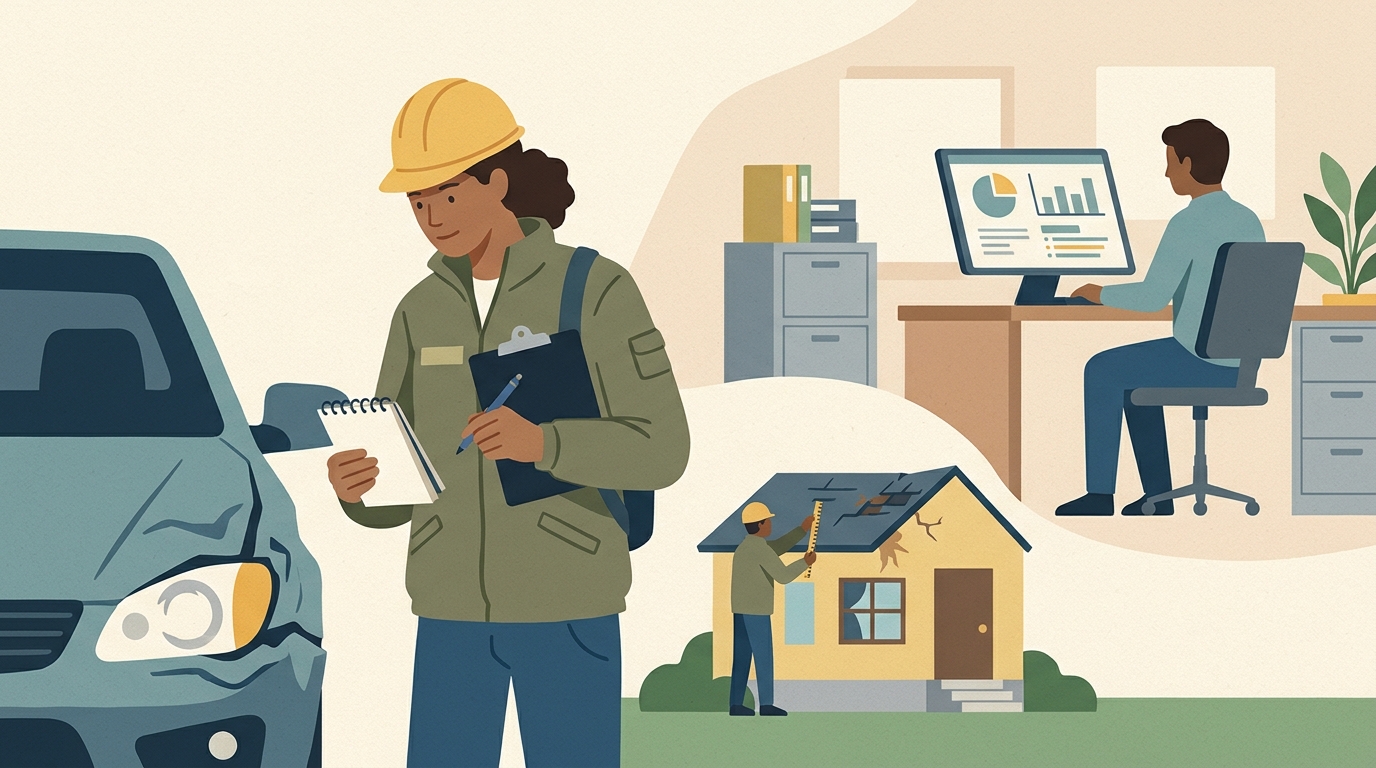
A claims adjuster evaluates insurance claims and decides whether the insurer has to pay, and how much (U.S. Bureau of Labor Statistics, 2026-08-27). The work splits between desk time — reading policy wordings, checking coverage, logging notes in claims software — and field time inspecting damaged cars, roofs, shops or machinery.
Entry usually starts with a high school diploma or equivalent, though some employers prefer a bachelor's degree or insurance experience (U.S. Bureau of Labor Statistics, 2026-08-27). Licensing rules differ sharply by state and by country, so check your own regulator before you train.
What a Claims Adjuster Does
A claims adjuster examines a reported loss and works out two things: does the policy cover it, and what is it worth. The occupation group — claims adjusters, appraisers, examiners and investigators — evaluates insurance claims and decides whether the insurance company must pay and how much (U.S. Bureau of Labor Statistics, 2026-08-27).
Standard tasks include examining claim forms and other records to determine insurance coverage, and investigating, evaluating and settling claims using both technical knowledge and people skills to reach a fair, prompt outcome (National Center for O*NET Development).
Adjusters and examiners work in offices reviewing documents and researching, then go out to examine damaged property; appraisers and investigators are outdoors more often, inspecting damaged automobiles and buildings (U.S. Bureau of Labor Statistics, 2026-08-27).
The main settings, by share of jobs in 2025, are direct insurance carriers other than life, health and medical; agencies, brokerages and other insurance-related businesses; the federal government; direct health and medical insurance carriers; and state government (U.S. Bureau of Labor Statistics, 2025). Outside the United States, the same work sits with insurers, loss-adjusting firms and government compensation schemes under local job titles.
Entry-level adjusters handle low-complexity, high-volume files — minor auto damage, small property claims — under supervisory review. Experienced adjusters take large-loss, commercial, liability or disputed files, negotiate with attorneys and public adjusters, and may audit the work of newer staff.
A Typical Day
- Opens the claims-processing system and sorts new first notice of loss files assigned overnight by severity and deadline.
- Reads the policy wording and examines claim forms and supporting records to determine whether the loss is covered (National Center for O*NET Development).
- Calls the policyholder for a statement and books an inspection, often in the evening or at a weekend to suit the client (U.S. Bureau of Labor Statistics, 2026-08-27).
- Drives to the loss site to inspect damaged property or a vehicle, photographing damage and taking measurements (U.S. Bureau of Labor Statistics, 2026-08-27).
- Builds a repair or replacement estimate in software such as Xactware Xactimate, listed as an in-demand technology for the occupation (National Center for O*NET Development).
- Chases police reports, medical records, repair invoices and contractor bids, filing them in a document management system such as Hyland OnBase (National Center for O*NET Development).
- Refers suspected fraud to the special investigations unit with a written summary of the inconsistencies.
- Negotiates settlement with the claimant, contractor or attorney, then authorises payment within the limit set for the adjuster's grade.
- Updates reserves, writes file notes and sets diary dates so open files resurface for follow-up.
Salary and Job Outlook
Pay is normally a salary rather than commission, with overtime or catastrophe-deployment arrangements in storm season. Independent and public adjusters are often paid per file or by an agreed fee, which makes income less predictable. The figures below are published by the U.S. Bureau of Labor Statistics for US occupation SOC 13-1031; look them up directly rather than relying on a number quoted second-hand.
| Stage | Published figure to look up | What shapes pay |
|---|---|---|
| Entry level | 10th and 25th percentile annual wages, SOC 13-1031 (U.S. Bureau of Labor Statistics, May 2023) | Trainee grade, supervised files, low settlement authority |
| Mid-career | Median and mean annual and hourly wages for the occupation (U.S. Bureau of Labor Statistics, May 2023) | Independent caseload, licensed in one or more states |
| Experienced | 75th and 90th percentile annual wages, SOC 13-1031 (U.S. Bureau of Labor Statistics, May 2023) | Large-loss, commercial or liability files; supervisory roles |
| National median | Median annual wage, claims adjusters, examiners and investigators (U.S. Bureau of Labor Statistics, May 2025) | All experience levels and employer types |
| Related specialism | Median annual wage, insurance appraisers, auto damage (U.S. Bureau of Labor Statistics, May 2025) | Reported separately from the adjuster group |
Overall employment of claims adjusters, appraisers, examiners and investigators is projected to decline, but openings are still projected each year on average over the decade, mostly to replace workers who transfer or leave the labor force (U.S. Bureau of Labor Statistics, 2026-08-27).
Outside the United States, check your own statistics agency — the Office for National Statistics, Statistics Canada or the Australian Bureau of Statistics — as pay, currency and job classifications differ by country.
Skills and Qualifications
Hard skills and credentials you can obtain and verify
- A high school diploma or equivalent, the typical entry requirement; some employers prefer a bachelor's degree or insurance-related work experience (U.S. Bureau of Labor Statistics, 2026-08-27). ONET rates the occupation Job Zone Four, "Considerable Preparation Needed", where most occupations require a four-year bachelor's degree (National Center for ONET Development).
- A state adjuster licence where required. Some states require prelicensing education, a satisfactory score on a licensing exam, or both (U.S. Bureau of Labor Statistics, 2026-08-27).
- Continuing education credits: some licensing states require a set number per year to renew (U.S. Bureau of Labor Statistics, 2026-08-27).
- For auto damage appraisal: a postsecondary nondegree award, or repair-shop experience estimating vehicle repair costs (U.S. Bureau of Labor Statistics, 2026-08-27).
- Estimating and claims software — Xactware Xactimate, database tools such as Microsoft Access, and document management systems such as Hyland OnBase (National Center for O*NET Development).
- The Associate in Claims (AIC) from The Institutes: four 13-week courses with four national exams, most appropriate for experienced adjusters, supervisors and examiners (International Risk Management Institute).
- A valid driver's licence and the physical ability to inspect damaged property outdoors, including unfinished or storm-damaged buildings.
Soft skills
- Negotiation, applied to settle cases fairly and promptly (National Center for O*NET Development).
- Clear written reasoning, since coverage decisions are read by claimants, supervisors and sometimes lawyers.
- Composure with people who have just lost a vehicle, a home or a business.
- Time discipline across a diary of open files with competing deadlines.
How to Get Started
- Finish a high school diploma or equivalent, and consider a bachelor's degree in business, finance, accounting or risk management for roles where employers prefer a degree or insurance experience (U.S. Bureau of Labor Statistics, 2026-08-27).
- Check your state or national licensing rules before paying for training. Requirements vary by state: some mandate prelicensing education, an exam score, or both, and in some states adjusters employed by insurers work under the company's licence while public adjusters face separate or additional requirements (U.S. Bureau of Labor Statistics, 2026-08-27).
- Complete the prelicensing course and sit the exam if your jurisdiction requires it — typically days or weeks of study, with your state insurance department publishing approved providers and exam rules.
- Build a technical base: for auto damage, a postsecondary nondegree award or repair-shop estimating experience (U.S. Bureau of Labor Statistics, 2026-08-27); for property, an estimating platform such as Xactimate (National Center for O*NET Development).
- Apply to trainee or associate adjuster roles with direct insurance carriers, agencies and brokerages, health insurers, or federal and state government bodies — the largest employers in 2025 (U.S. Bureau of Labor Statistics, 2025). Expect a supervised training period on low-value files.
- Keep the licence current with the continuing education credits your state requires, and after a few years of file handling start the Associate in Claims (AIC) — four 13-week courses and four national exams (International Risk Management Institute).
Frequently asked questions
Do you need a degree to be a claims adjuster?
Not usually at entry level. A high school diploma or equivalent is typically required for entry-level claims adjusters, examiners or investigators, though some employers prefer a bachelor's degree or insurance-related work experience (U.S. Bureau of Labor Statistics, 2026-08-27). O*NET classifies the occupation as Job Zone Four, where most occupations call for a four-year degree, so a degree helps for competitive or specialist files.
Do claims adjusters need a licence?
It depends where you work. Licensing requirements vary by state, and some states require prelicensing education, a satisfactory score on a licensing exam, or both (U.S. Bureau of Labor Statistics, 2026-08-27). In some states, adjusters employed by an insurance company work under the company's licence, while public adjusters may face separate or additional requirements. Check your state insurance department or national regulator.
Is being a claims adjuster stressful?
The pressure comes from specific sources. Most adjusters work full time and often arrange evening and weekend client appointments, which means irregular hours (U.S. Bureau of Labor Statistics, 2026-08-27). You also carry a diary of open files with deadlines and deliver decisions claimants sometimes dispute, and property work means inspecting damaged buildings outdoors in poor conditions.
Is claims adjusting a growing field?
No. Overall employment of claims adjusters, appraisers, examiners and investigators is projected to decline (U.S. Bureau of Labor Statistics, 2026-08-27). Openings are still projected each year on average over the decade, mainly to replace workers who transfer to other occupations or leave the labor force.
Sources
- U.S. Bureau of Labor Statistics — Claims Adjusters, Appraisers, Examiners, and Investigators : Occupational Outlook Handbook (2026-08-27)
- U.S. Bureau of Labor Statistics — Occupational Employment and Wage Statistics, May 2023: 13-1031 Claims Adjusters, Examiners, and Investigators (2023-05)

Written by
Priya tracks wages, layoffs, and the slow shifts in what counts as a stable job. She writes for readers trying to make sense of numbers that rarely match their own experience.


